The metal that becomes inviting
Erosion and Forma by De Castelli: metal wall coverings with handcrafted finishes, in relief or smooth. Formats, metals, finishes and key points for their use.
Products6 min read
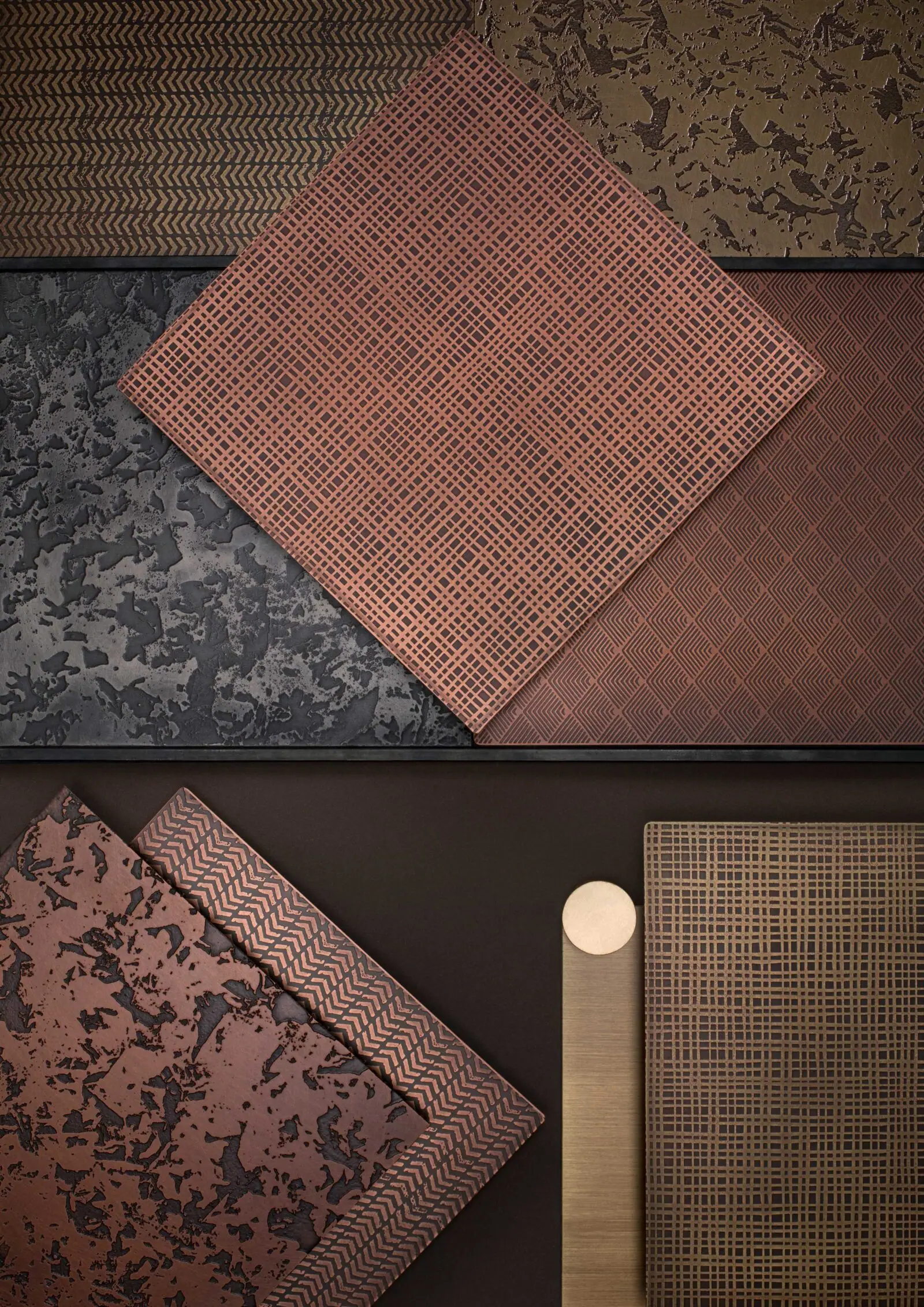
We present two collections from the Italian brand De Castelli, a benchmark in metal-based “haute couture” design, which transforms the “cold” character associated with the material and gives it a distinctive decorative quality. This is the result of a long process of experimentation that combines technical solutions with manual craft techniques. Its products bring clear added value to a space and arise from constant collaboration with architects and interior designers in search of new forms of expression.
In this article we look at who De Castelli is, what the handcrafted finishes that bring warmth to metal are like, and what its two wall covering collections offer: Erosion, with relief and texture, and Forma, with smooth pieces in a wide range of formats. We close with the key points for specifying them and some frequently asked questions.
De Castelli: four generations working metal
De Castelli has its headquarters and workshops in Crocetta del Montello, in the province of Treviso. The company presents itself as one of the first Italian firms to bring design into metalwork, with know-how inherited from four generations of blacksmiths and combined with advanced technology and aesthetic research.
That dual approach, industrial and artisanal, explains its wall coverings: the sheet metal is cut and processed in the factory, but the final appearance depends on finishes applied by hand. That is why each piece has its own nuances and the metal no longer reads as a cold, uniform surface.
Handcrafted finishes that bring warmth to metal
De Castelli's finishes accelerate the natural oxidation of the metal by hand and are fixed with a clear protective varnish, which halts the oxidation and preserves the appearance of the surface with proper maintenance. These are the ones used in the two collections:
- DeErosion: controlled erosion of the metal, a technique developed by De Castelli that creates irregular textures in relief, inspired by the passage of time. It is then oxidised by hand and varnished.
- DeLabré: manual oxidation that produces cloudy colour effects in different shades.
- Orbitale DeLabré and Striped DeLabré: after oxidation, hand brushing creates a scratched effect (Orbitale) or a streaked effect (Striped).
- Brushed: the metal is brushed by hand and coated with a clear protective varnish.
As these are handcrafted processes, the manufacturer warns that slight differences in tone and uniformity may appear compared with the sample, especially between pieces produced at different times. They are not considered defects but part of the value of the finish.
Erosion and Forma in figures
The table summarises the data for the two collections as they were presented at the time. Both are made from 2 mm thick sheet metal and can be combined with each other.
Erosion: relief and texture like a tapestry
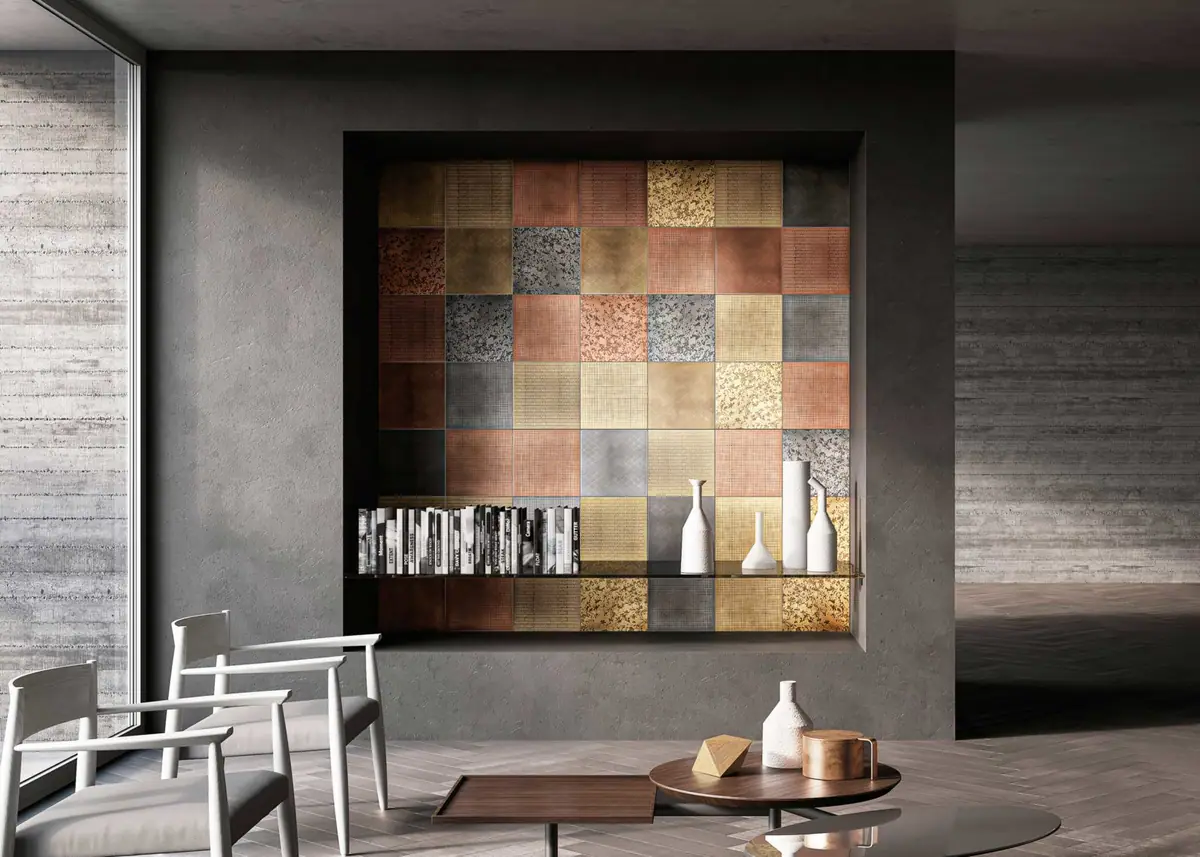
Controlled erosion on 30 × 30 cm modules.
We begin with the Erosion series, which De Castelli markets as DeErosion within its DeTile wall covering line. It recalls a tapestry and brings out the full range of colours and textures associated with the collection. The finishes are the result of a controlled erosion of the base metal —copper, brass or iron—, available in several three-dimensional reliefs that give the surface depth and warmth. It is sold in square modules of 30 × 30 cm.
According to the manufacturer, the collection is the culmination of long experimentation that integrates technological solutions with manual techniques of fine craftsmanship. The modules allow patterns and metals to be combined with complete freedom, so that a single wall can alternate geometric and organic reliefs or coppery and golden tones.
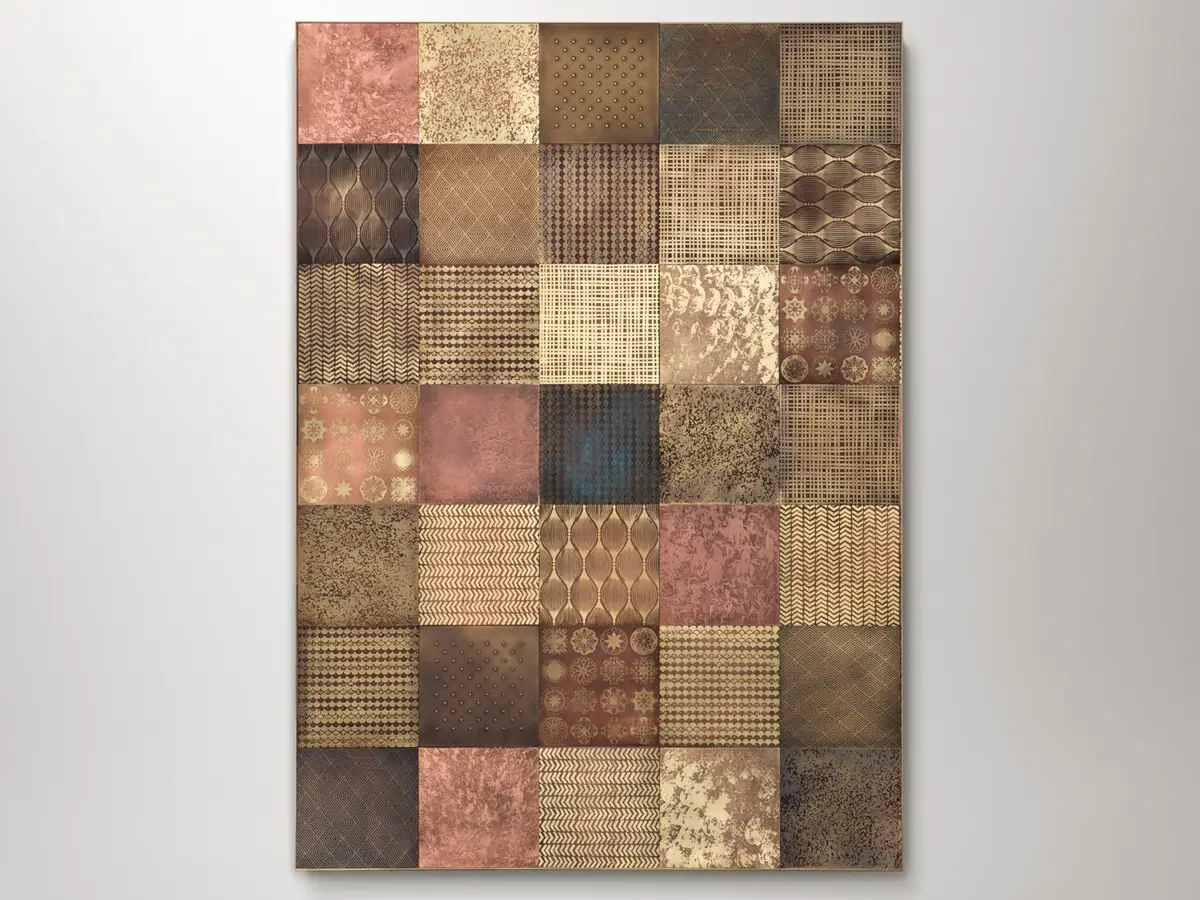
Erosion as a decorative piece: the DeFrames collection
The same finish gives its name to Erosion, one of the pieces in DeFrames, the collection in which De Castelli turns its surfaces into panels to hang on the wall. Erosion is a 150 × 210 cm panel weighing about 66 kg, made up of square brass and copper modules with a mix of DeErosion finishes: a way of bringing the material into a space without cladding the whole wall.
Forma: large formats and pieces to compose with
Smooth pieces, cut and finished by hand.
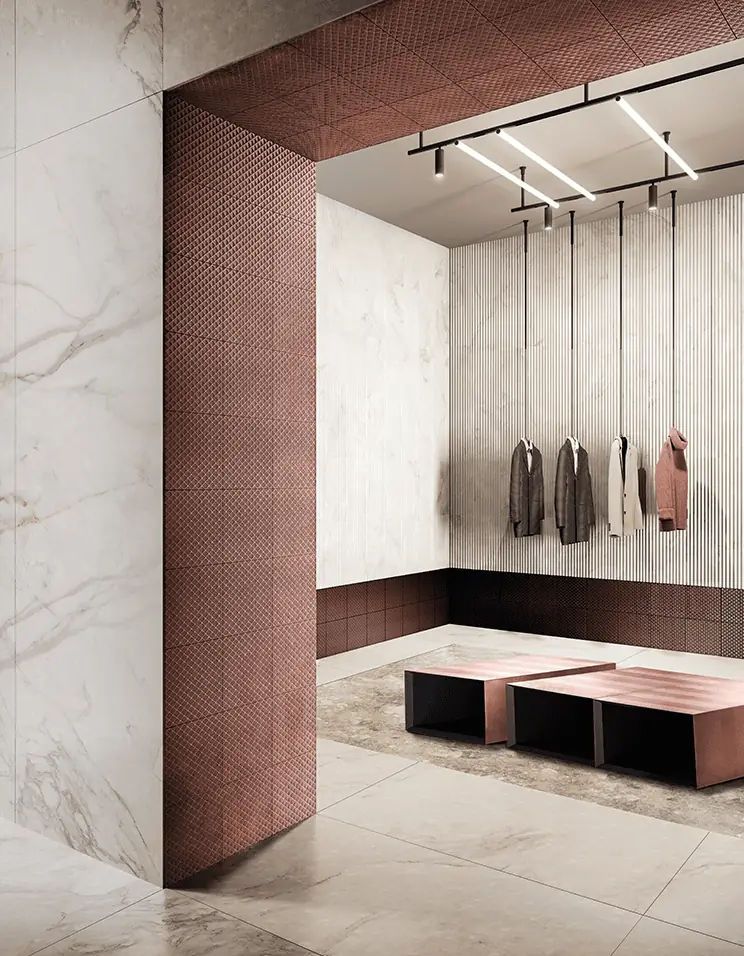
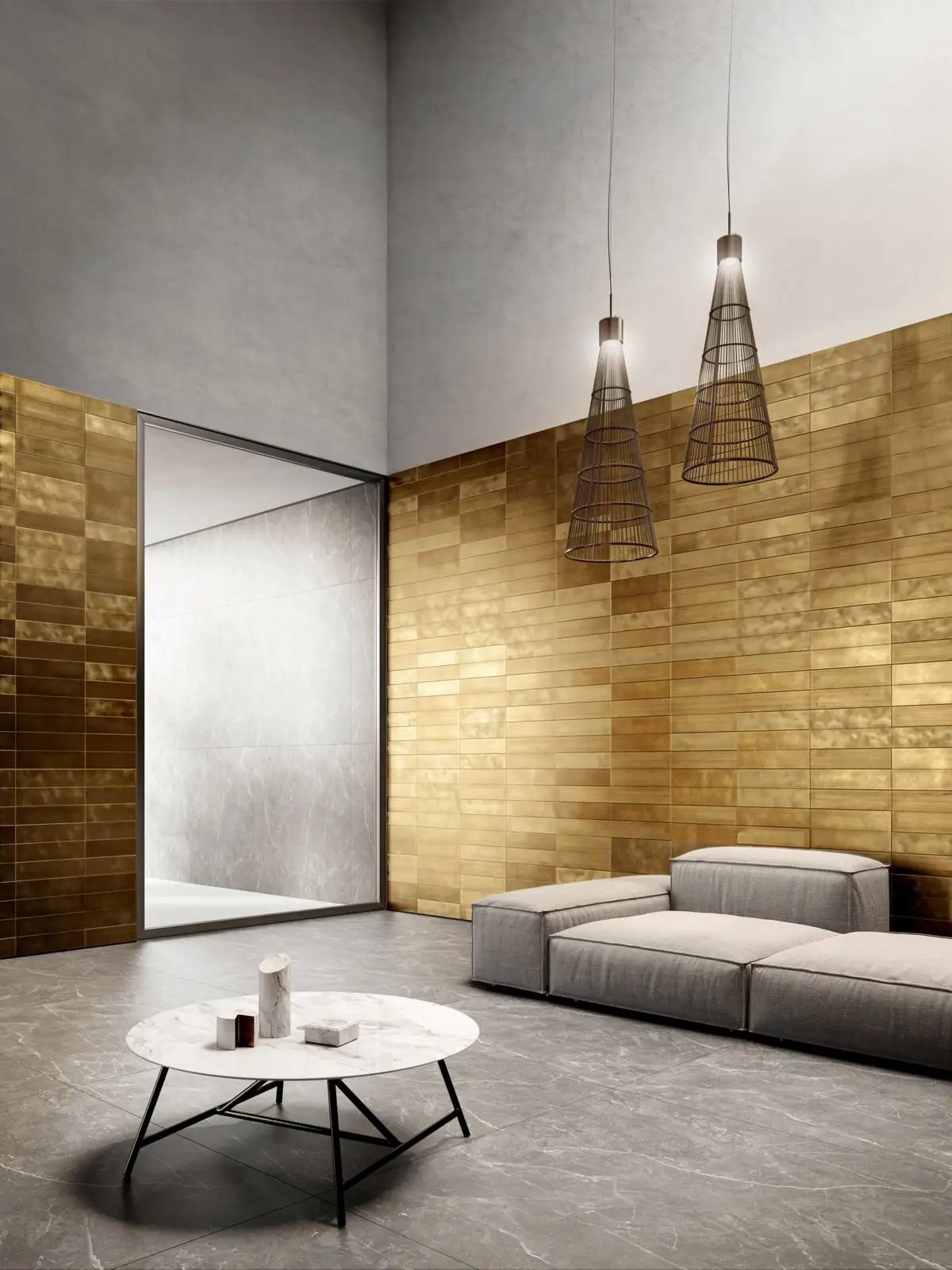
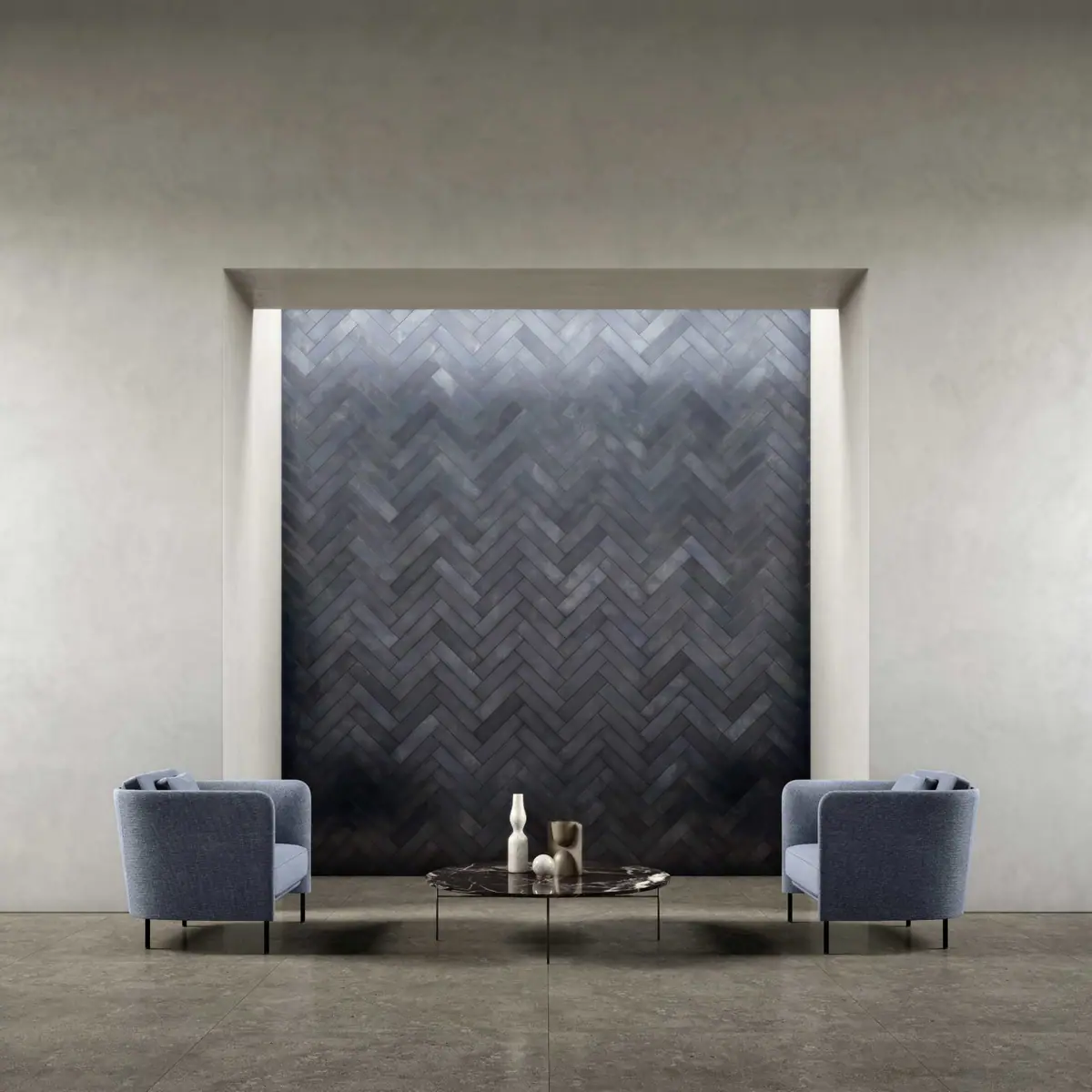
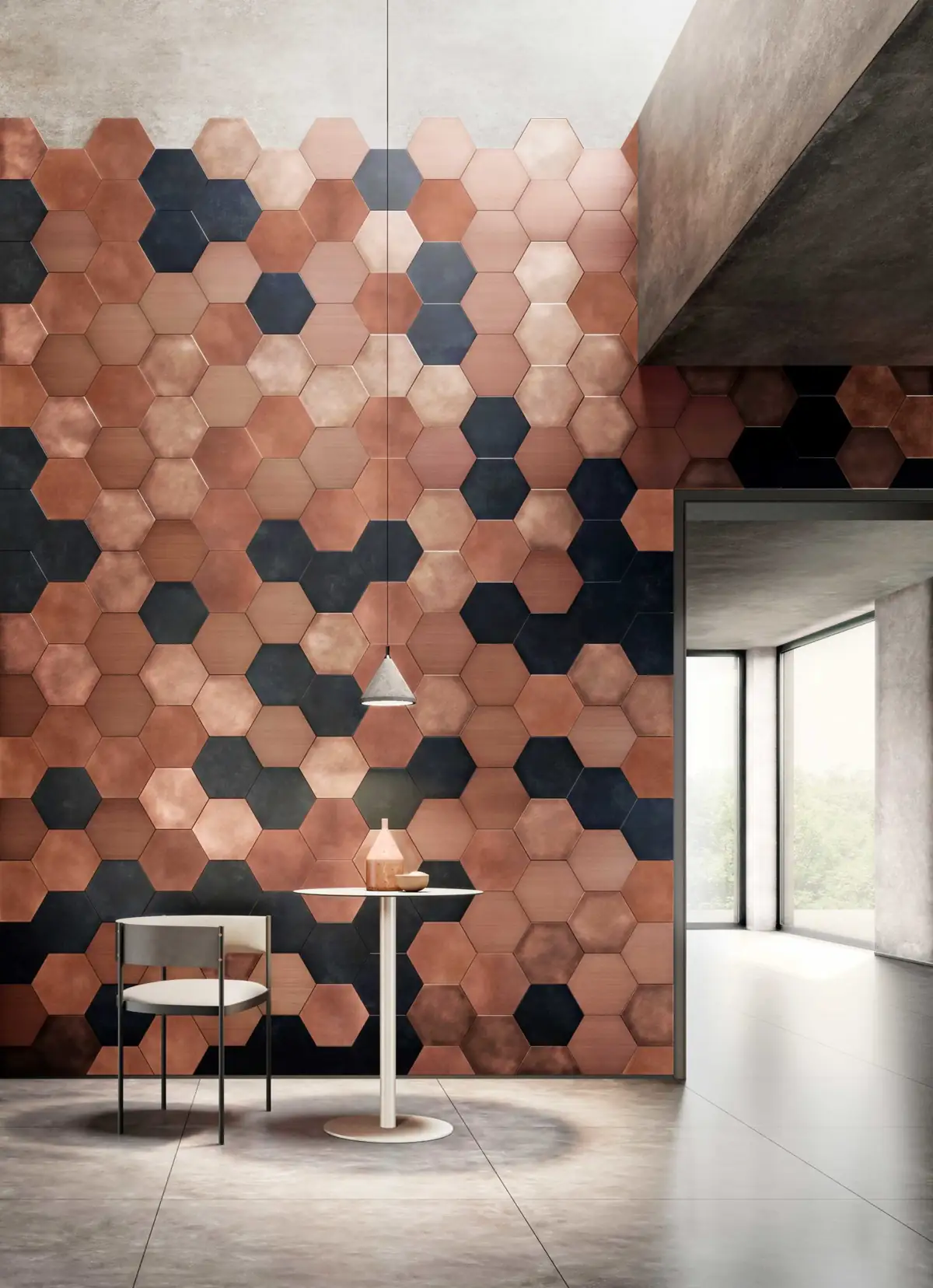
The Forma series, on the other hand, focuses on larger pieces, with large rectangular formats of 30 × 120, 60 × 120 and 120 × 240 cm, and squares of 90 × 90 and 120 × 120 cm. It also comes in a small or decorative format: rectangular 10 × 40 cm and hexagonal 35 × 30 cm. The latter offer a wide range of laying options which, combined with the different metals and finishes, make it possible to create original tapestries.
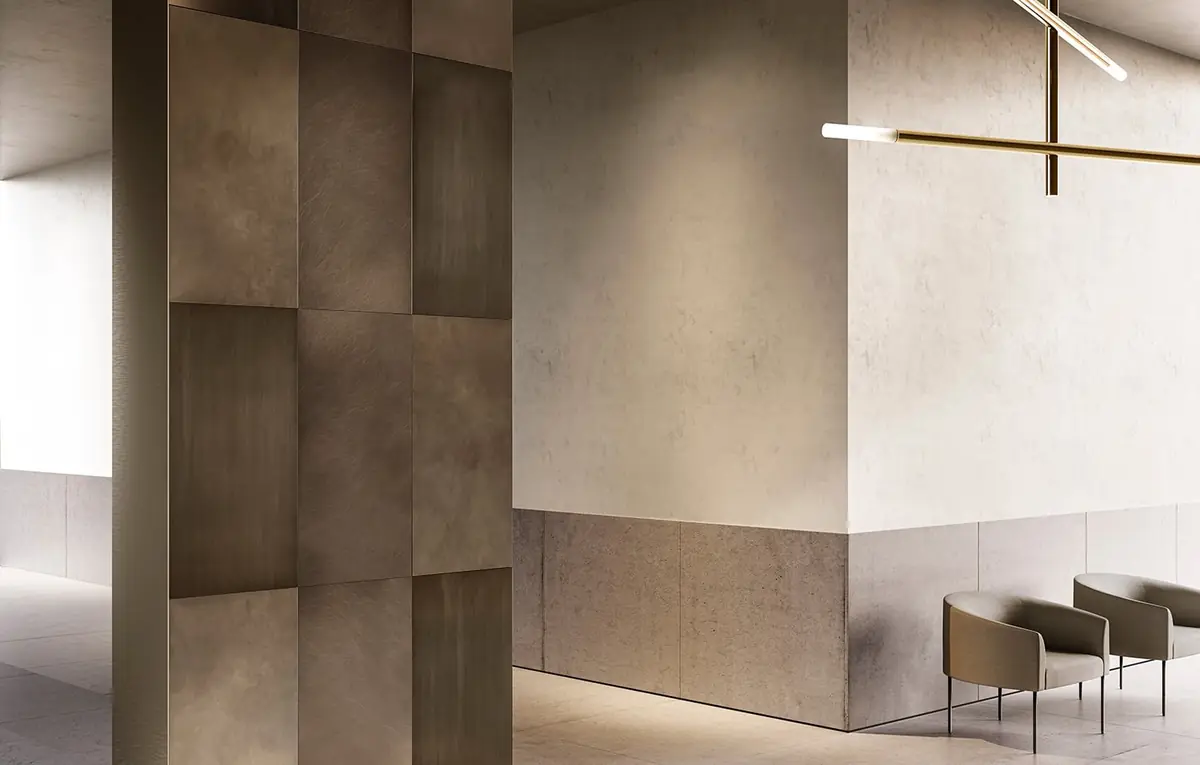
Unlike the Erosion series, which emphasises relief, Forma pieces are mostly smooth, cut and finished by hand so that edges and corners are particularly soft. In 2021 they were produced in four different base metals —iron, stainless steel, brass and copper— and in various brushed and hand-worked finishes (DeLabré, Orbitale DeLabré and Striped DeLabré).
Key points for specifying and installing
Before choosing a collection, it is worth checking these points, according to the manufacturer's technical data with which we presented the collections:
- Use: vertical interior wall covering. Not recommended in wet areas.
- Weight and thickness: the sheets in both families are 2 mm thick and weigh between 16 and 17.8 kg/m².
- Fixing: they are bonded to the wall with epoxy adhesive or a bedding layer at least 2 mm thick.
- Handcrafted finish: allow for variations in tone between pieces and compared with the sample, especially if the order is extended later.
- Customisation: the pieces can be combined in countless ways and customisation options are available on request.
From a decorative piece in a living room to a bar counter or a shopfront, there are many applications that bring quality and individuality to a space.
Update: in 2026 De Castelli published an installation manual for its DeTile surfaces. It calls for a flat substrate (tolerance of ±3 mm measured with a 2 m straightedge), dry and clean, Litokol's LITOELASTIC EVO adhesive spread on both the substrate and the back of the piece, and spacers of at least 2 mm between pieces. It is worth consulting before planning the works.
Frequently asked questions
- Can they be used in bathrooms or kitchens?
- According to the manufacturer's data, they are vertical interior wall coverings and are not recommended in wet areas. De Castelli also states that the DeErosion finish is for interior use only.
- What is the difference between Erosion and Forma?
- Erosion (DeErosion) works with relief: 30 × 30 cm modules with a controlled erosion that creates three-dimensional textures. Forma consists of mostly smooth pieces, in formats from 10 × 40 cm to 120 × 240 cm and in a hexagon, with brushed or oxidised finishes.
- Will all the pieces match the sample?
- Not exactly. The finishes are applied by hand and the manufacturer warns that there may be slight differences in tone and uniformity, especially between production runs on different dates. This is part of the character of the material.
- How are they cleaned?
- De Castelli recommends a cotton cloth moistened with water or neutral products specifically for varnished surfaces, and drying thoroughly if water is left standing. Abrasive cloths, solvents, alcohol and aggressive detergents must not be used.
The reliefs of the erosion, the nuances of an oxidation or the sheen of a brushed finish are better understood by seeing the metal in person. At Matter we help you assess metal wall coverings for your project and compare finishes and applications with your technical team.
Book your visit to Matter.
Book a visit