Florim: large format, fewer joints, more continuous surface
How large-format porcelain stoneware changes the way floors, walls and furniture are designed, and which Florim collections put it into practice.
Products9 min read
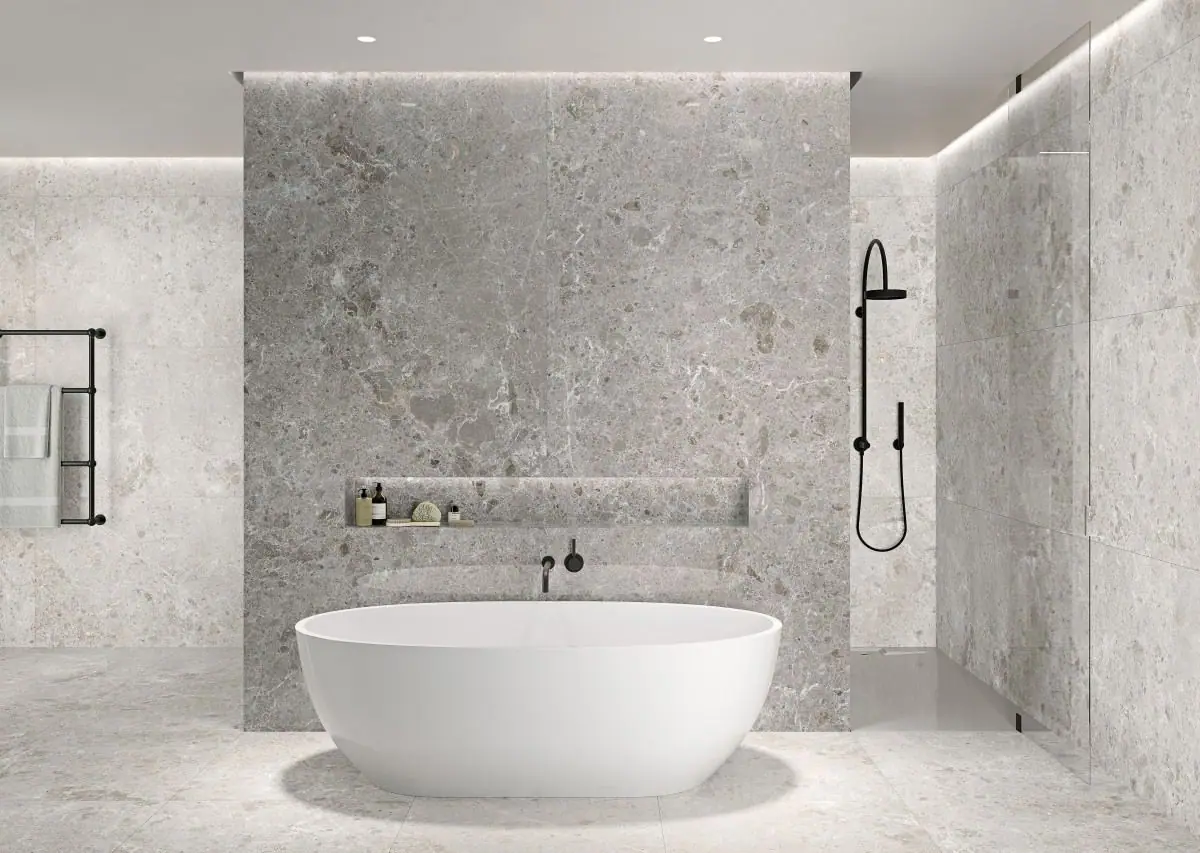
Porcelain stoneware is no longer just a covering: it has become an architectural surface. Slabs of up to 120×280 cm in standard collections —and 160×320 cm in the largest formats—, thicknesses from 6 mm and precise colour control make it possible to treat floors, walls and even furniture as continuous planes, with only the joints that are strictly needed. This is the vision behind every Florim collection, an Italian manufacturer since 1962.
In this article we look at what large format brings to a project, what to bear in mind when specifying and installing it, and how the Florim collections you can see at Matter put it into practice: Authentic Luxe, Araldica by Cedit, Crayons, Neutra 6.0 and Match-Up.
What counts as large format
The Spanish ceramic installation standard, UNE 138002, defines as large format any tile whose longest side exceeds 70 cm. Today, however, the term refers to much larger pieces: 120×120, 120×240 and 120×280 cm in standard collections, and 160×320 cm slabs in Florim's largest lines.
All of them are porcelain stoneware: pressed ceramic tiles with water absorption of 0.5% or less (group BIa under EN 14411). That low porosity is what makes them resistant to frost, stains and wear, and what allows the same material to be used on floors, walls, worktops and outdoors.
Thickness depends on use. As a general guide:
- 6 mm: wall cladding, furniture and fronts, and refurbishments laid over the existing floor to avoid demolition.
- 9 mm: interior floors, residential and commercial, with sturdier behaviour under point loads.
- 20 mm: outdoors, terraces and raised or gravel-laid paving, where the slab works without bonding to a continuous substrate.
Why fewer joints
Joints are necessary —we will see why in a moment—, but the fewer there are, the more the surface reads as a single plane. Large format brings advantages that go beyond aesthetics:
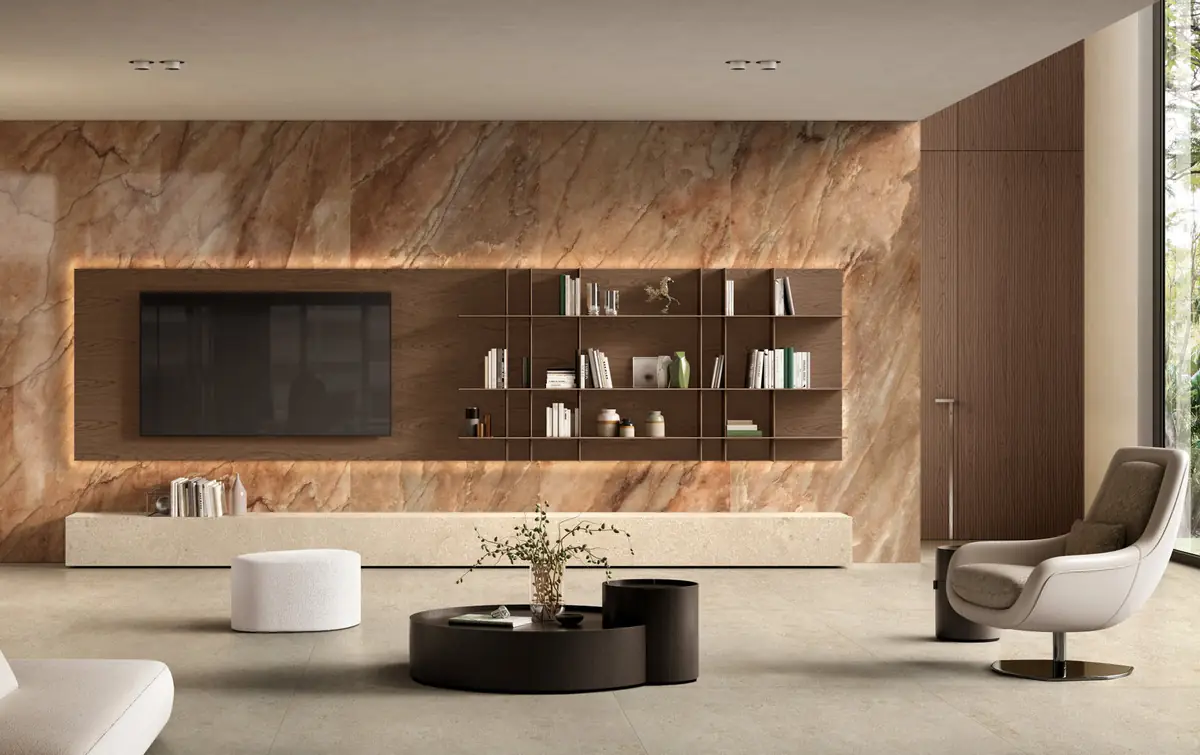
- Visual continuity: the veining of a marble or the movement of a travertine can be followed from slab to slab, and walls and floors are perceived as one material.
- Hygiene and maintenance: the joint is the most porous part of a covering. Fewer linear metres of joint mean less surface where dirt builds up, which is especially valuable in bathrooms, kitchens and hospitality.
- Less thickness, less work: 6 mm slabs make it possible to renew a floor or wall without demolition, with less debris and shorter schedules.
- Design coherence: the same material can clad the floor, the wall, the worktop or a cabinet front, in the same tone and finish.
Fewer joints is not zero joints
Large format reduces joints, but does not eliminate them. UNE 138002 states that ceramic coverings must never be laid without a joint or with a gap below 1.5 mm, and adhesive manufacturers recommend at least 2 mm, increasing it as the piece grows and depending on indoor or outdoor use. With rectified tiles and grout in the same tone as the slab, a 2–3 mm joint is barely noticeable.
Laying a large-format slab well requires more precision than a conventional tile. These are the key points to plan for from the design stage:
- Flat, stable substrate: the recommended flatness tolerance is ±1.5 mm. If the substrate exceeds it, it must be levelled before laying.
- The right adhesive: improved, deformable cementitious adhesive (class C2, S1 or S2). For slabs over 1 m² or with sides longer than 120 cm, a highly deformable adhesive (S2) is recommended.
- Double buttering: adhesive on the substrate and on the back of the slab, with ridges parallel to the short side, then tamped to expel air and achieve virtually full contact.
- Handling and levelling: frames with suction cups to carry and place the slabs, and levelling clips (roughly one every 50 cm) to avoid lippage between slabs.
- Movement joints: always respect perimeter, structural and partition joints. Uncoupling membranes allow whole slabs to be laid without cutting them at the substrate joints.
- Façades: for exterior vertical cladding, the designer should assess whether mechanical anchoring or a ventilated façade system is needed.
Authentic Luxe
Luxury understood as permanence
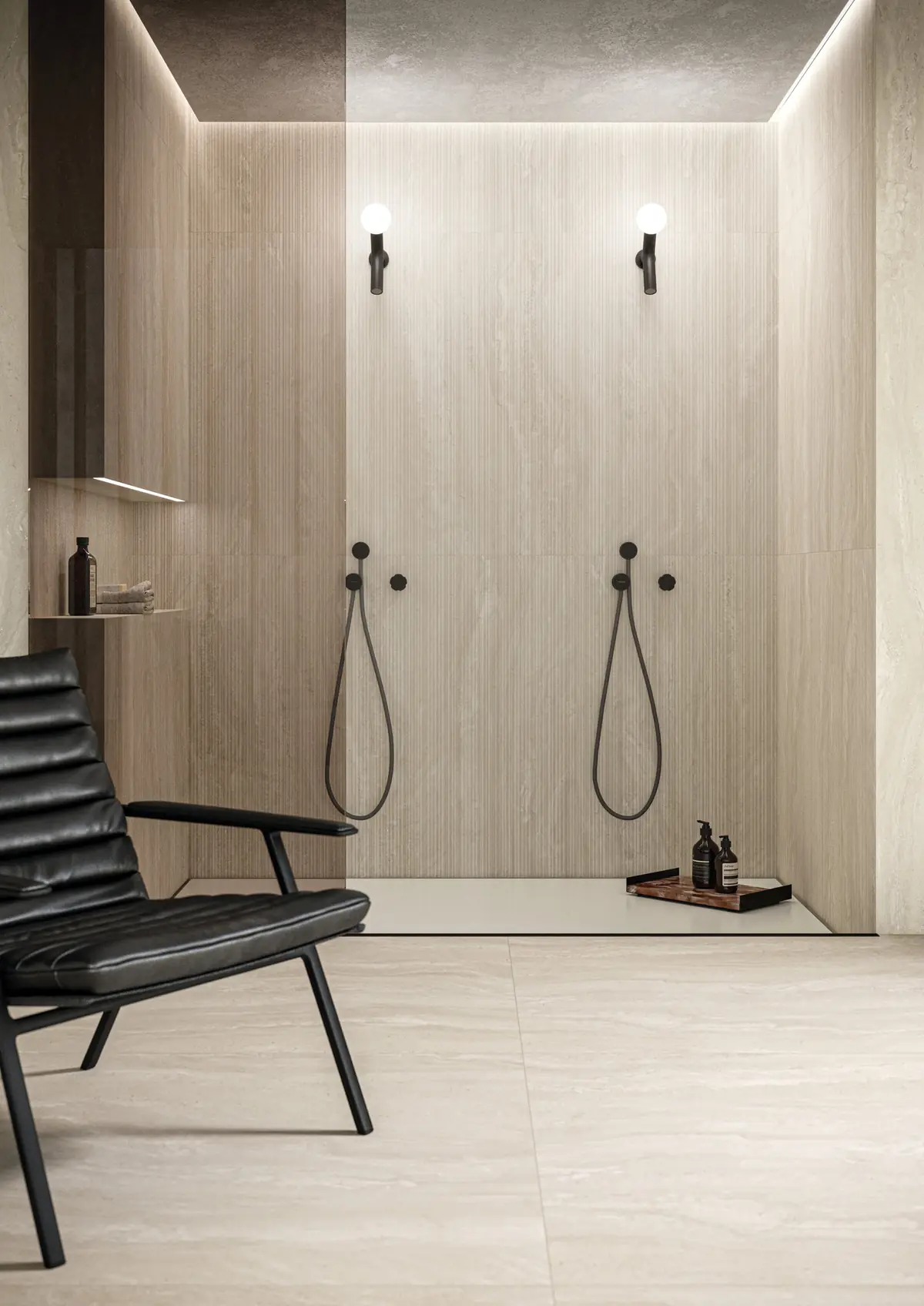
Authentic Luxe is part of Florim's Luxury Design expression and draws on the idea of Quiet Luxury: a more discreet notion of luxury, based on quality, essentiality and permanence, away from overly decorative or showy effects. The result is a sober, contemporary aesthetic designed to create refined spaces without ostentation.
Its starting point is three materials that have defined quality architecture for centuries: travertine, limestone and marble. The palette remains deliberately neutral —sands, warm greys, off-whites— and opens up at specific points to colour accents that add depth without breaking the coherence of the whole. It is also the collection in this selection that reaches the largest format, 120×280 cm, and it comes in a 20 mm thickness for outdoor use.
The collection's families
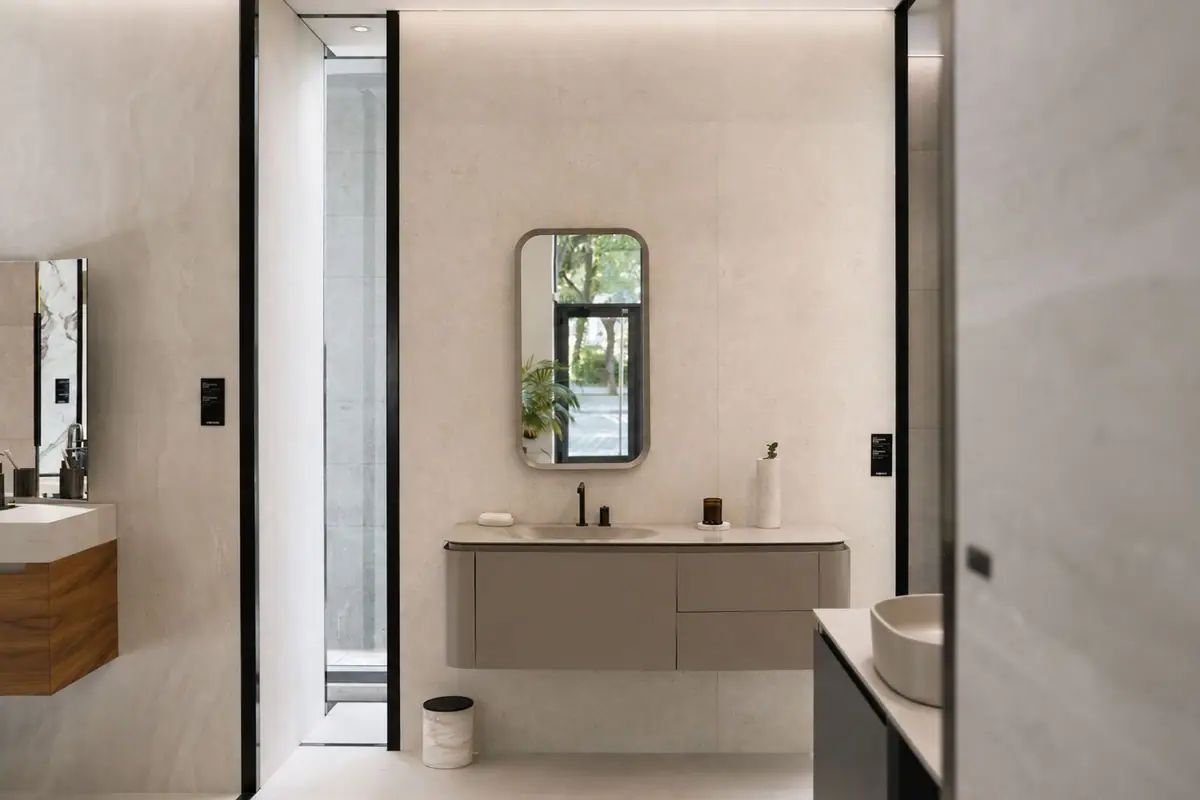
Authentic Luxe is organised into nine colours grouped into three families, each with its own visual behaviour:
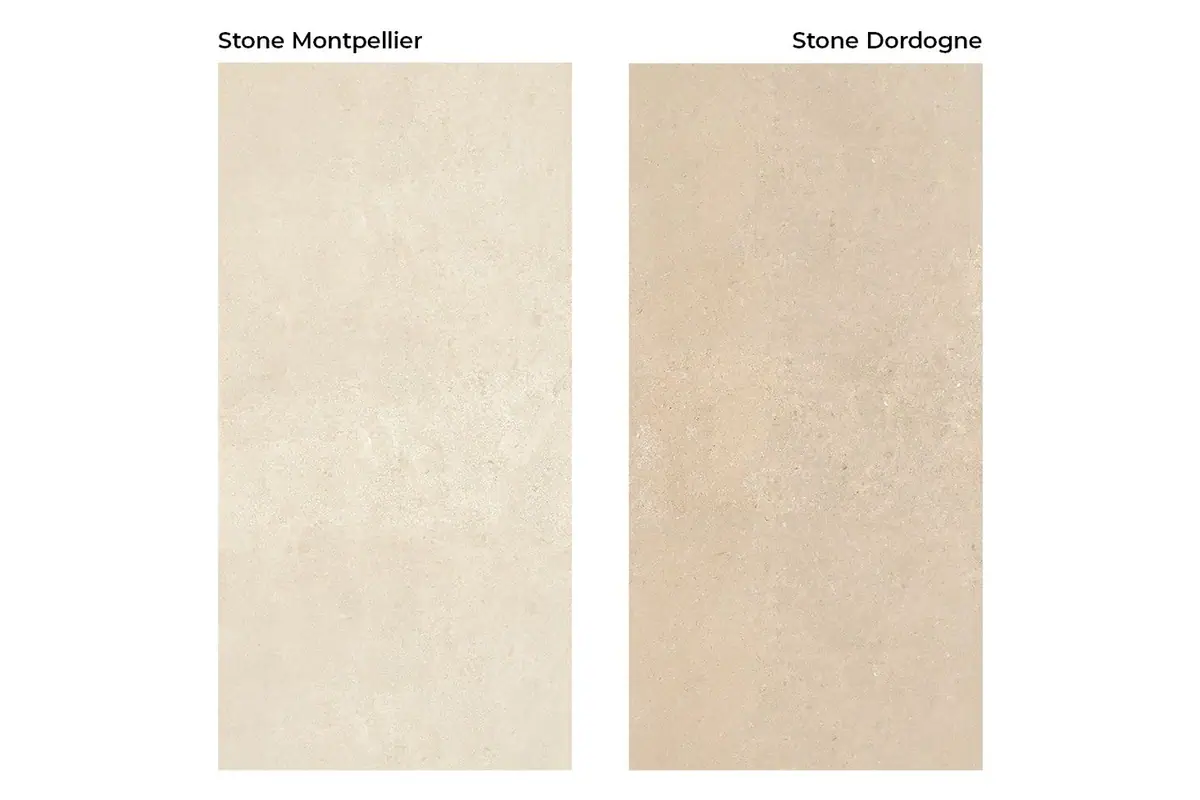
- Stone — the broadest and most neutral family, referencing European limestones: Stone Montpellier · Stone Dordogne · Stone Chablis · Stone Jura.
- Travertine — a contemporary reading of travertine, its characteristic porosity handled with restraint: Pearl Travertine · Gold Travertine · Travertine Nut.
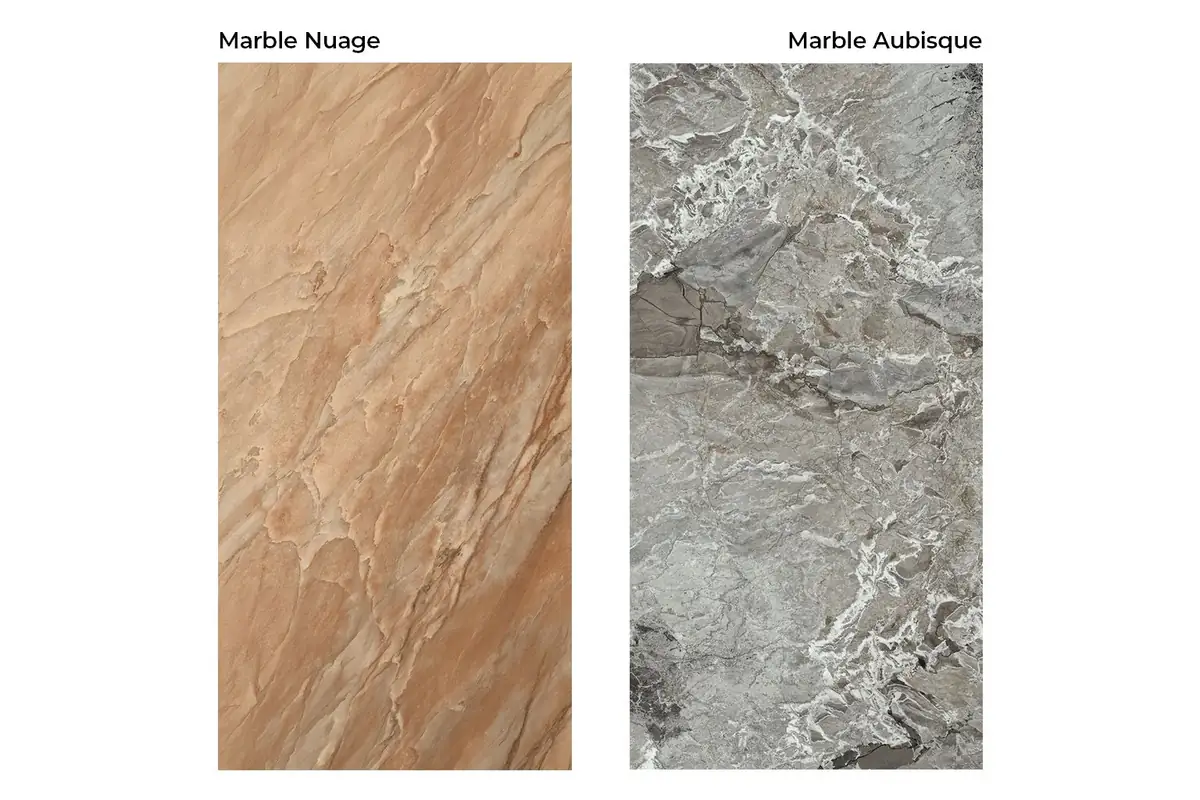
- Marble — the collection's most expressive gesture, reserved for the points where the project calls for emphasis: Marble Nuage · Marble Aubisque.
Where it works
Authentic Luxe is as versatile technically as it is aesthetically. Its natural uses are:
- High-end residential: continuous floors across rooms, bathrooms and kitchens.
- Hospitality and retail: lobbies, guest rooms and shops where the surface must convey quality and withstand intensive use.
- Offices and corporate spaces: reception areas and meeting rooms.
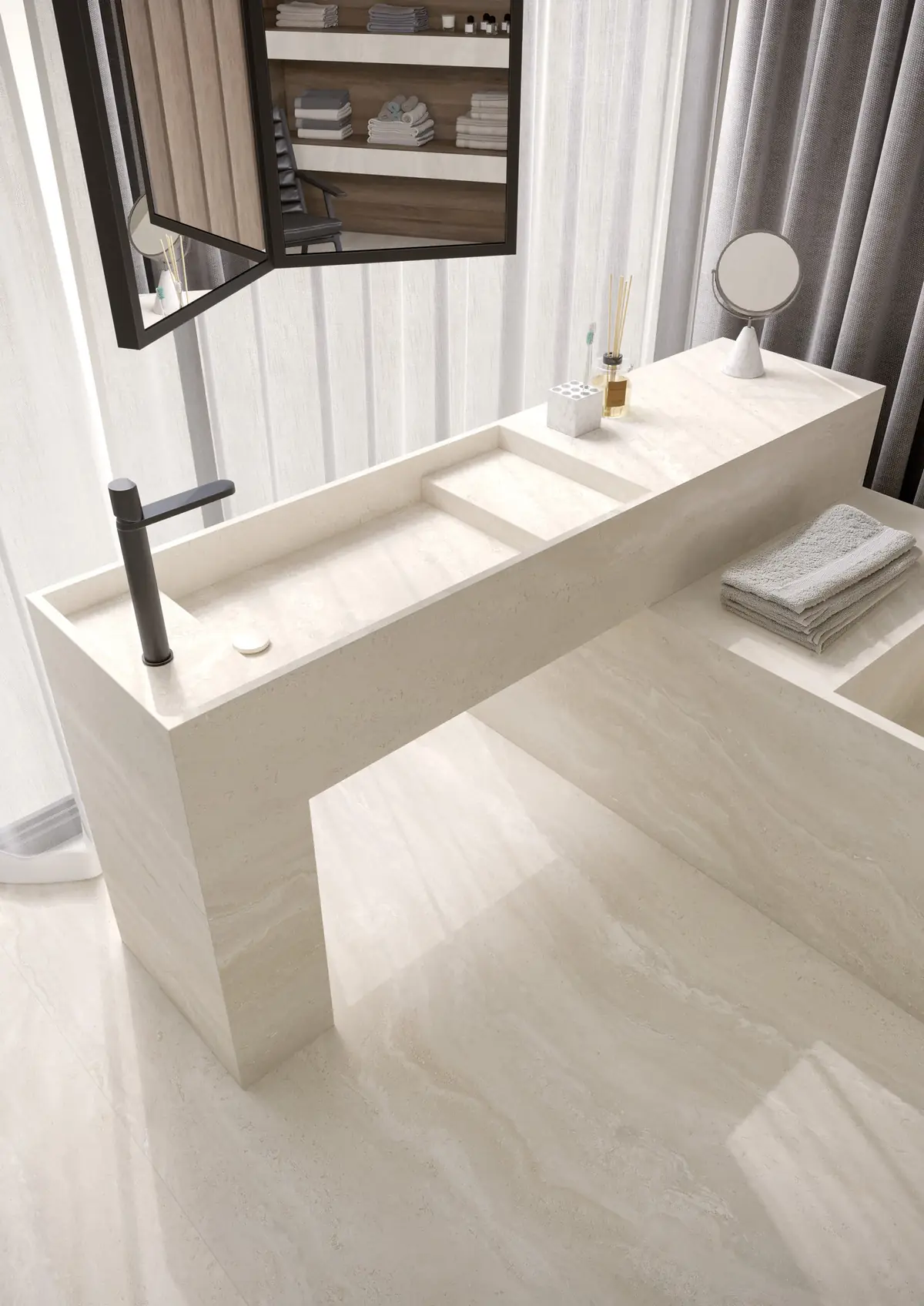
- Furniture and horizontal surfaces: worktops, washbasins and fronts in the same material as the floor.
- Outdoors: terraces and paving in the 20 mm thickness.
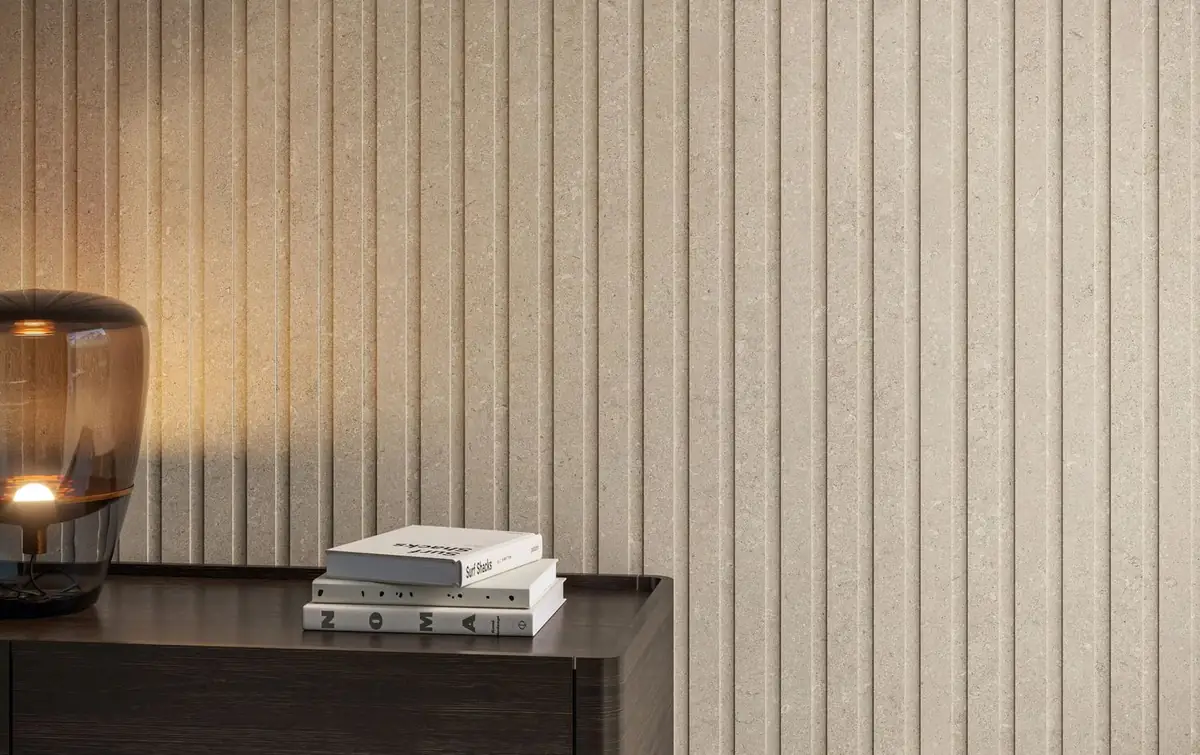
Its mineral look pairs well with wood, metal and natural textiles, and the finish can be matched to each room: Matte Silk (R9) for dry interiors and Matte Leather (R10) where more slip resistance is needed.
Other Florim collections at Matter
Large format is not only stone and marble. These four collections bring it to colour, graphics and mixed materials, and share the same logic: large, rectified pieces designed to work whole surfaces.
Araldica — Cedit · Federico Pepe
A medley of bright, contrasting, pure colours.
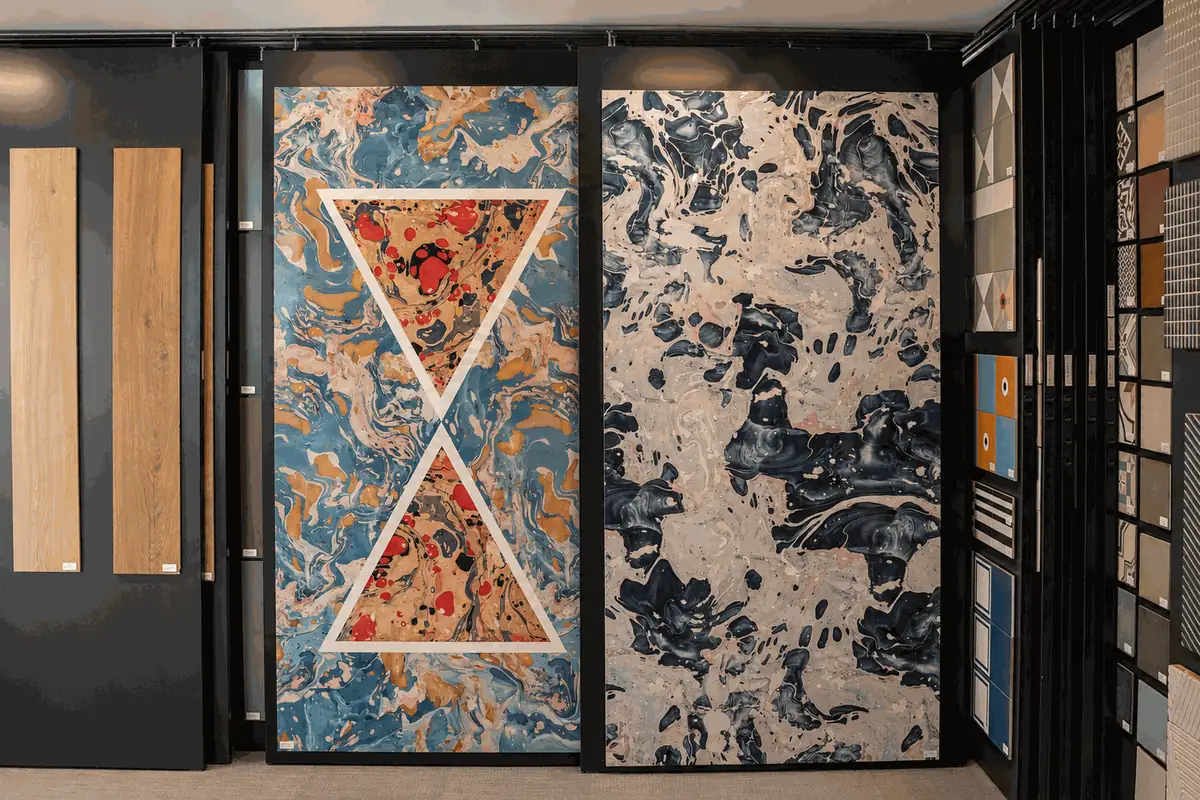
Araldica is an authorial collection by Federico Pepe for Cedit, Florim's design brand, built on a deliberate tension. The designer himself describes it as a clash between «something very rigid that wants to be very structured» —the geometric compositions, the linear graphics— and a free variable: traditional marbled paper, the technique of floating inks on water that produces unrepeatable veining.
It is made in a 6 mm thickness and formats up to 120×240 cm, in matte and glossy finishes: pieces that work almost as graphic panels and need generous walls to be read in full.
Crayons — Contemporary Design
1950s pastels with a contemporary logic.
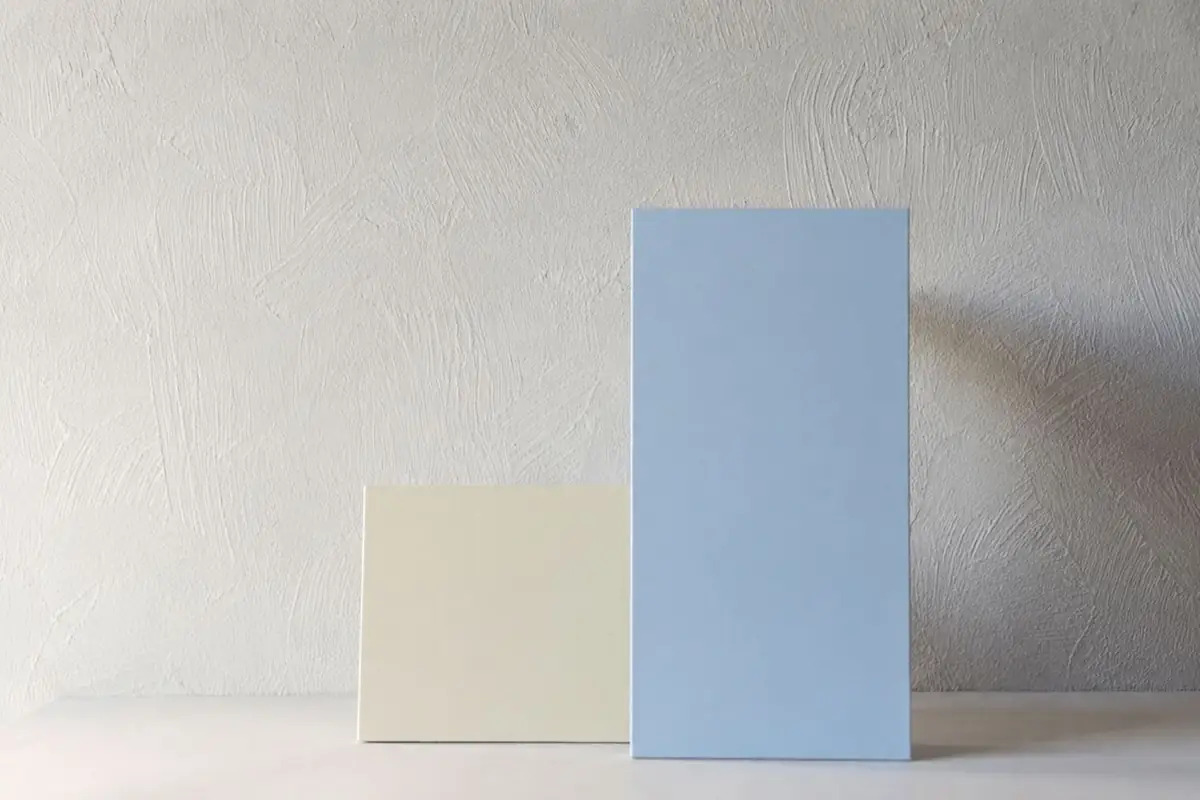
Crayons belongs to Florim's Contemporary Design expression. Its starting point is the colour imagery of the 1950s: the soft, dusty tones of the lamps, appliances and furniture of that era, which are back today as a reference in product and interior design.
The collection offers eight shades: from the dusty Hazelnut, Old Lace, Primrose (faded yellow) and Skyline (sky blue) to the more defined Mist (dusty grey) and Moss (moss green), with Milk and Buttercream as warm neutral bases. All in 6 mm with a matte R9 finish, in formats from 60×120 to 120×240 cm.
Neutra 6.0 — Creative Design
An open colour system: fourteen shades, two thicknesses, three formats.
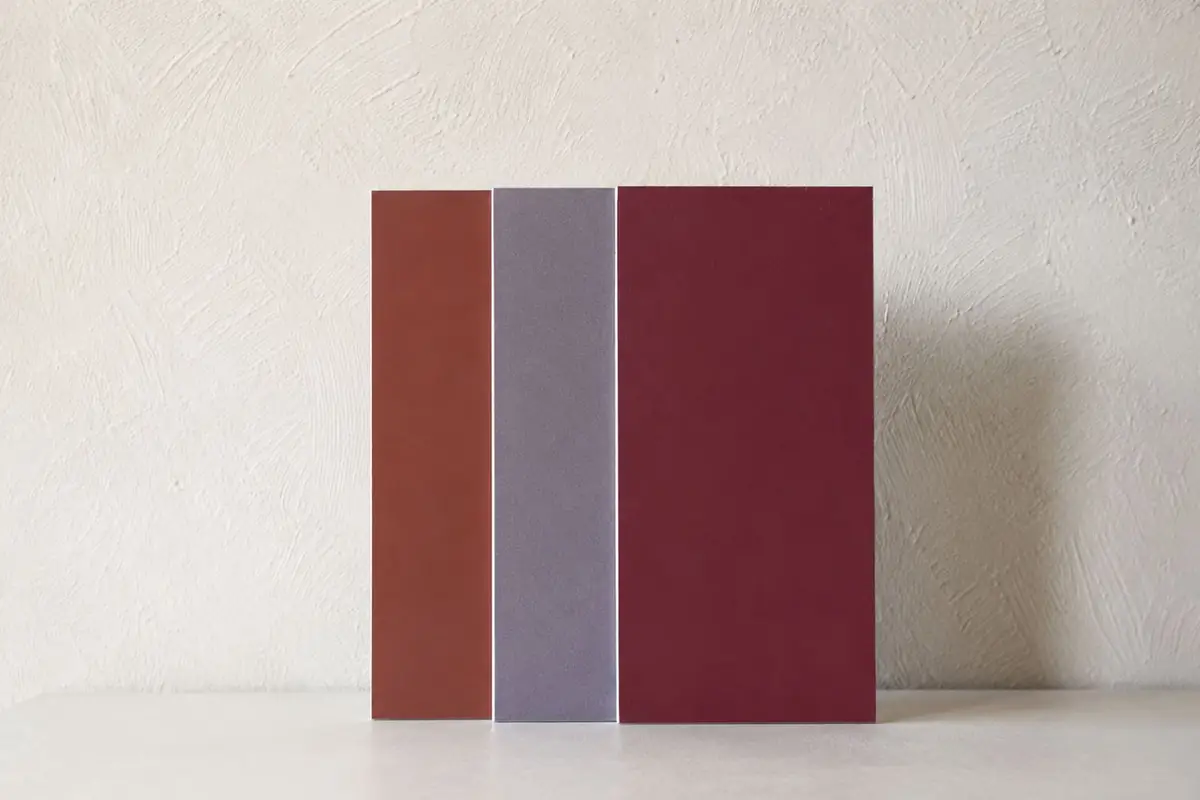
Neutra 6.0 belongs to the Creative Design expression and is the colour collection with the widest range and the greatest flexibility of application. Florim describes it as an open project: a container of colour where walls work as large canvases and tone is the main means of expression.
Its colour range runs from neutrals —01 Bianco, 02 Polvere, 03 Perla, 04 Ferro, 05 Quarzo, 06 Grafite— to a second family of vibrant, deep tones: 07 Petrolio, 08 Avio, 09 Oliva, 10 Acquamarina, 11 Melanzana, 12 Malva, 13 Corallo and 14 Arancio. That dual nature makes it a design tool rather than a closed collection: the neutral base and the accent can be built with the same material, finish and module, in 6 or 9 mm.
Match-Up — Contemporary Design
Two different materials in one system: patchwork as a design strategy.
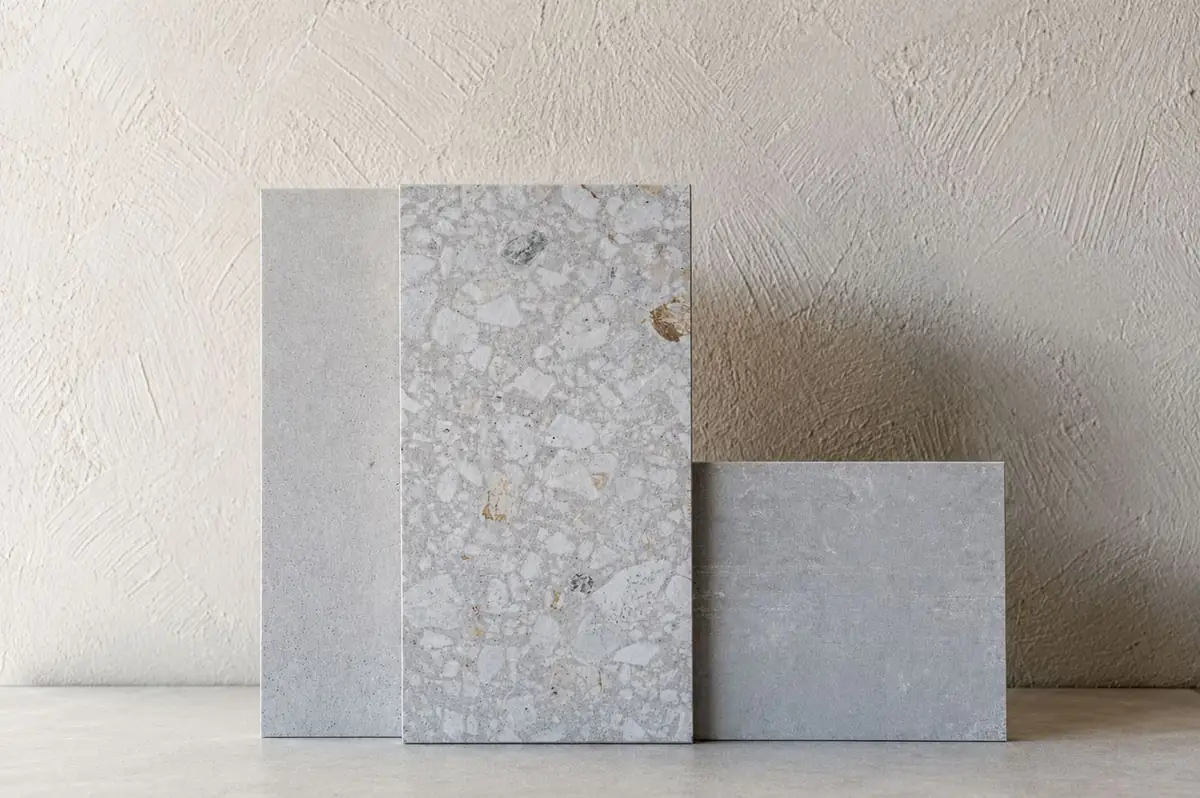
Match-Up also belongs to the Contemporary Design expression, but its approach is the opposite of Crayons: here the focus is not colour but the meeting of two materials. The collection starts from two base surfaces —a cement effect with an urban, industrial look and an original graniglia effect that blends tone-on-tone material fragments of irregular shapes and varying sizes— and designs them to live together.
It is a play of contrasts that breaks the essentiality of minimalist interiors through a material patchwork: cement, a symbol of modernity; graniglia, of authenticity and tradition. With twelve colours, Mix versions and 6, 9 and 20 mm thicknesses, the same combination can be carried from indoors to outdoors.
More Florim collections for every project
Each collection follows its own logic of effect, format and performance. At Matter we also work with these Florim lines, grouped by effect:
- Wood and fibre effect: Woodslate · Oaky Life · Nature Mood · Planches.
- Stone and natural material effect: Planches de Rex · Materiali de Rex · Archeologie · Gondolin · Biotech · Coretech · Elemental Stone.
- Cement and technical surfaces: Industrial · Essential Mood · Easy Life · Compatta.
- Marble effect: Eccentric Luxe · Heritage Luxe · Etoile Illusion · Les Bijoux · Les Origines · Reves · Iconic Life.
- Colour and plain surfaces: Sensi Colors.
A manufacturer with a sustainable approach
Florim manufactures in Fiorano Modenese and Mordano (Italy) and in 2020 became the world's first porcelain stoneware manufacturer to obtain B Corp certification. It recovers 100% of its production waste to feed it back into new collections, reuses 100% of its process water and has environmental product declarations (EPD) based on life-cycle assessment. For specifiers, that means verifiable documentation for certifications such as LEED or BREEAM.
Frequently asked questions
- From what size is a tile considered large format?
- According to UNE 138002, any tile whose longest side exceeds 70 cm. In practice, large format usually means pieces of 120×120 cm and above, up to 120×280 or 160×320 cm slabs.
- Can it be laid without joints?
- No. UNE 138002 does not allow ceramic coverings without joints or with joints below 1.5 mm, and at least 2 mm is advisable for large format. With rectified pieces and grout in the same tone, the joint becomes practically integrated.
- Can 6 mm slabs be laid over an existing floor?
- Yes, as long as the existing floor is well bonded, stable and within the ±1.5 mm flatness tolerance. It is laid with a deformable C2 adhesive and, on non-absorbent substrates, the appropriate primer. It avoids demolition, reduces debris and shortens schedules; door clearances and junctions should be checked.
- Which thickness should I choose for outdoor paving?
- Terraces and outdoor areas use 20 mm slabs, which can be laid on pedestals or gravel without bonding to a continuous substrate. Authentic Luxe and Match-Up are made in this thickness; the finish should be chosen according to the slip resistance the project requires.
- What maintenance does large-format porcelain need?
- Very little. With water absorption of 0.5% or less, it needs no treatments or sealing: regular cleaning with neutral detergents is enough. And with fewer joints, there is less surface to maintain.
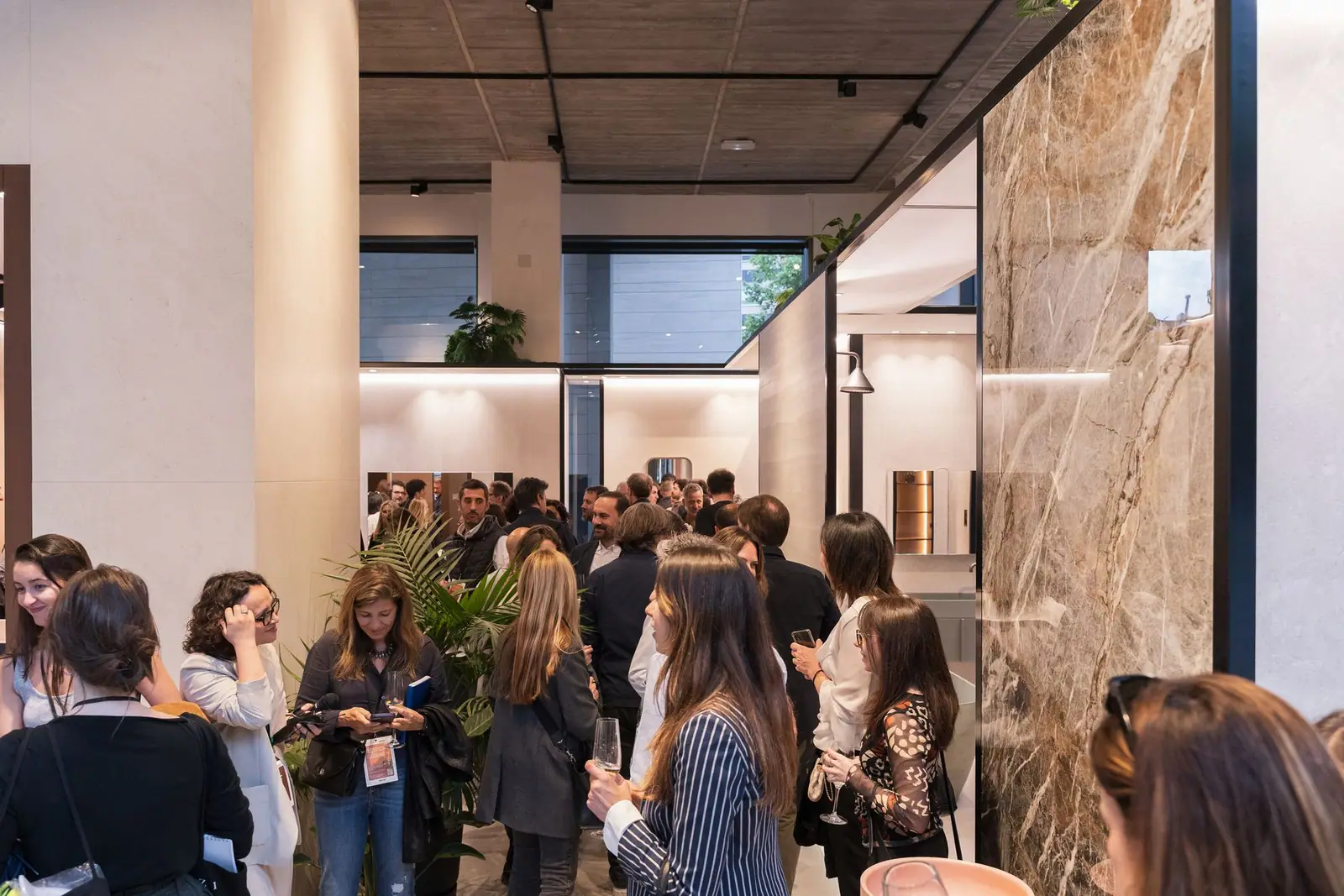
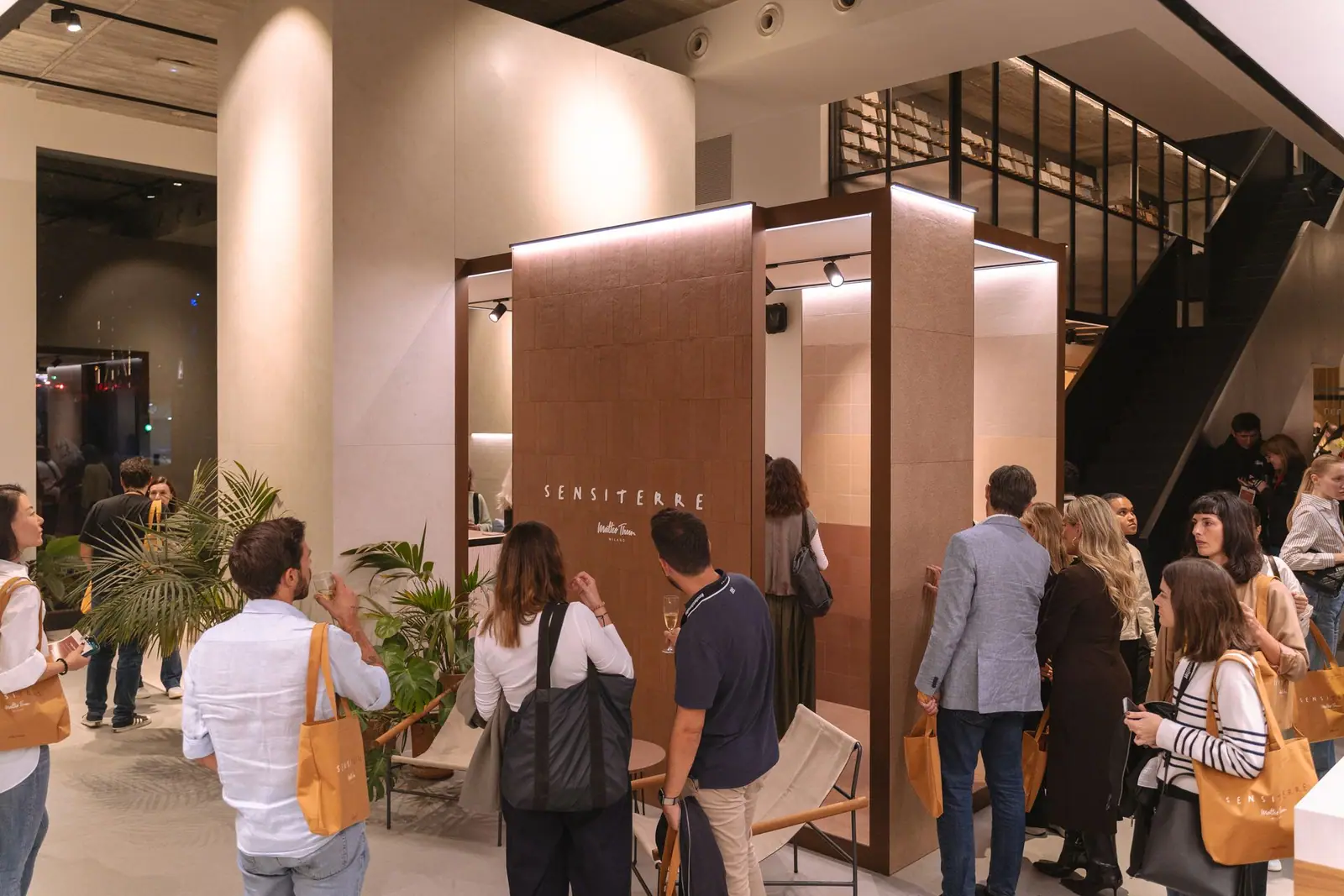
Large-format slabs are best understood at full scale: size, the feel of each finish and the effect of the joint do not come across in the same way in a catalogue. At Matter Barcelona we have a space dedicated to Florim where you can see and compare them with your technical team.
Book a visit to Matter to see these collections in person.
Book a visit