Noorth by Milldue: exclusive materials and excellence in design
Puro, Touch, Roma and Azuma: four bathroom collections by Noorth, designed by Michele Marcon and Lievore Altherr, with their materials, compositions and key project points.
Products8 min read
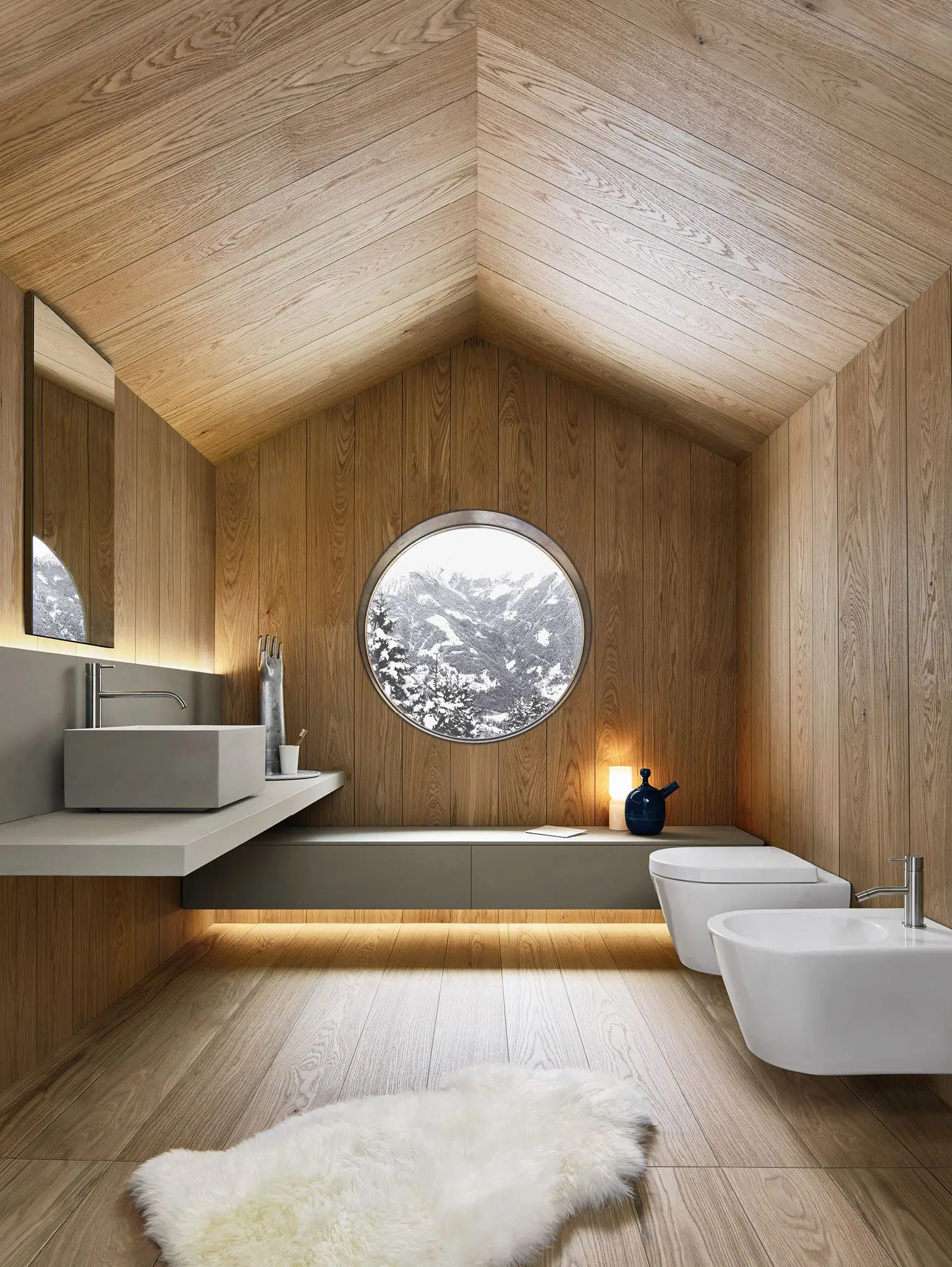
Some designs transport us to the places we dream of: spaces where we could spend hours enjoying those much-needed moments of personal well-being. The beauty of the design and the quality of each element complete that experience of ‘well-being’. A brand that clearly exemplifies that feeling of time standing still is Noorth by Milldue, with exclusively designed pieces worked down to the smallest detail.
Noorth draws on the long experience of Milldue, the family company Mario Brescacin founded in 1976 in Riese Pio X (Treviso) as a furniture maker and which over the years specialised in bathroom furniture. Its collections are characterised by pieces that are bold yet delicate, bringing out the beauty of the material.
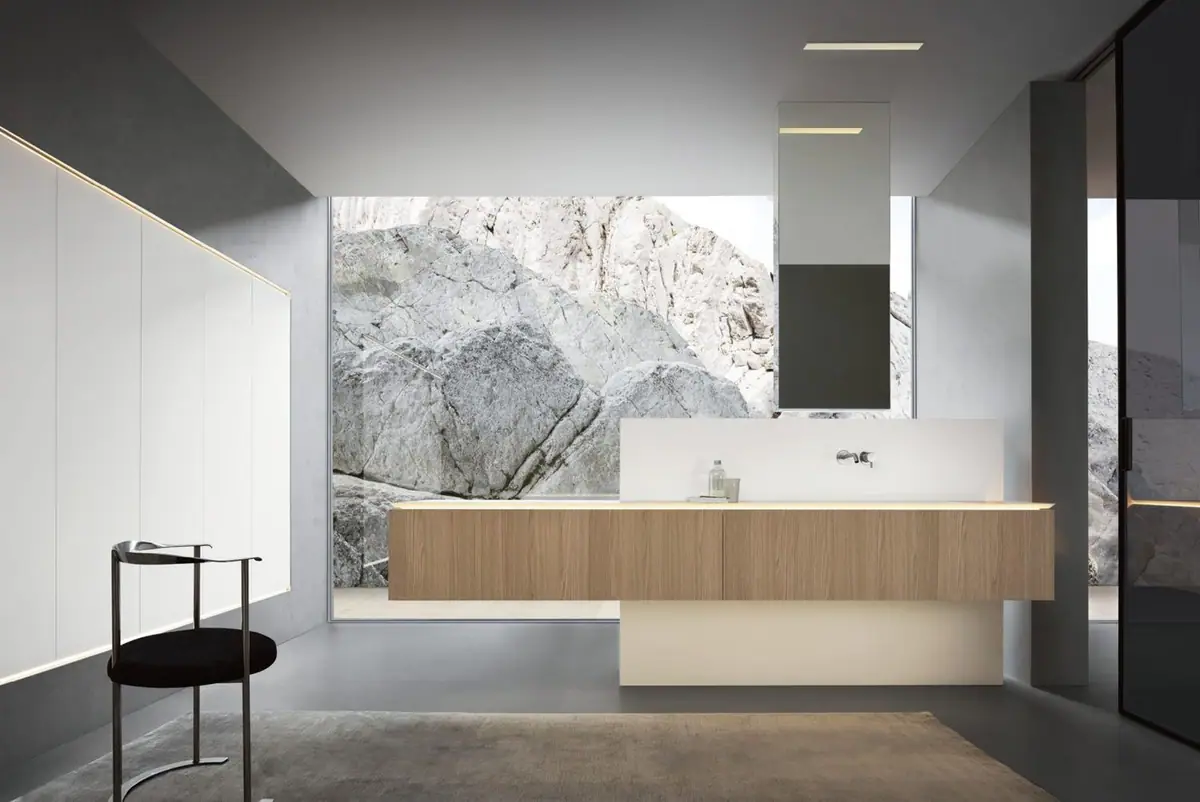
Noorth’s collections are conceived as complete settings, adapted to today’s bathrooms, and propose a new way of approaching the project: an architectural idea takes shape and then becomes a broad, exclusive collection. They are functional collections, with a personalised and architectural approach, that reinterpret the traditional bathroom with a modern touch and achieve elements imbued with simplicity and beauty.
In this article we discuss four of them, Puro, Touch, Roma and Azuma, each with its own style but sharing attention to detail as a common denominator. We look at who designed them, the materials that define them, the compositions shown in the images and what to bear in mind when specifying them.
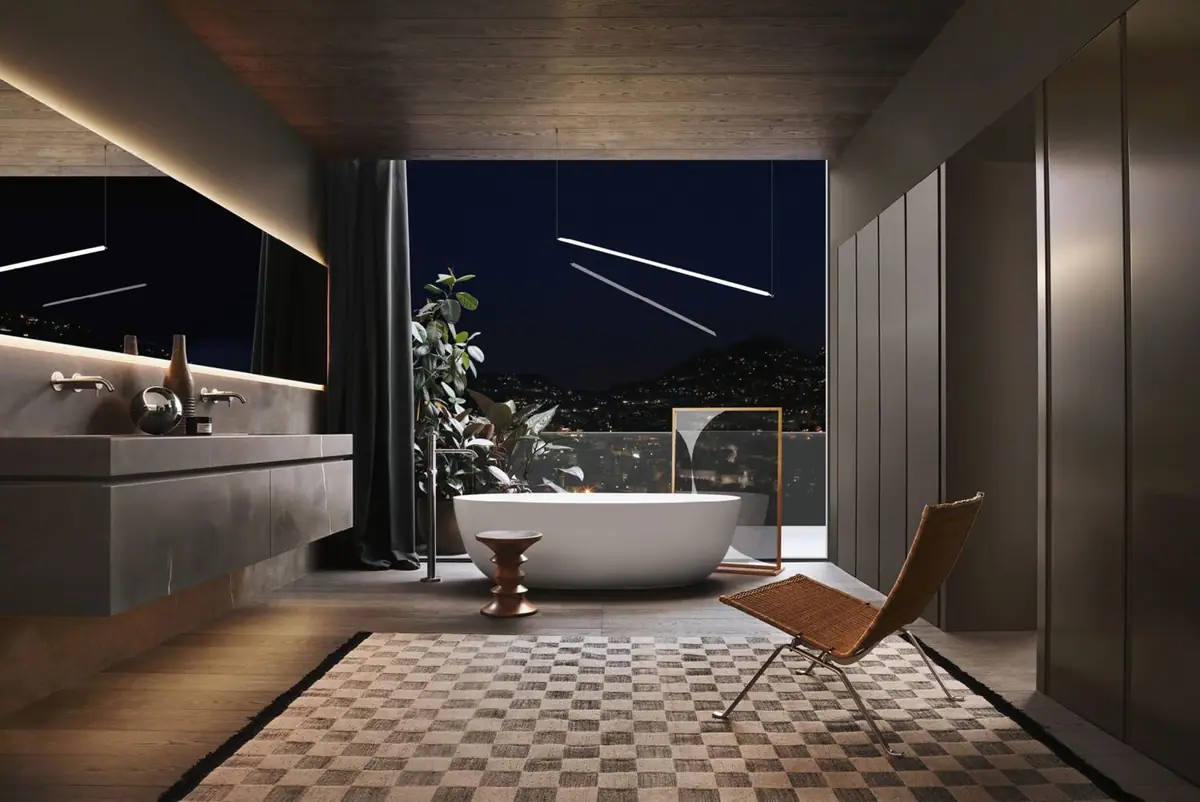
Noorth, Milldue’s design project
Milldue launched Noorth in 2016 at the Salone del Bagno in Milan with the aim, according to the brand, of expressing a modern vision based on research and innovation. Its catalogue combines modular systems with a very wide range of washbasins and accessories: rigorous, simple proposals alongside highly expressive iconic pieces.
To achieve this, Noorth works with designers of different languages and sensibilities, such as Michele Marcon, designer of Puro and Touch; the Barcelona studio Lievore Altherr, designer of Roma and Azuma; and Giuseppe Bavuso, designer of Fjord. The table summarises the four collections in this article as Noorth presented them in its 2019 compositions.
The Puro collection
A modular system in which the material rules.
Puro is designed by Michele Marcon (Treviso, 1970), who trained in graphic arts, industrial design and interior design, gained further experience in furniture and interior architecture alongside Lino Codato and, since 2008, has collaborated with Italian and international companies in the sector.
Designed in different materials (wood, lacquer and stone), the collection is characterised by surfaces of great beauty and precise geometries. It is a modular system offering a wide variety of solutions without losing sight of its starting point: to bring out the essence and intrinsic beauty of the material and to treat the space with an architectural approach, with structural solutions also designed for island configurations.
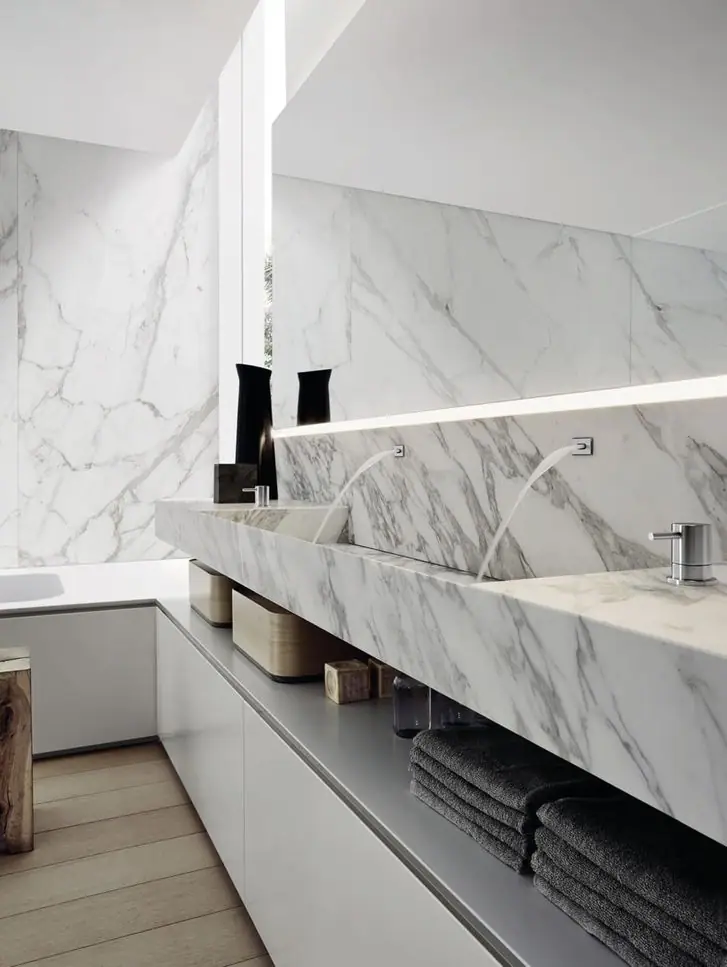
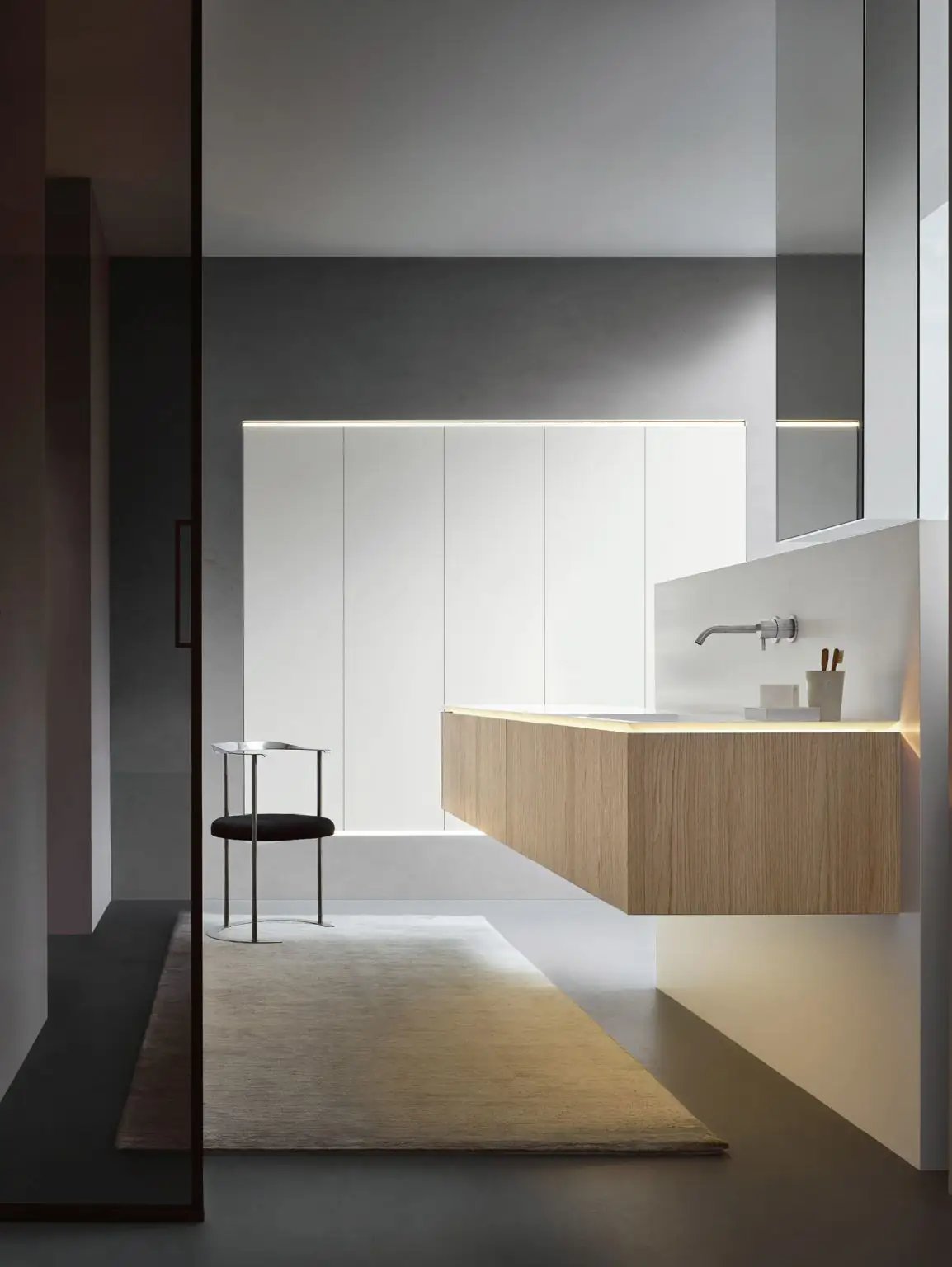
The absence of handles, replaced by grooves that can also be placed on the side, accentuates the purity of the volumes, as do the washbasins integrated into the worktops. The LED lighting built into the elements underlines their geometry and enhances the unmistakable qualities of marble, stone and wood.
Three Puro compositions
The images in this article show three of the compositions with which Noorth presented the collection:
- Puro 19.01: Next 56 wall-hung worktop, base units, 45° side panels and boiserie in Medea stone; Vetra mirror with LED backlighting on all four sides, columns lacquered in matt Fango and Oval bath in Cristalplant.
- Puro 19.04: Tray 94 worktop in Milltek Solid with LED underlighting, base units in Rovere Mezza Fiamma, Prisma mirror hung from the ceiling, Senna sanitaryware in matt ceramic and columns lacquered in matt white.
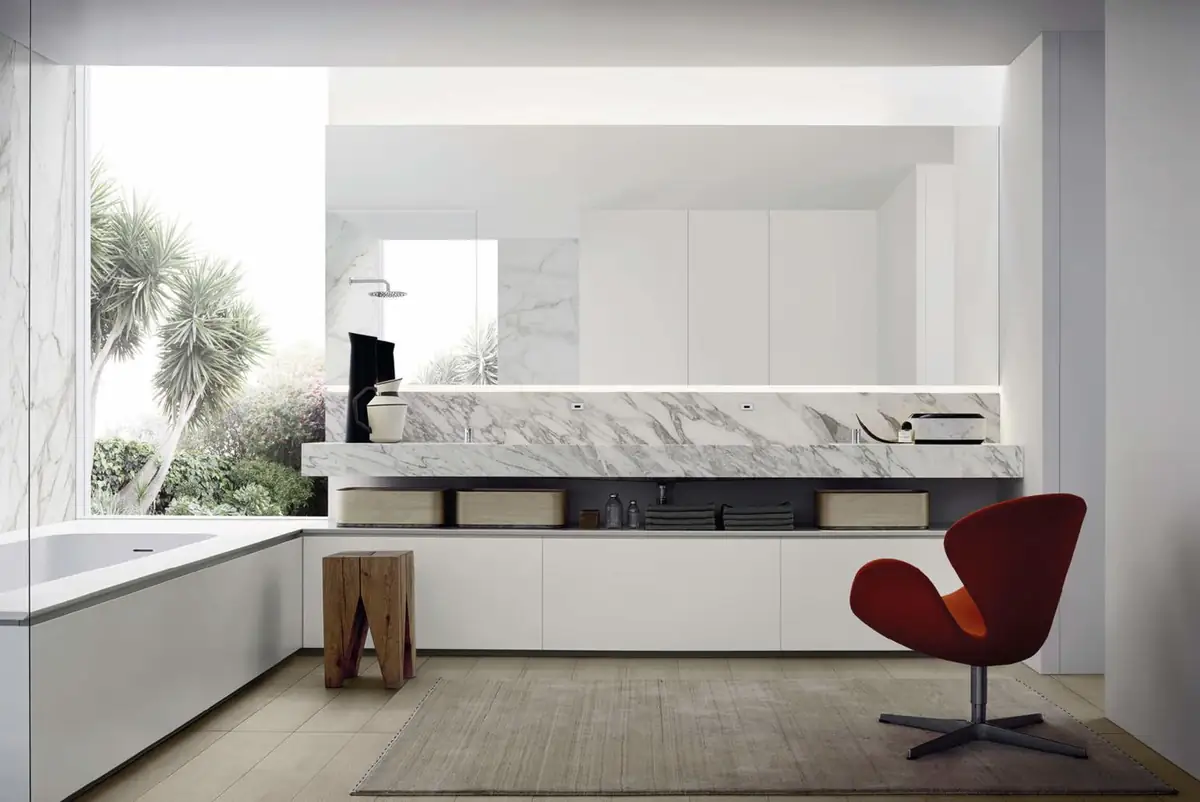
- Puro 19.09: Strict 140 worktop in Arabescato marble with integrated washbasin, matt white lacquered base units, Styling bath and Line shower tray. Noorth describes it as a domestic micro-architecture inspired by the fountains and wash-houses of historic cities.
The Touch collection
A monolithic washbasin that fits into a small space.
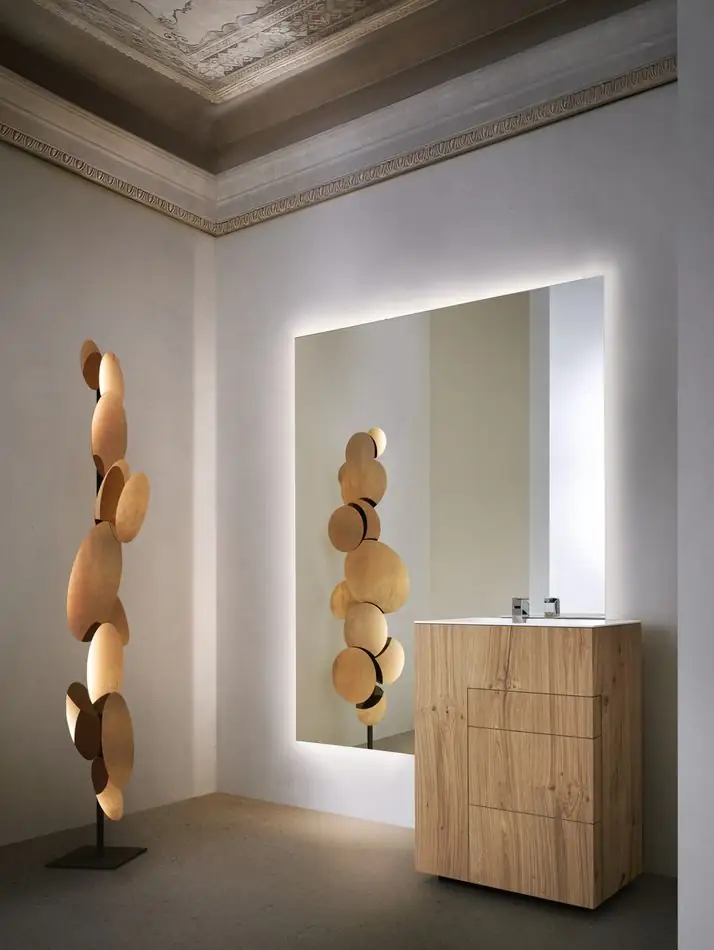
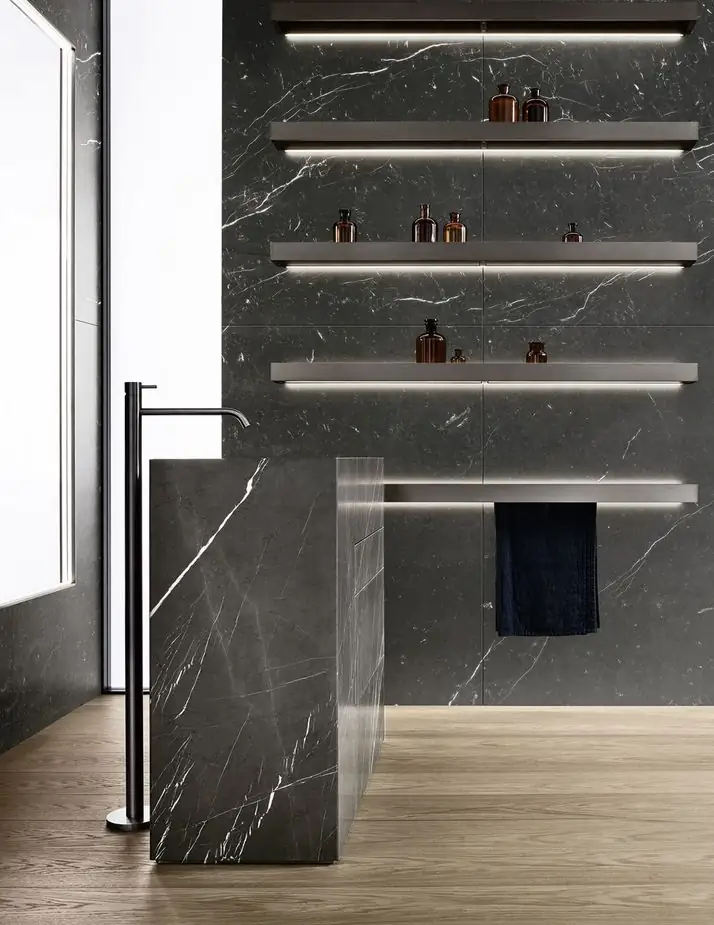
Touch, also by Michele Marcon, is a monolithic washbasin with a minimalist aesthetic that gives personality and an identity of its own to all kinds of spaces, even the smallest. It combines a wide variety of finishes, from lacquers and natural woods to clays and marbles. It is a compact, functional design, contemporary and strongly sculptural, an effect heightened when it is combined with mirrors with integrated LED lighting.
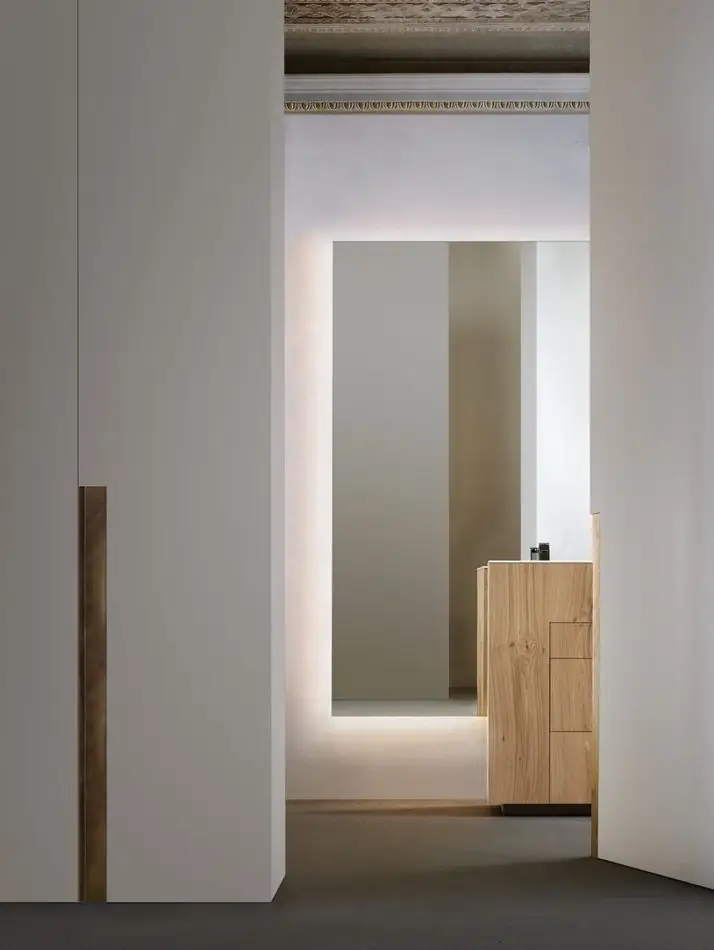
Noorth defined it as a compact volume, a pure parallelepiped, rigorous in its geometry and expressive in its form. In the Touch 19.03 composition, the washbasin unit in Rovere Barrique reproduces the look of a solid-wood monolith: very fine cuts mark the outline of the drawers. It has a Short 64 washbasin in Milltek, a base prepared for a floor waste and a tilted mirror with LED backlighting.
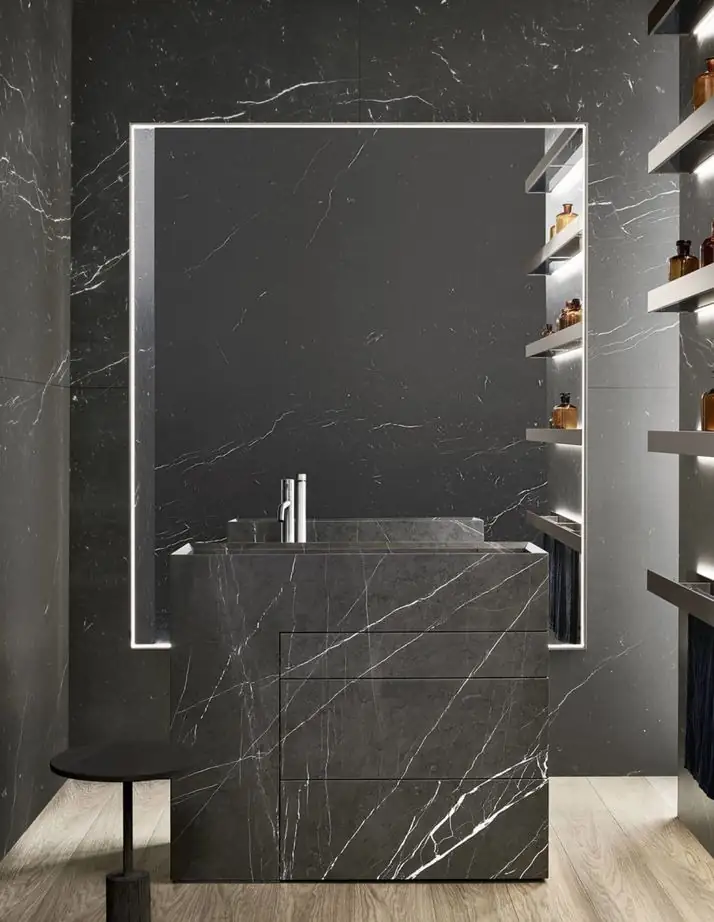
The Touch 19.01 composition carries the same idea into stone: a Full 100 washbasin in Grafite marble on a base prepared for a floor waste, with an Ekos V mirror lit around its entire perimeter and Ljos shelves with LED backlighting.
The Roma collection
Stone and classical architecture, in a domestic key.
For Roma, the Lievore Altherr studio reinterprets Mediterranean architectural culture. Stone takes centre stage and explicitly evokes the buildings of ancient Rome. The collection celebrates the ritual of bathing and the moment of calm and repose associated with Roman baths, transporting us to the grandeur and pleasure of those places.
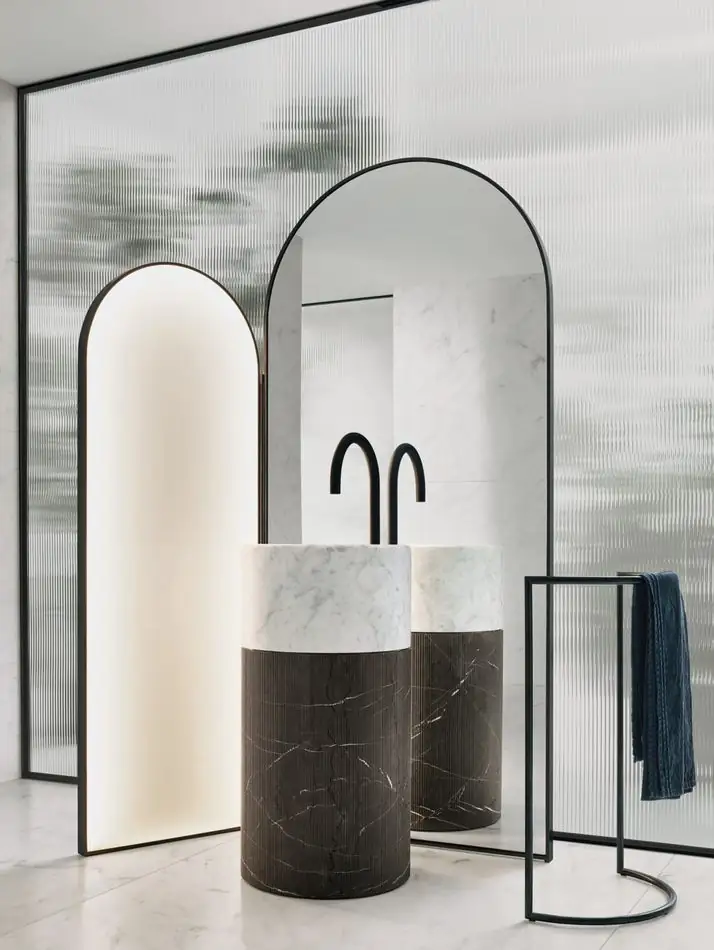
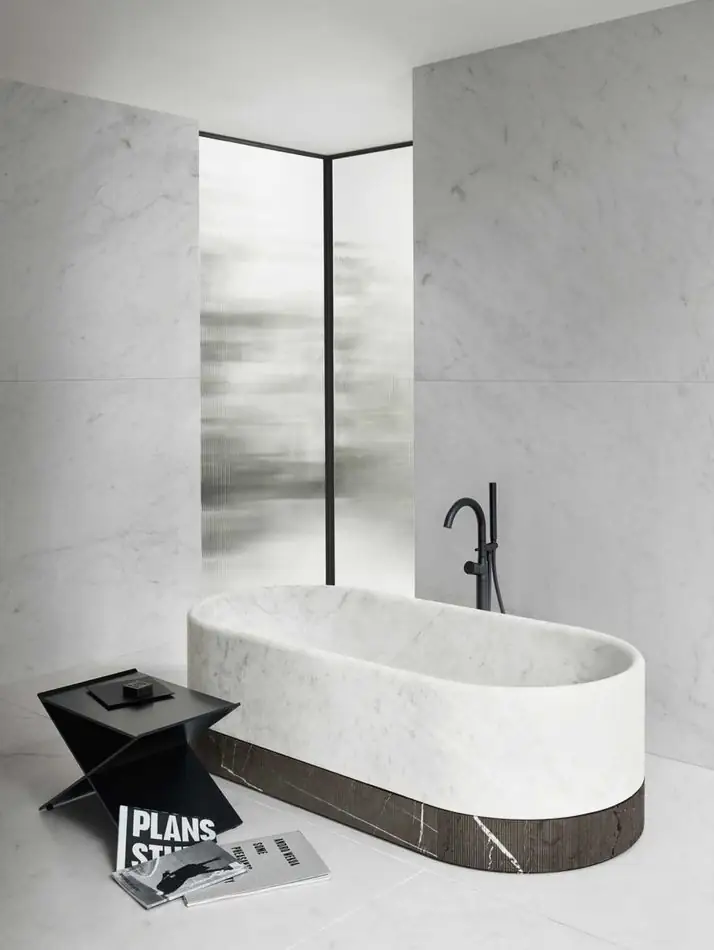
The core of the collection is a vertical cylindrical washbasin: a series of very pure floor-standing monoliths in stone of different veining, colours and finishes. They are accompanied by a bath with rounded forms, single or double mirrors conceived as theatre wings, and freestanding metal towel rails that repeat the curve of the mirrors.
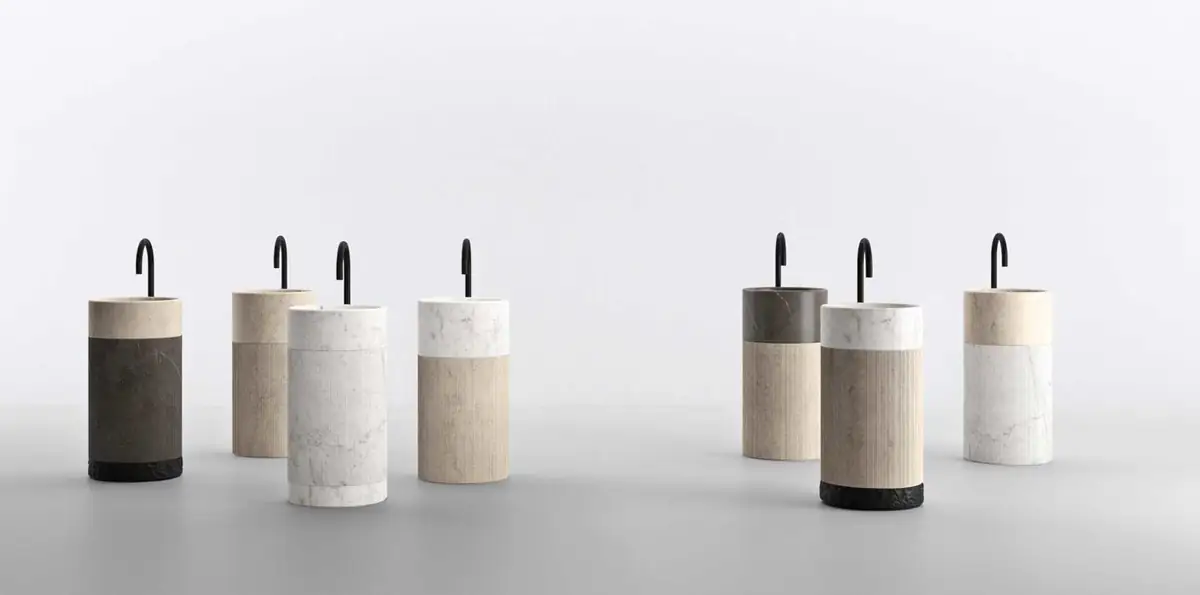
The combinations of different marbles, contrasting in tone and texture, turn each monolith into a powerful, monumental sculptural element. Roma III joins a smooth marble washbasin with a lower section with irregular milling; Roma IV adds a third band, with a milled central section and a plinth in split Ardesia slate or smooth marble.
Roma 19.01 and Roma 19.03
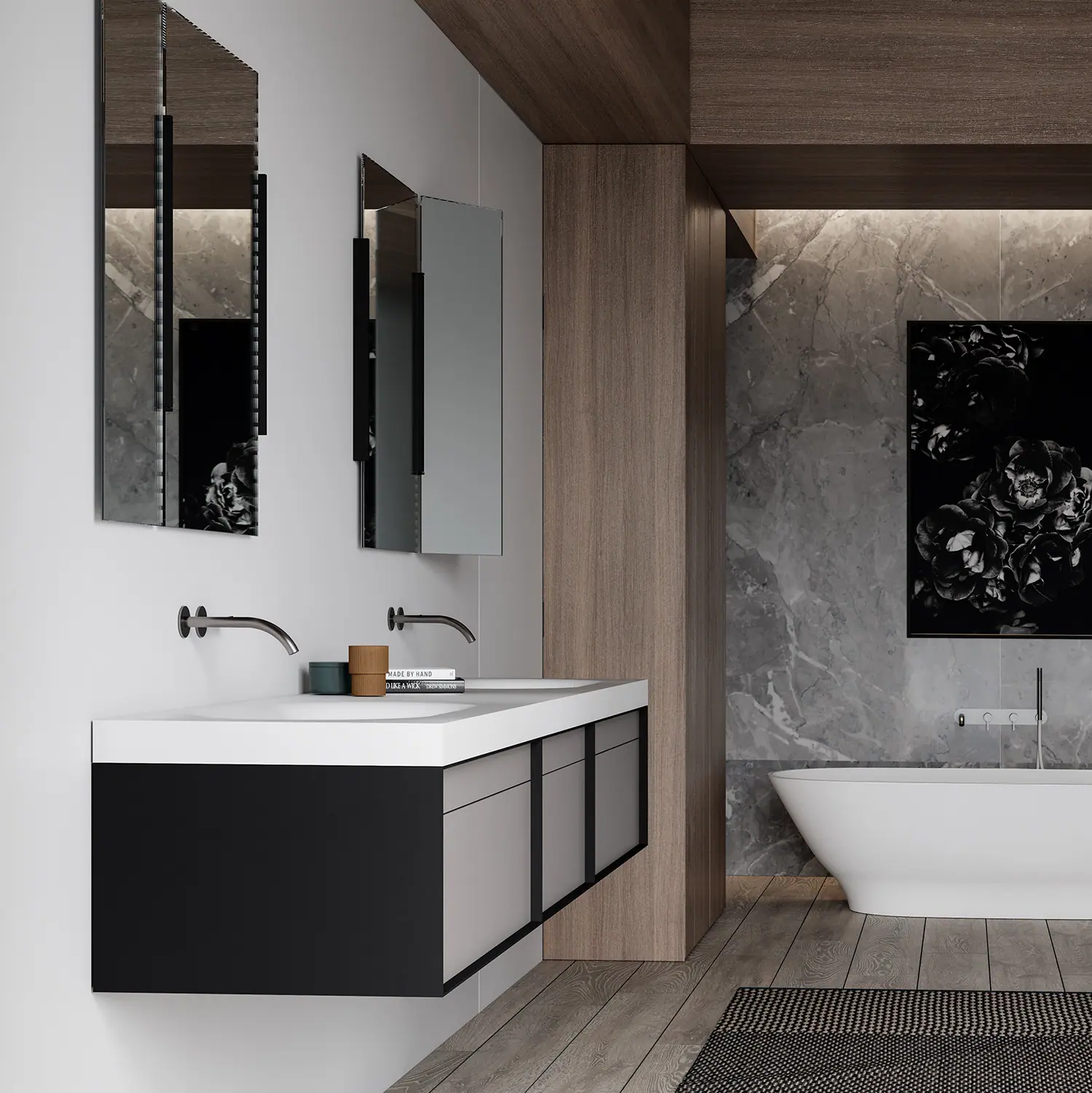
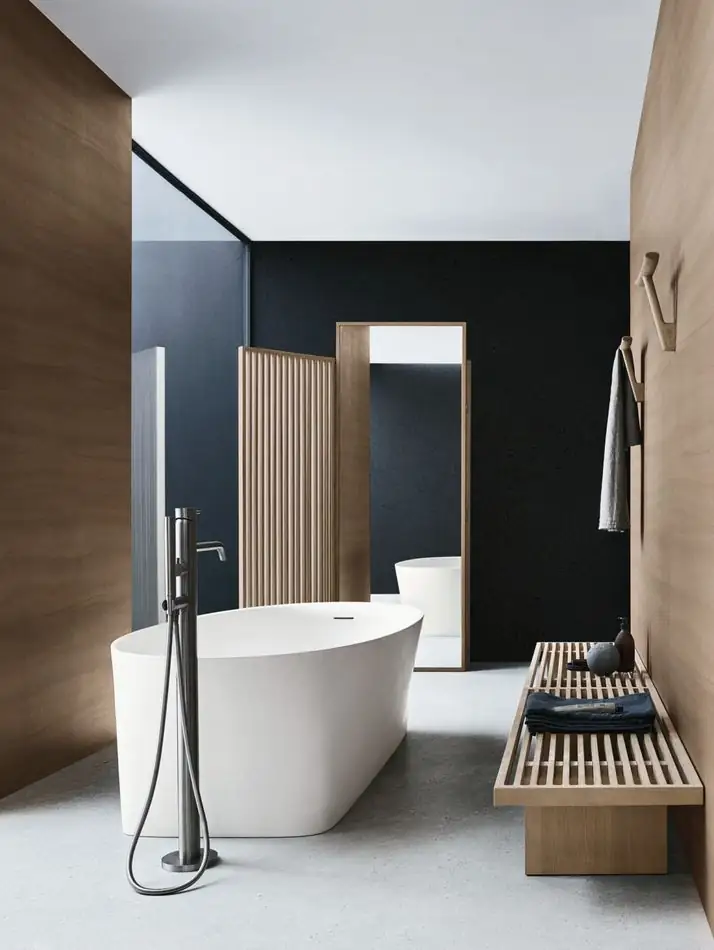
The Roma 19.01 composition brings together a Roma III monolith with a smooth Bianco Carrara washbasin and a lower section milled in Grafite, the Roma bath in the same marbles, a black lacquered Roma towel rail and freestanding black-framed mirrors with one of their panels illuminated.
The Roma 19.03 model is a Roma II floor-standing monolith with a matt black ceramic washbasin, a band in satin gold finish, a central section in Noce Canaletto and a plinth in Rovere Nero. It is completed by a Ljos shelf in aluminium lacquered in Titanio and an Air mirror, both with LED backlighting.
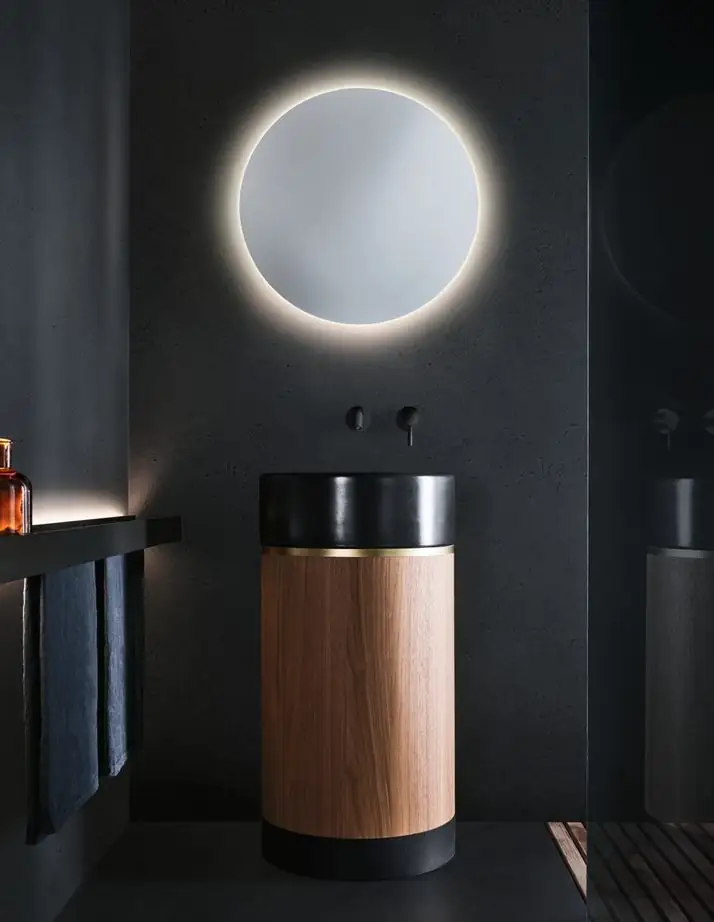
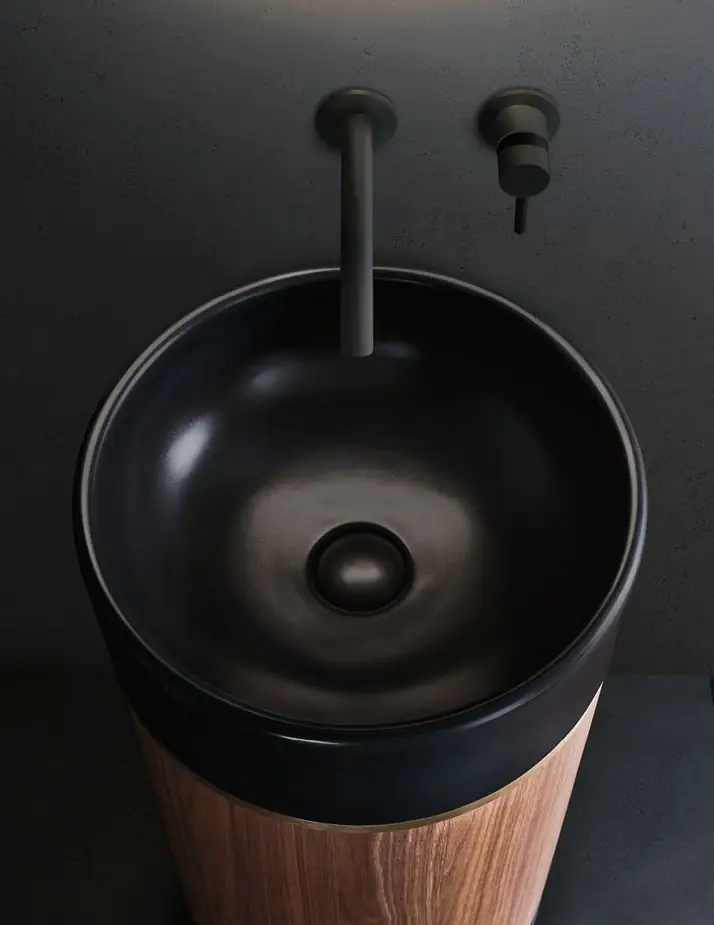
Roma and Azuma were, together with Fjord by Giuseppe Bavuso, the stars of Noorth’s space on Via Palermo, in the Brera district, during Milan Design Week 2019.
The Azuma collection
The Japanese bath as a reference.
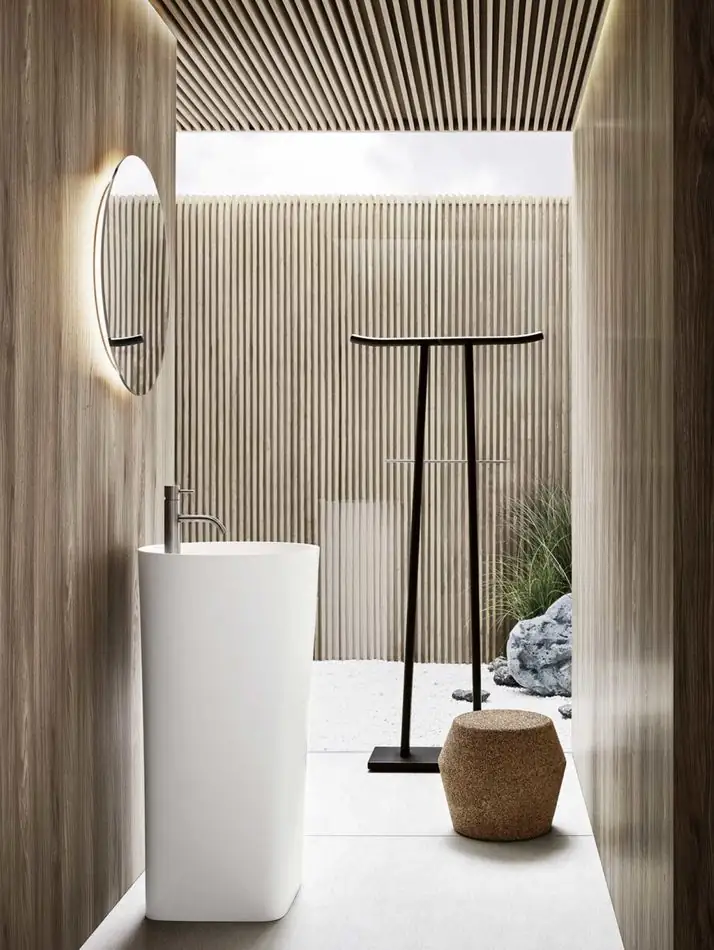
In Azuma, also by Lievore Altherr, the reference is the Japanese bath: it recalls the well-known onsen, spaces that celebrate nature and associate it with that moment of relaxation and well-being. That is why the sides of the washbasins and the bath are shaped like a falling drop of water and evolve from the roundness of the top to the square of the base. The ledges of the bath recall stones polished by water, and the stools are essential volumes, like the rocks of a Zen garden. They are forms that are simple in appearance and always current, because they draw on a timeless language.
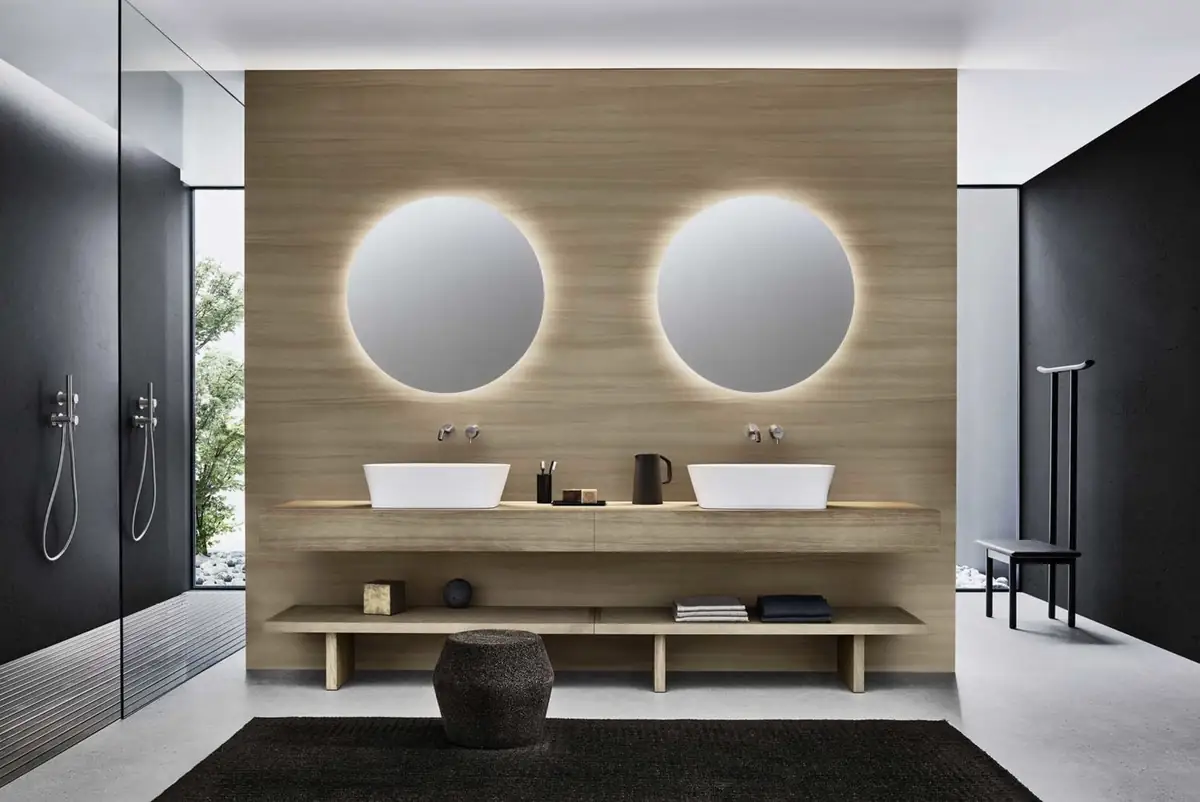
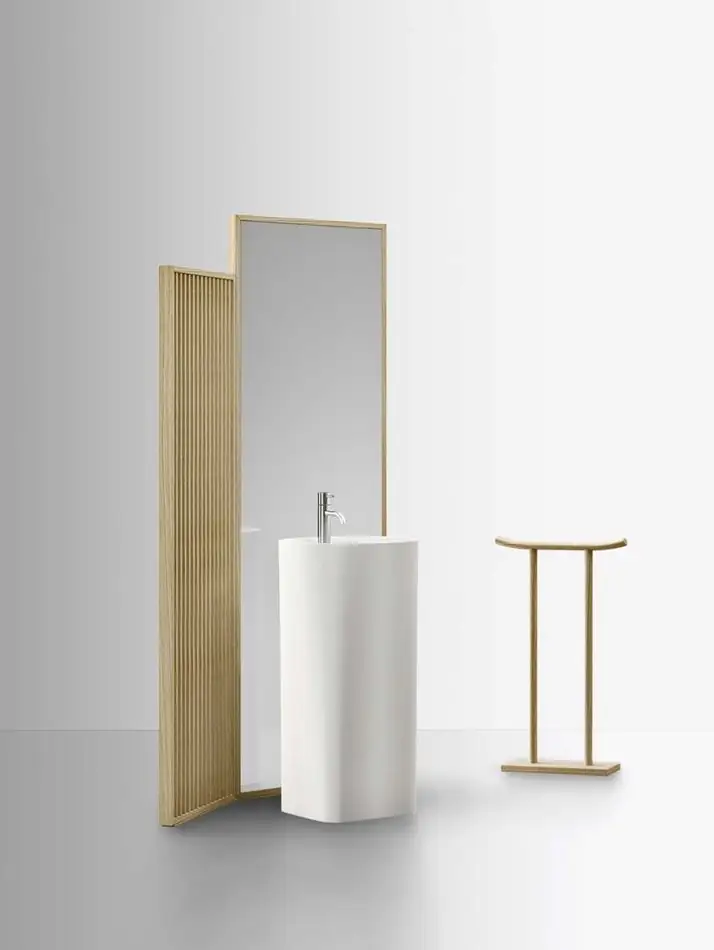
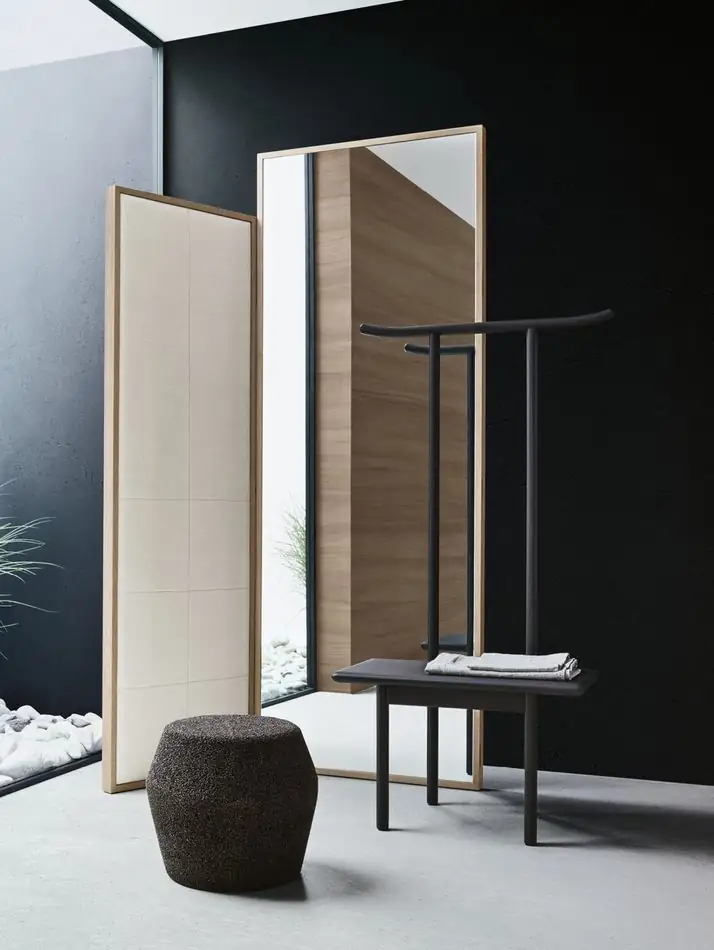
The 19.02 and 19.03 compositions centre on the Azuma 88 floor-standing washbasin in Cristalplant. In the first, it is accompanied by the Levante screen, with two panels of mirror and Rovere Mezza Fiamma slats, and a floor-standing towel rail from the Toro series; in the second, by a Toro coat stand and towel rail in Rovere Carbone, a Maki cork pouf and a backlit Air mirror.
What to bear in mind when specifying
Beyond aesthetics, these collections involve some decisions best taken at design stage:
- Waste: in the Touch 19.01 and 19.03 compositions the base is prepared for a floor waste, and the Azuma 88 floor-standing washbasin is offered, according to its technical data sheet, with a floor or wall waste. The version should be decided and the connection positioned before the floor is finished.
- Integrated lighting: worktops, columns, mirrors (Vetra, Ekos V, Air) and Ljos shelves have LEDs. The power supply and its position must be planned in the building services design.
- Island configurations: Puro allows freestanding compositions in the centre of the bathroom, which means running water, waste and electricity through the floor.
- Stone at full scale: in Puro, Touch and Roma, marble and stone take centre stage. The combination of veining and finishes is best chosen with physical samples, not just images.
- A common language: Air mirrors, Ljos shelves, Flow taps and the Toro series appear across several collections, making it possible to fit out the whole bathroom with pieces that are consistent with one another.
Frequently asked questions
- Who designs the Puro, Touch, Roma and Azuma collections?
- Puro and Touch are by Michele Marcon. Roma and Azuma are by the Barcelona studio Lievore Altherr, which now works as Lievore + Altherr Désile Park.
- What distinguishes Puro from Touch?
- Puro is a modular system of base units, columns and worktops that adapts to linear or island compositions. Touch is a single piece: a monolithic floor-standing washbasin unit, designed even for small bathrooms.
- What material are the Roma washbasins made of?
- It depends on the model. In the 2019 compositions, Roma III combined a smooth marble washbasin with a milled marble base, while Roma II had a matt ceramic washbasin on a wooden cylinder, with a metal band.
- What is Cristalplant?
- It is the material of the Azuma washbasins and bath and of Puro’s Oval bath. According to Noorth’s technical data sheet, it is a composite with a high percentage of natural mineral fillers (aluminium trihydrate derived from bauxite) and a low percentage of polymers; it is compact and homogeneous throughout its thickness, so scratches or persistent stains can be removed by sanding with very fine abrasive paper.
These are some of the collections we have selected, but we encourage you to get to know them better and appreciate the details of each of Noorth by Milldue’s designs. Today (2026), all four remain in Noorth’s catalogue, with updated compositions.
In Matter’s material library we help you plan the complete bathroom: the furniture, the sanitaryware and the surfaces that go with it. If you would like to know more about Noorth’s collections, get in touch or book your visit.