Kartell by Laufen
Palomba Serafini’s bathroom collection for Kartell and Laufen: SaphirKeramik washbasins, transparent accessories and a modular colour palette.
Products7 min read
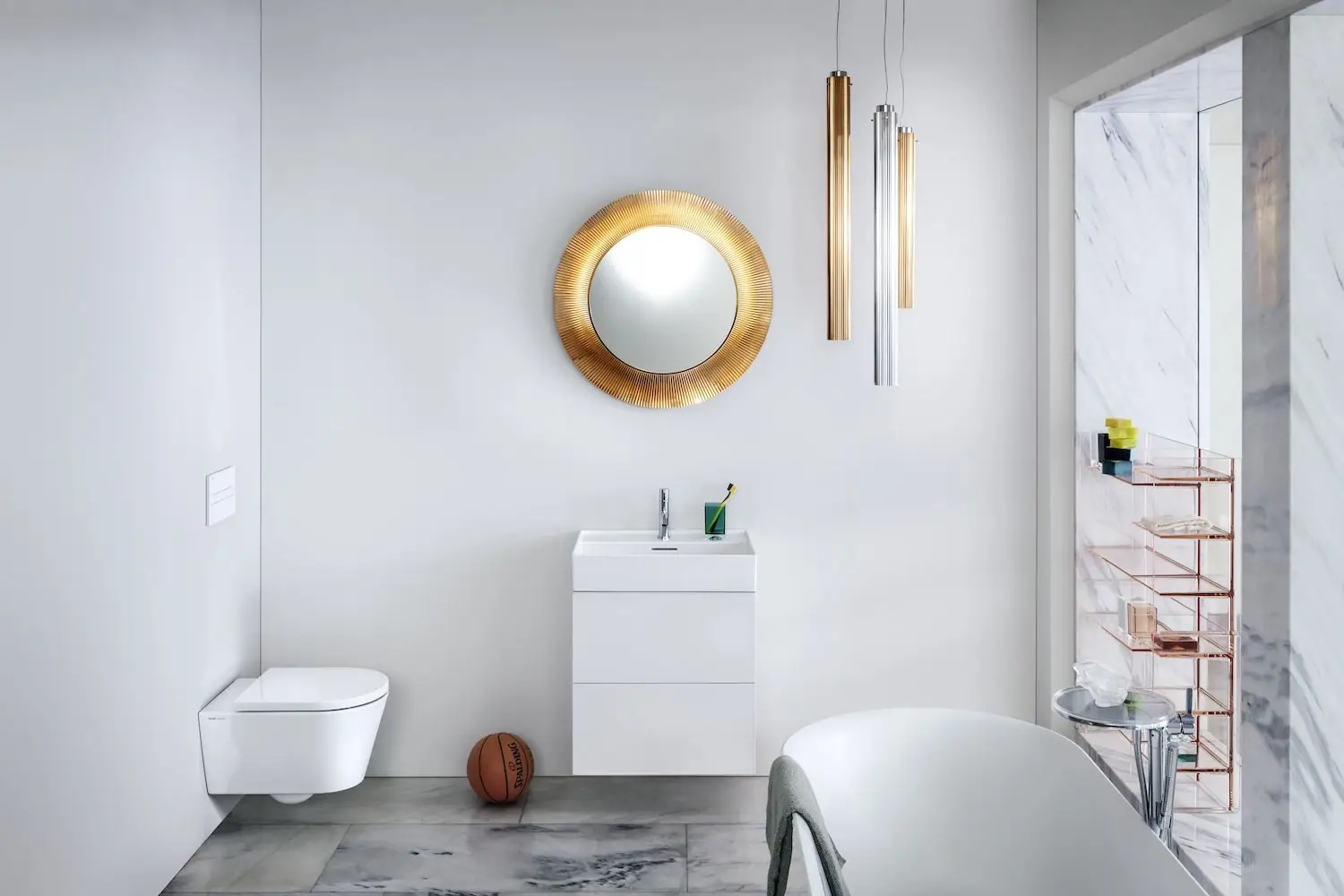
Kartell by Laufen is based on open compositions that play with colour and transparency to turn the bathroom into a fluid, flexible architectural space. The collection brings together two ways of thinking about product: the Italian design of Kartell, a specialist in plastics, and the industrial rigour of Laufen, the Swiss sanitary ceramics manufacturer. It is designed by Ludovica Serafini and Roberto Palomba (Palomba Serafini Associati), was launched in 2013 and was extended by Laufen in 2021 with new colours, finishes and furniture.
In this article we look at the idea behind the collection, what SaphirKeramik — the Laufen ceramic material its washbasins are made from — brings to it, which pieces make it up and their main dimensions, how its colour palette is combined and what to bear in mind when specifying it.
The bathroom as a living space
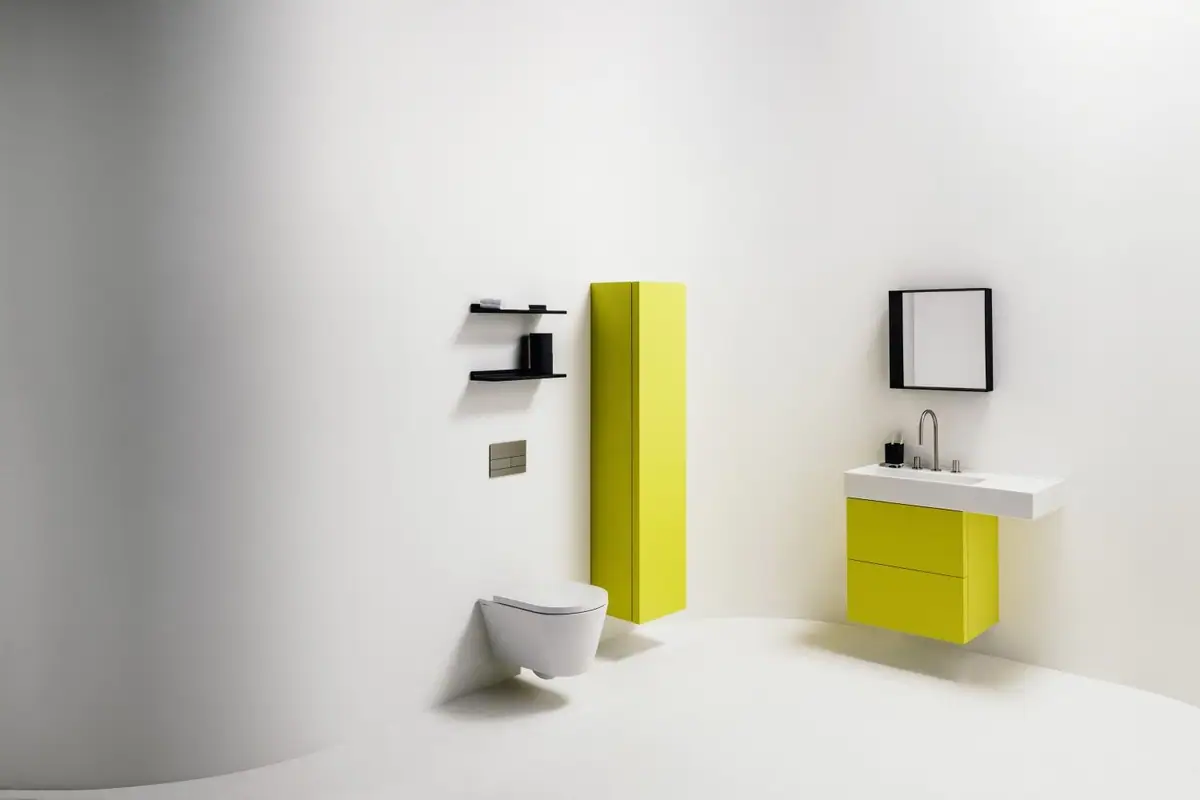
The collection embodies Laufen’s view of the bathroom as a room that has evolved into a living space, a place to relax. Over the years, the bathroom has gone from being a space relegated to a corner of the house, organised around personal hygiene, to a welcoming setting in line with interior design trends.
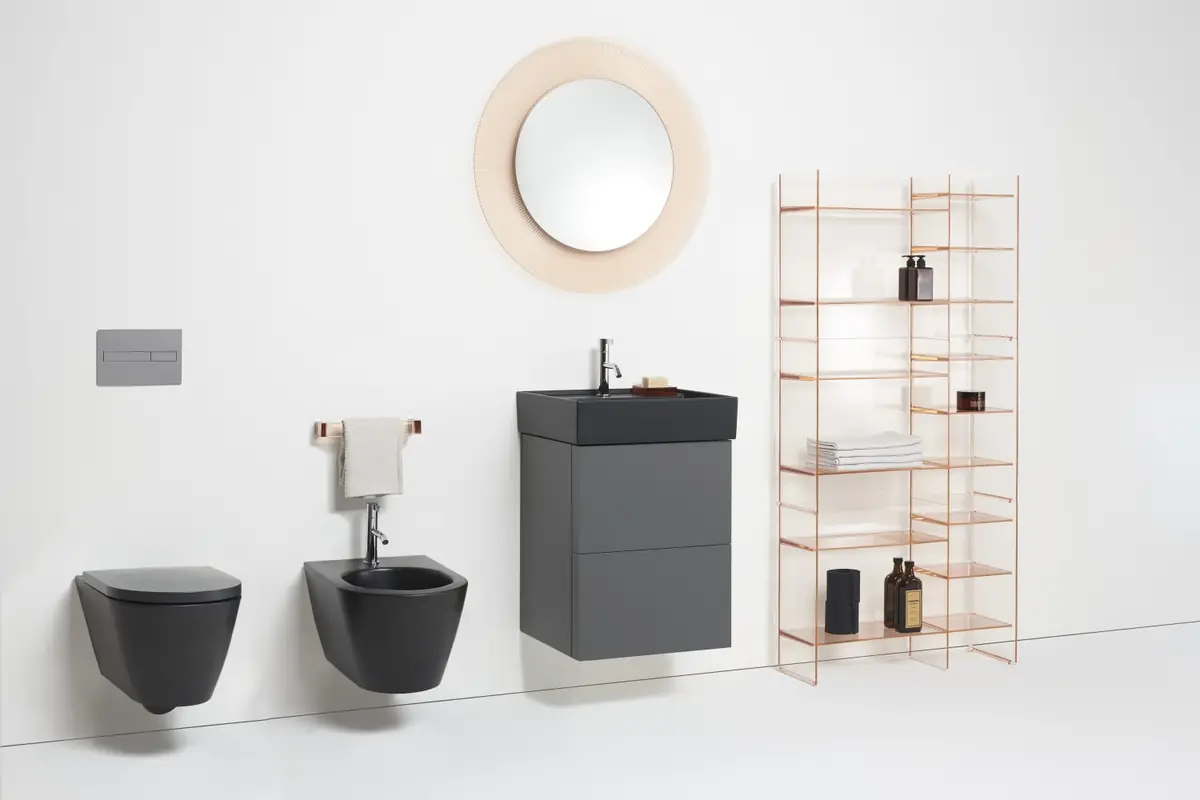
Laufen explains the starting point with a simple distinction: the bathroom contains fixed pieces — washbasin, bath, WC, furniture — which are changed rarely and require building work, and movable pieces — shelving, stools, mirrors, accessories — which can be replaced easily. Kartell by Laufen gives each brand a role: Laufen’s ceramics, with their sober geometry and neutral colours, form the stable base; Kartell’s transparent objects, in bright colours, change the atmosphere without touching the installation.
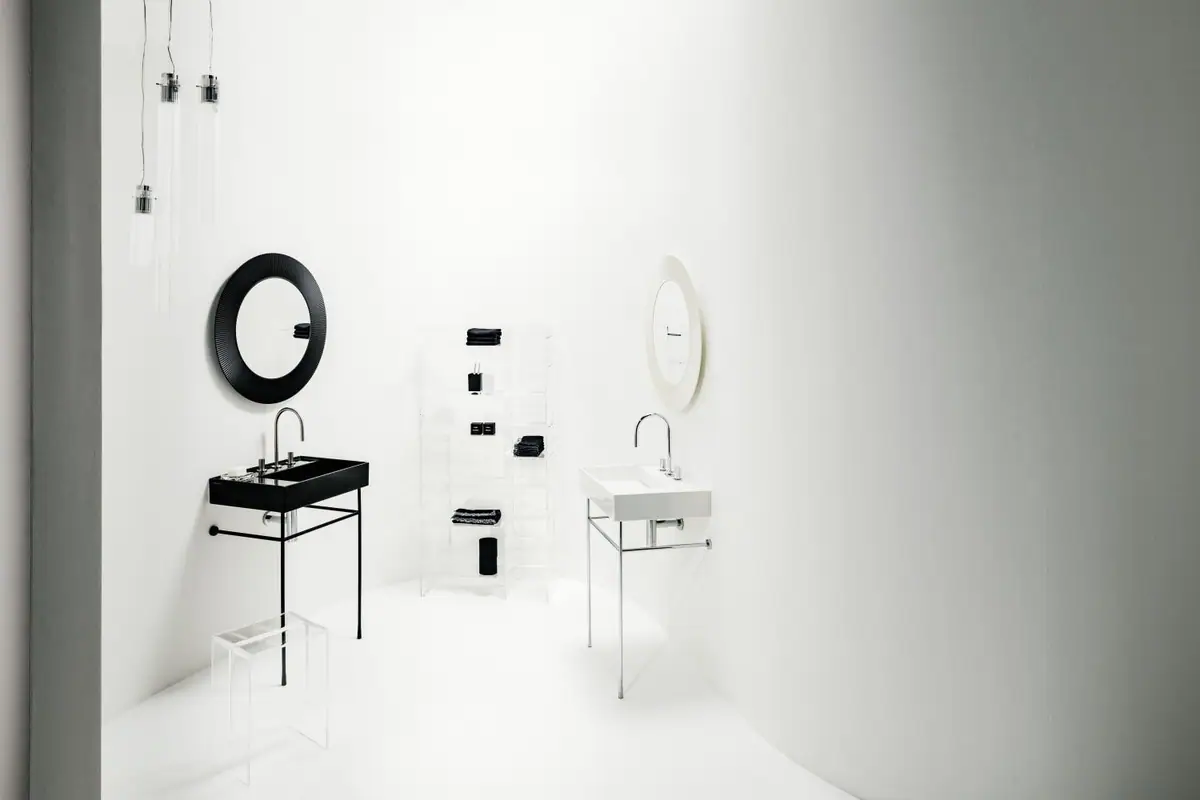
That is why the collection is so complete: washbasins, WCs, bidets, baths, furniture, taps, mirrors, lamps and accessories designed to be combined with one another. Its rigorous forms make it possible to pair the lightness of transparency with the solid, robust presence of ceramics, and they bring the bathroom closer to the logic of a living room: pieces that are placed, moved and changed.
Two manufacturers, one project
Kartell, founded in 1949 by Giulio Castelli, has built its history on research and experimentation with materials unusual in furniture, above all plastic. Its designers, keen observers of lifestyle, have kept pace with the public’s changing needs with functional, high-quality objects and furniture.
Laufen was founded in 1892 in the Swiss town of the same name as a brick and roof tile works, and began producing sanitary ceramics in 1925. Today it is the only Swiss manufacturer of this type of ceramic and has been part of the Roca Group since 1999. In the collection it contributes the ceramics, the technical expertise and the industrial production of the whole.
Ludovica Serafini and Roberto Palomba, architects trained in Rome, founded their studio in Milan in 1994 and have worked with firms such as Boffi, Cappellini, Driade, Flaminia, Foscarini, Poltrona Frau and Zanotta. For Laufen they have designed two collections: Kartell by Laufen and Palomba.
SaphirKeramik: thin walls and precise edges
What sets the collection’s washbasins apart is the material. SaphirKeramik is a ceramic patented by Laufen and launched in 2013, the same year as the collection. It contains corundum, a colourless mineral that is a component of sapphire, which gives it far greater hardness and flexural strength than conventional vitreous china.
- Strength: according to tests by the Federal Institute for Materials Research and Testing in Berlin (BAM), its flexural strength exceeds 120 MPa on average, twice that of vitreous china and comparable to carbon steel.
- Thin walls: it allows walls of 3 to 5 mm and edge radii of 1 to 2 mm, compared with the 7-8 mm usual in traditional ceramics. Hence the crisp edges and precise geometry of the washbasins.
- Less material: lighter pieces, using less raw material and less energy in firing and transport. Laufen received the Swiss Design Prize 2017/18 for this material.
- Same hygienic performance: it retains the properties of sanitary ceramics and is just as recyclable.
Not every piece is in SaphirKeramik. According to Laufen’s product pages, the wall-mounted and countertop washbasins and the bowl washbasin are; the freestanding washbasin, the WCs and the bidets are made in conventional sanitary ceramics, and the baths in Sentec, a compact mineral material (solid surface).
What the collection includes
The table summarises the main families with the dimensions from Laufen’s technical catalogue. Codes and variants (shelf on the right or left, number of tap holes, with or without overflow) are given on each product page.
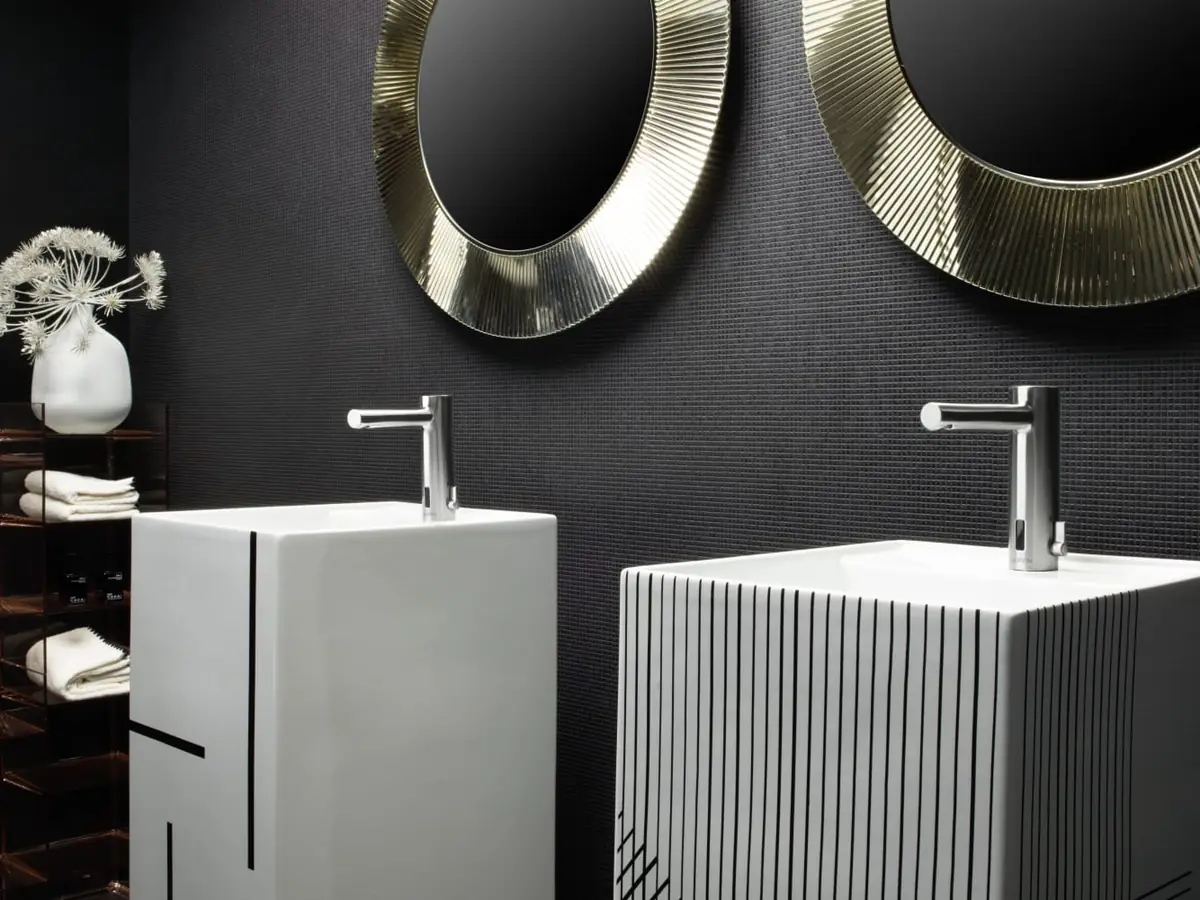
The freestanding washbasin is the collection’s most recognisable piece: a single-piece ceramic volume that stands on the floor and works almost as a sculptural object in the centre of the room or against the wall. As well as the plain finish, it can be ordered with three graphic decorations in black and grey — lines, a grid of lines and surfaces — applied before firing and permanently bonded to the ceramic.
Colour and transparency: how the palette is combined
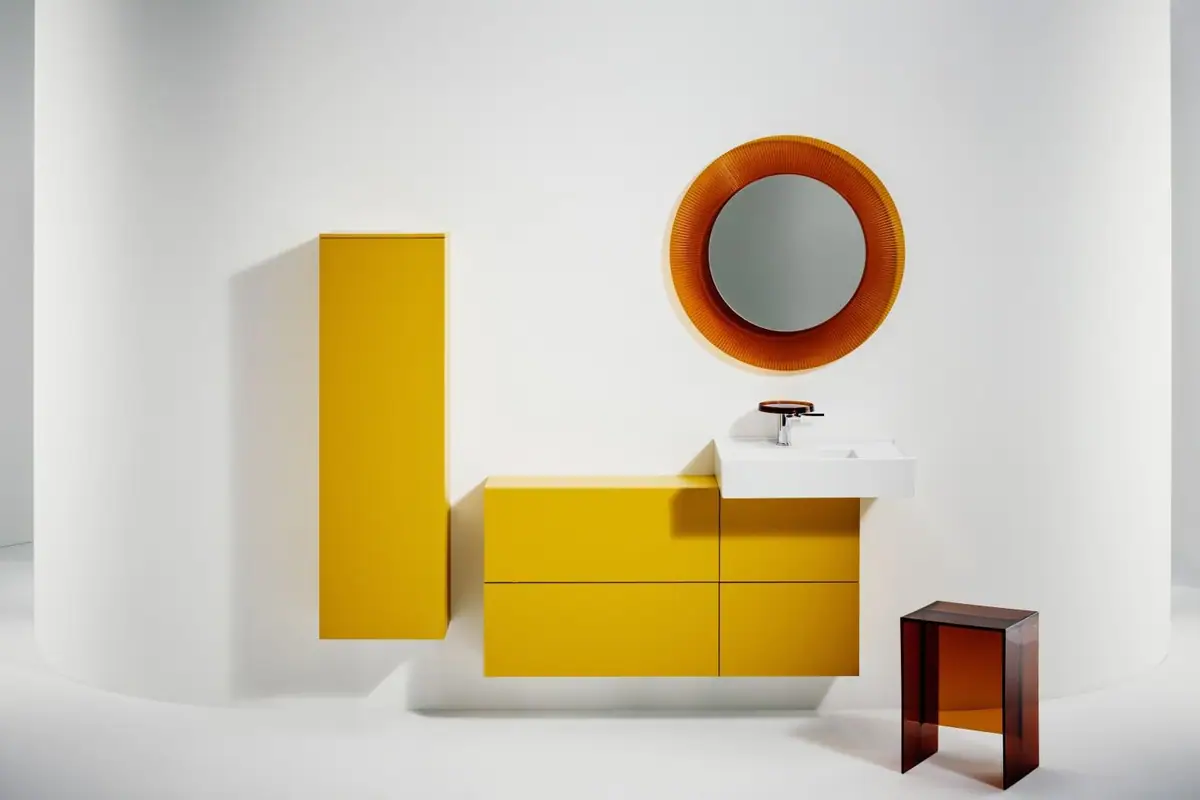
Colour is the identity of Kartell by Laufen, but it is organised by material. The ceramics and furniture stay within sober or earthy tones; the accents come from the transparent accessories and the taps. This means a bathroom’s character can be changed with replaceable pieces, without redoing the fixed elements.
- Ceramics: white, white with LAUFEN Clean Coat, matt white, gloss black, matt black, matt graphite and matt grey. The freestanding washbasin and the floor-standing pieces have a narrower range.
- Furniture: matt white, pebble grey and slate grey, to which the 2021 extension added mustard yellow, blue-grey and ochre. The washbasin and vanity unit sets are offered in the first three.
- Kartell accessories (All Saints mirror, Shelfish shelves, Rail towel rails, Max Beam stool, Sound Rack shelving, Rifly lamps): crystal clear, amber, mandarin, blue, smoke grey, emerald green, powder pink, gold, silver and copper, plus opaque white and black for those who prefer to match the ceramics.
- Taps: chrome and PVD finishes in gold, rose gold, matt black titanium and stainless steel look. Laufen describes them as having slender cylindrical bodies; the disc series includes a small coloured plastic tray.
Key points for specifying Kartell by Laufen
Beyond aesthetics, these are the points worth resolving at design stage:
- Washbasin and vanity unit together: each vanity unit is designed for a specific washbasin, and on models with a shelf the side (right or left) must be chosen. It is best to settle the washbasin before defining the unit and the taps.
- Small bathrooms: the 46 cm hand basin, the 50 cm washbasin and vanity unit set and the compact wall-hung WC, with a 49 cm projection, keep the same language in cloakrooms and guest bathrooms.
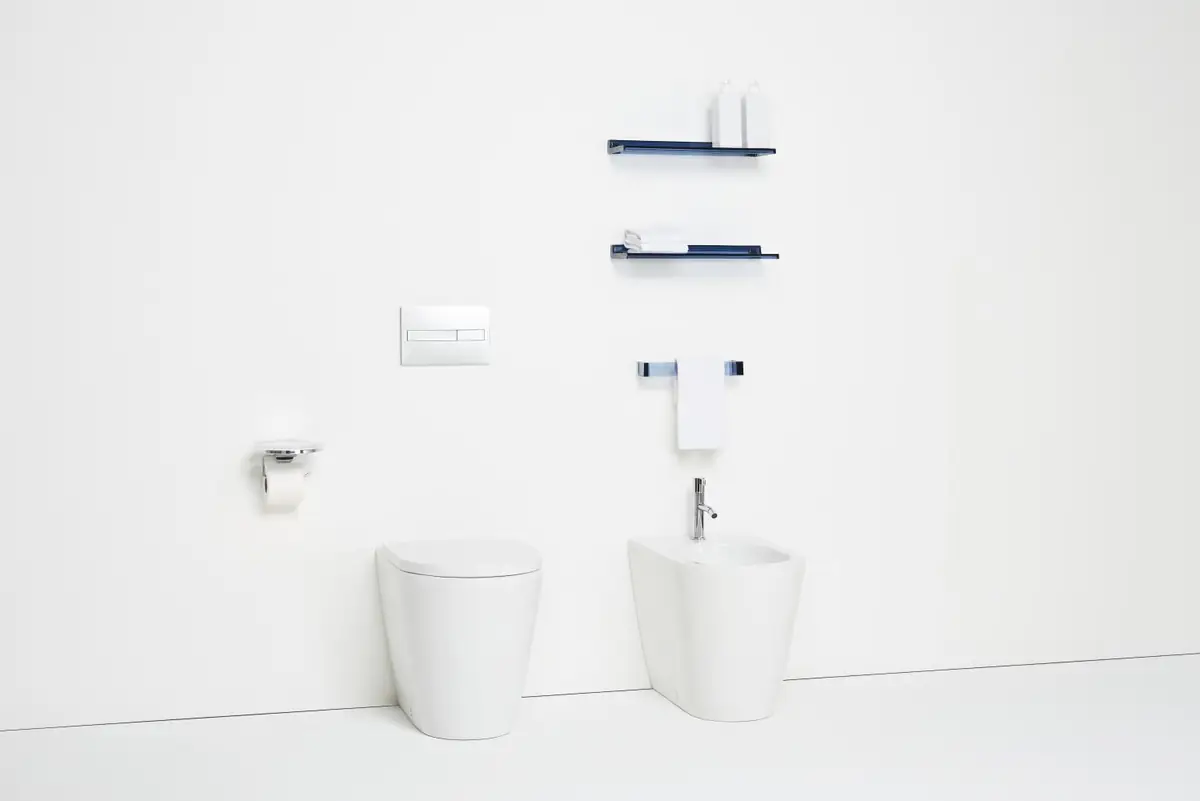
- Rimless WCs: all the WCs in the collection are rimless, with no inner rim. The wall-hung model complies with EN 997 and EN 33 and works with a 4.5/3 litre flush and a concealed cistern.
- Easy-clean surface: the LAUFEN Clean Coat (LCC) option is a vitrified ceramic coating fired onto the glaze. Its roughness is around 4 nanometres, which makes it harder for dirt, limescale and bacteria to adhere.
- Baths and freestanding washbasin: these pieces are seen from all sides. Their position, waste and floor- or wall-mounted taps must be planned before the installation is closed up.
Frequently asked questions
- Is Kartell by Laufen a new collection?
- No. It was launched in 2013 and extended by Laufen in 2021 with new colours, finishes and furniture. It remains in the catalogue and is one of the brand’s complete bathroom collections.
- What is SaphirKeramik and which pieces use it?
- It is a ceramic patented by Laufen that contains corundum. It allows walls of 3 to 5 mm and edges with a 1 to 2 mm radius, with a flexural strength twice that of vitreous china. In this collection it is used for the wall-mounted, countertop and bowl washbasins.
- Can it be used in a small bathroom?
- Yes. There is a 46 cm hand basin, a 50 cm washbasin and vanity unit set and a compact wall-hung WC with a 49 cm projection, in the same colours as the rest of the collection.
- What are the coloured accessories made of?
- Kartell transparent plastic. Laufen states that the mirrors, shelves, lamps, towel rails, soap dishes and tumblers are made in acrylic glass, in transparent colours or in opaque white and black.
- What is the advantage of the LCC finish?
- LAUFEN Clean Coat is a ceramic coating fired onto the glaze that becomes part of the piece. Its very smooth, non-porous surface makes cleaning easier and reduces the use of cleaning products.
At Matter we help you plan the whole bathroom: the ceramics, furniture, taps and the surfaces that go with them. The Kartell by Laufen collection is on display in our material library: come and see it and compare materials and finishes with your technical team.
Book your visit to Matter.
Book a visit