Wood and natural fibres
Wood myths and technical data, comfort, parquet and new materialities with plant fibres, plus Mardegan Legno's handcrafted parquet, at Matter.
EventsMatter Session5 of 76 min read
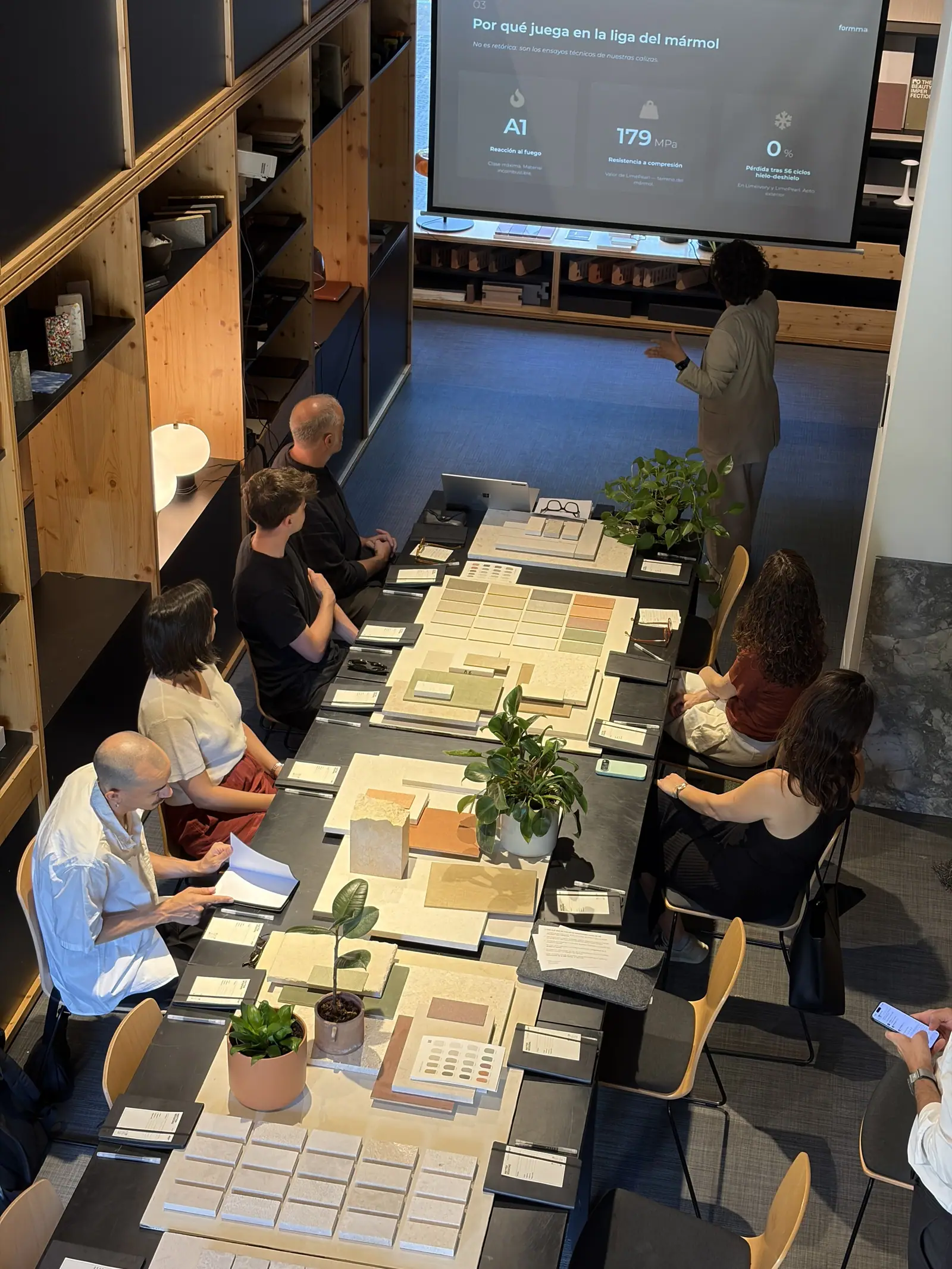
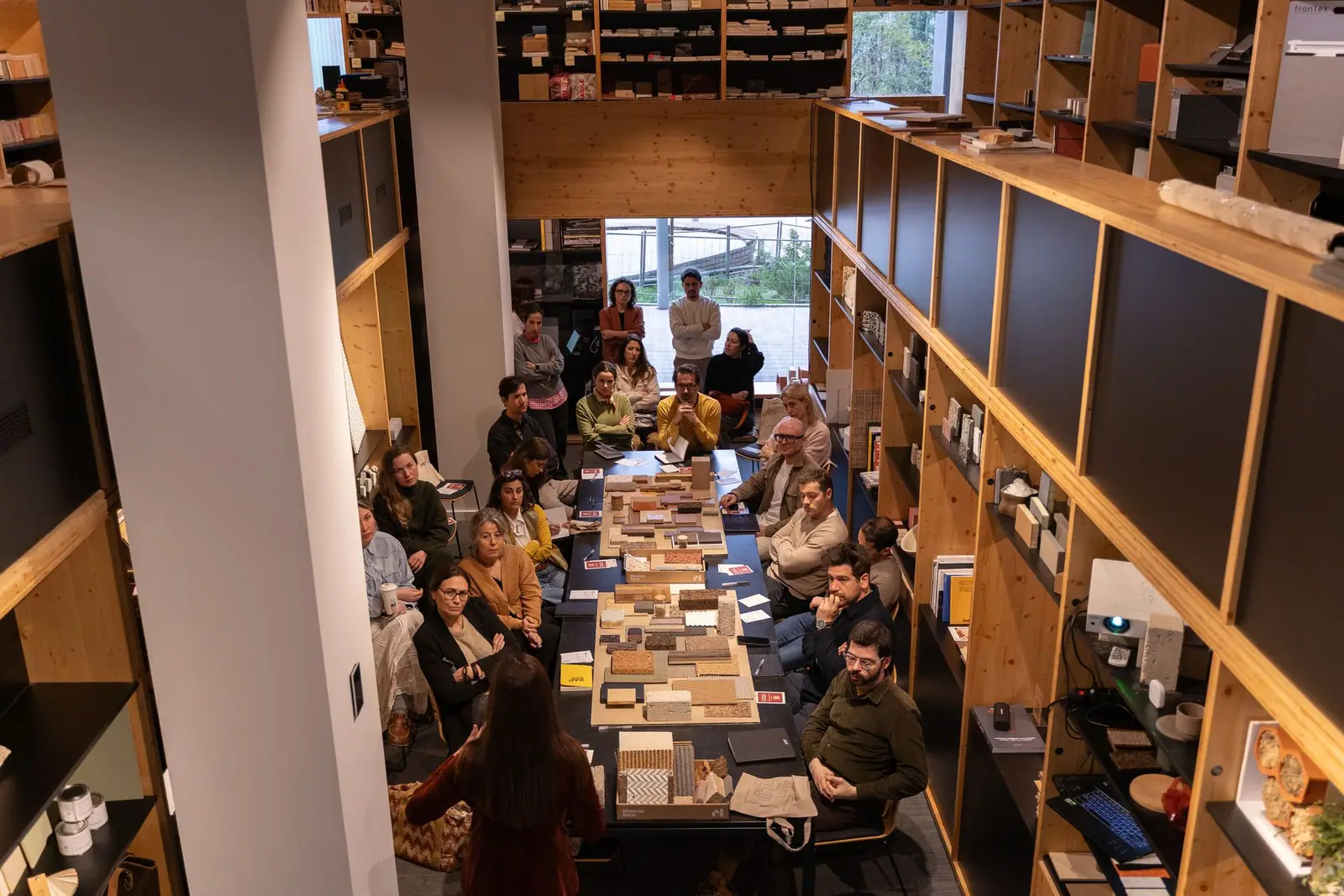
At MATTER SESSION 07: Wood and natural fibres, we devoted a training and inspiration session to exploring the potential of wood as a material that brings value, identity and warmth to architecture and interior design projects.
As usual in our sessions, we combined specialist knowledge with real samples. We talked about the material's behaviour, its technical characteristics and everything it contributes in terms of wellbeing, efficiency and material narrative, in addition to its aesthetic qualities.
The session was led by Jorge Latorre, of Matter's consultancy team, and Andrea Pozzobon, of Mardegan Legno. In this article we cover both parts —the myths, properties and new materialities of wood, and Mardegan Legno's parquet— together with the technical data worth having to hand when specifying wood.
Myths about wood and what the technical data say
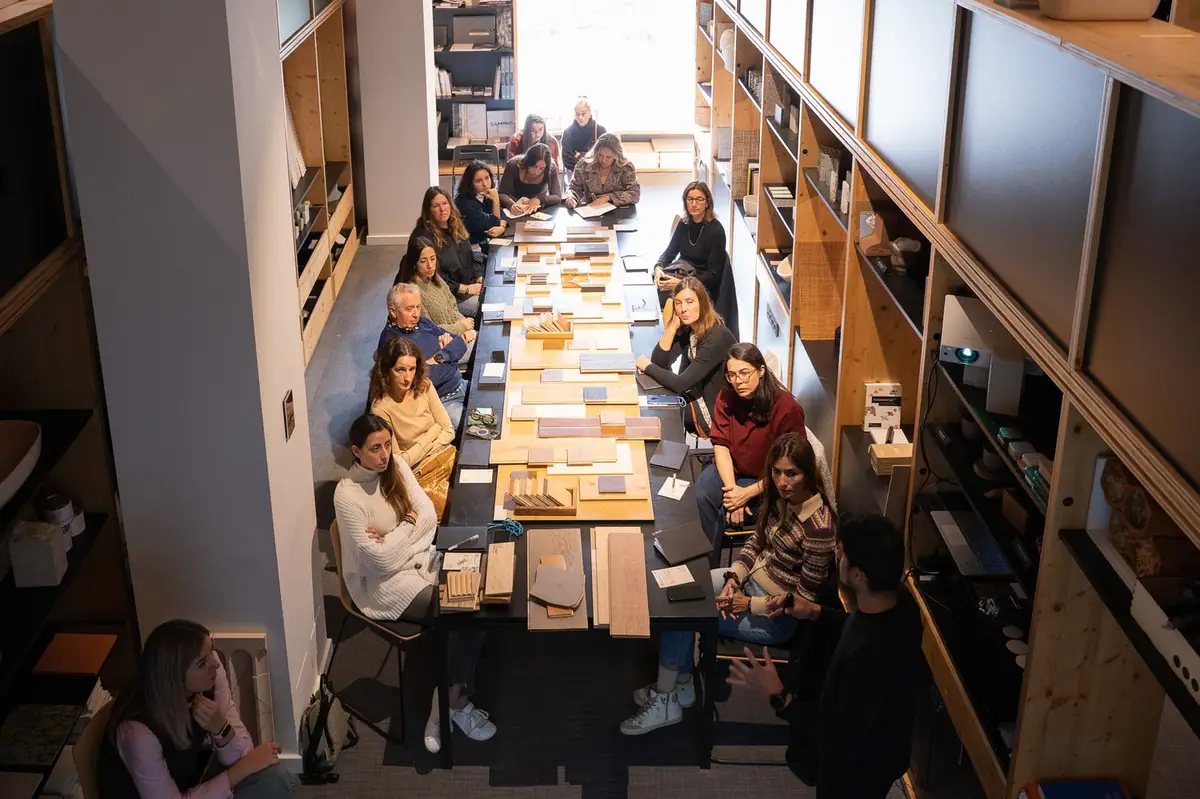
The session began with a technical presentation by Jorge Latorre, of Matter's consultancy department, who reviewed the myths that persist around wood in architecture and design. Through examples, images and physical samples, we dismantled misconceptions such as “it isn't sustainable”, “it rots quickly”, “it burns easily”, “it isn't strong”, “it requires too much maintenance” or “it's too expensive”.
The technical reality shows that contemporary wood, correctly selected and treated, is a high-performance material with enormous creative possibilities. For several of those myths, the regulations give a specific answer:
In a fire, solid wood from dense hardwoods such as oak chars at around 0.55 mm per minute according to the Spanish Building Code (CTE): after 30 minutes of fire, the affected layer is about 16 mm deep and the rest of the section keeps working. Outdoors, durability is achieved by choosing a species with sufficient natural durability for its use class, applying a treatment or using modified woods, together with good construction detailing that prevents water from collecting.
Wood as a material for comfort
Following this introduction, we looked at its value as a material for comfort. Wood is warm to the touch, helps to stabilise the indoor microclimate and, when well arranged, contributes to environmental quality by reducing reverberation and conveying a sense of wellbeing that is difficult to replicate with synthetic materials.
Its performance is worth defining precisely. Thermally, wood conducts heat far less than other building materials: between 0.13 and 0.29 W/m·K depending on its density, compared with 2.5 W/m·K for reinforced concrete or 50 W/m·K for steel, according to the CTE Catalogue of Construction Elements. Even so, it does not replace insulation, which is below 0.05 W/m·K. Acoustically, wood surfaces —especially slatted or perforated panels— help to control a room's reverberation, while sound insulation between rooms depends on the complete construction system.
Parquet: aesthetics and technology
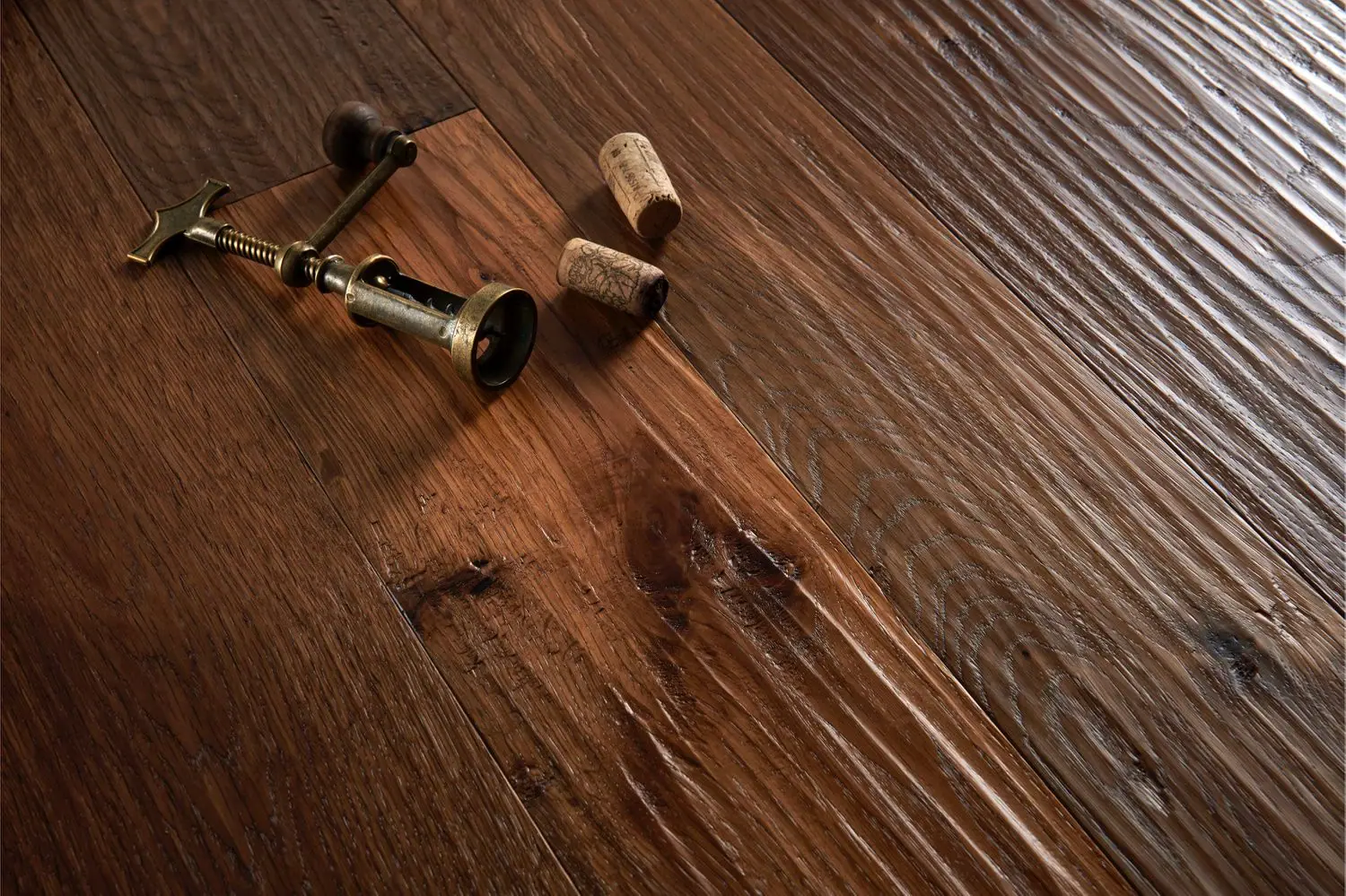
We also discussed parquet as a surface that combines aesthetics and technology. Beyond its appearance, wood introduces sensory and tactile nuances that enrich the spatial experience. Today's manufacturing and finishing systems guarantee dimensional stability and durability, making parquet a reliable option even in demanding projects.
When specifying it, the first decision is the type of element. Solid parquet is wood throughout its thickness (UNE-EN 13226); multilayer parquet combines a hardwood wear layer with a multi-layer backing (UNE-EN 13489), a construction that reduces the wood's movement and allows longer, wider boards. The second is the finish: varnish protects more and needs less maintenance, while oil gives a more matt, natural look and allows localised repairs.
New materialities in wood and plant fibres
An overview of innovative materials that make it possible to work with wood in contemporary registers, more technical or more expressive, depending on the project.
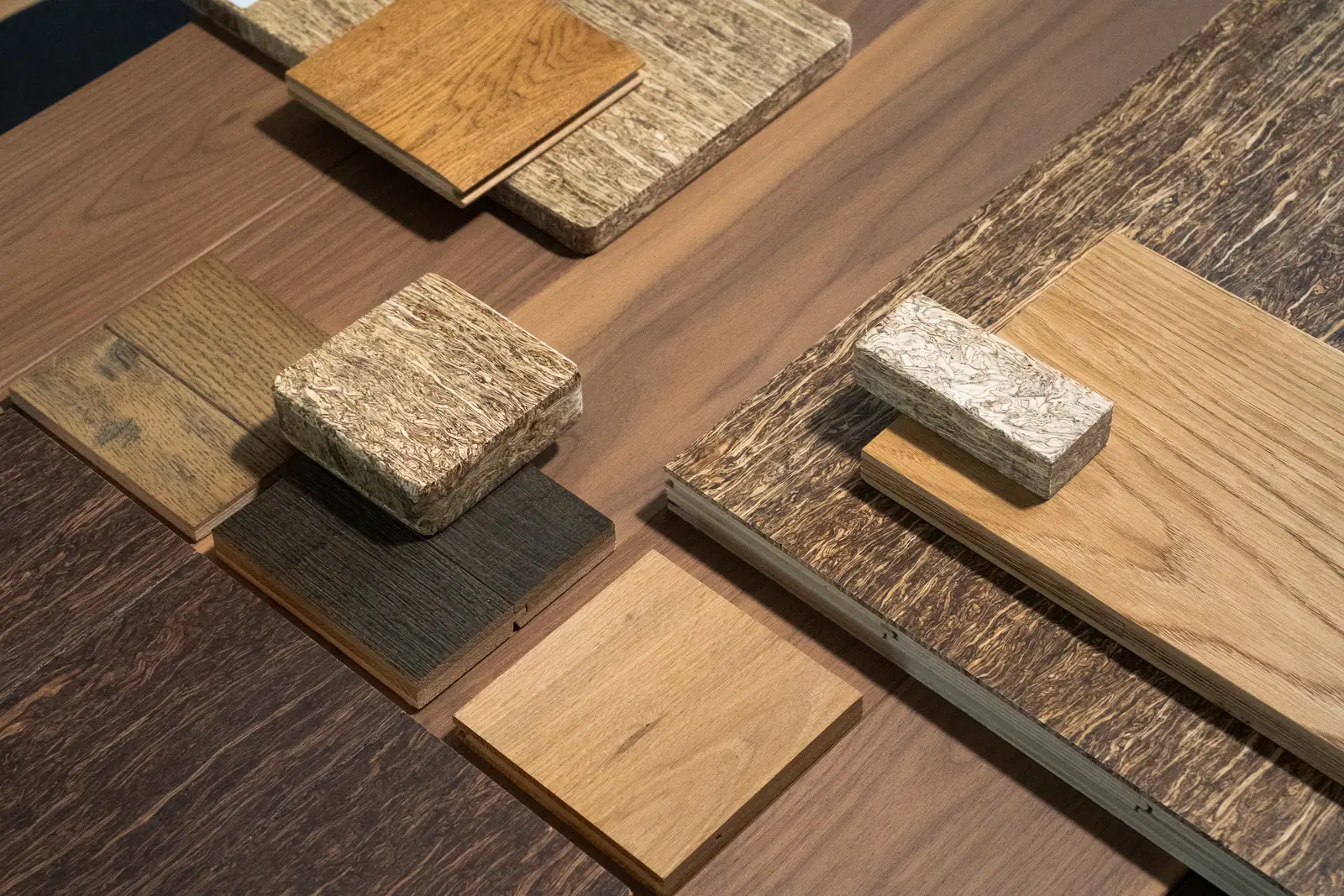
To close the first part, we explored new material expressions that broaden the contemporary language of wood and plant fibres:
- Heat-treated wood: modified at high temperature in the presence of steam and without added chemicals, it gains dimensional stability and, in the more intense classes, durability for outdoor use.
- Charred wood: the surface is burnt in a controlled way, a technique of Japanese origin known as yakisugi, giving a black, textured finish.
- Reclaimed or recycled woods: pieces from demolitions or other uses that keep the patina of time and extend the material's life.
- Chip and fibre composites: boards and claddings made from wood chips or hemp fibres, with strongly marked textures.
- Bamboo and spalted woods: bamboo, botanically a grass, is processed into boards and panels; spalted wood owes its dark veining to the action of fungi.
All these variants make it possible to work across a very wide spectrum of aesthetics and performance, while remaining consistent with sustainability criteria and offering solutions that respond to the current needs of design.
Mardegan Legno: signature surfaces
Multilayer parquet, from the log to the handmade finish.
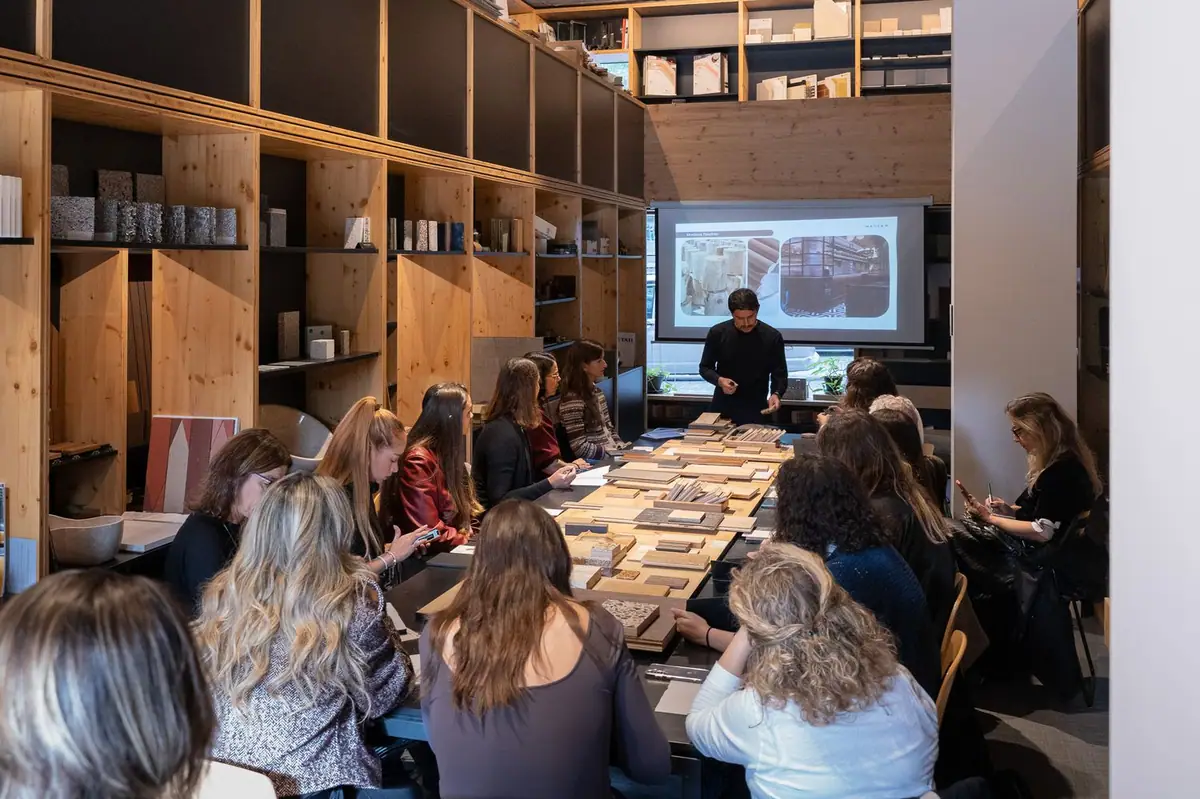
The second part of the session was devoted to Mardegan Legno, presented by Andrea Pozzobon. We looked at the solutions the brand offers and its main point of difference in the market: control over the entire production process —from the selection of the log to the final finish— and manufacturing that combines industrial precision with a level of craftsmanship that is hard to replicate.
Mardegan Legno manufactures in Barcs (Hungary), close to the forests of Slavonian oak, its main raw material, in a 70,000 m² plant. There the logs are debarked, cut into lamellas and dried in kilns fuelled by the offcuts themselves; then come the surface work, colour, finish and quality control. Its floors are multilayer parquet in accordance with UNE-EN 13489 and EN 14342, and the company holds ISO 9001 and ISO 14001 certification, according to the manufacturer.
The stability of their floors is one of their main strengths: they work with extended drying times, a robust technical backing and joining systems that ensure the boards, even in very large formats, perform well over the years. We also highlighted the quality of their finishes: bespoke pigments, a wide palette of hand-applied tones and the possibility of developing specific colours and textures for each project.
All of this translates into a floor with a refined aesthetic, long durability and a level of customisation that allows architects and interior designers to work with wood in a more creative and controlled way.

What we took away from the session
- Myths have a technical answer: fire behaviour, durability and carbon footprint can be quantified with the regulations and each product's data sheets.
- Comfort, with nuances: wood conducts little heat and improves a room's acoustics, but it does not replace thermal or acoustic insulation.
- Parquet is specified layer by layer: solid or multilayer, species, finish and site conditions determine its stability and maintenance.
- Beyond the board: heat-treated, charred or reclaimed wood and plant fibres broaden the range of textures and performance.
Frequently asked questions
- Is wood a good thermal insulator?
- It conducts heat far less than concrete or steel —between 0.13 and 0.29 W/m·K depending on its density—, which is why it feels warm to the touch. But it is not an insulating material: common insulation materials are below 0.05 W/m·K.
- How does wood behave in a fire?
- It burns, but it chars at a known rate —0.55 to 0.80 mm per minute depending on the type of wood, according to the CTE— and the charred layer protects the inside of the member. That is why its fire resistance can be calculated and, if needed, increased with a larger section or with protection.
- Solid or multilayer parquet?
- Solid parquet is wood throughout its thickness and can be sanded more times over its life. Multilayer, with a wear layer on a multi-layer backing, is more stable against changes in humidity, allows longer and wider boards and can be glued down or floated.
- Can wood be used outdoors?
- Yes, with a species of sufficient natural durability for its use class, with a protective treatment or with modified wood, such as heat-treated wood. Construction detailing matters as much as the species: water must not be allowed to remain trapped in the wood.
Thank you for being part of the session
Once again, we held a training session aligned with Matter's mission: to offer design and architecture professionals the best tools, not only in terms of materials but also in all those areas that are key to the running and growth of a studio. Thank you to everyone who took part in this session. We continue to drive knowledge and innovation in the sector to create more and better projects.
Stay tuned for our upcoming Matter Sessions and book your visit to Matter to discover our Materials Library and talk about the wood and natural fibres for your next project.