Tessieri: the craftsmanship of Italian cementine and graniglia
Double-layer cementine and graniglie handmade in Lucca since 1902: Tessieri's process, formats, colours, installation and collections.
Products8 min read
At a time when many finishing materials are produced industrially, some manufacturers continue to work from tradition to preserve techniques that bring a material richness that is hard to replicate. Such is the case of Tessieri, an Italian manufacturer specialising in the handcrafted production of cementine and graniglie, two types of cement tile that have been part of Mediterranean architecture for over a century. The Premiata Fabbrica di Mattonelle A. Tessieri & C. has been making them by hand in Lucca since 1902.
In this article we explain how a double-layer tile is made, what sets a cementina apart from a graniglia, which formats and colours the factory offers and what to plan for to install them properly. We then look at its decorative collections and some projects, and at how to see the Tessieri samples we have at Matter.
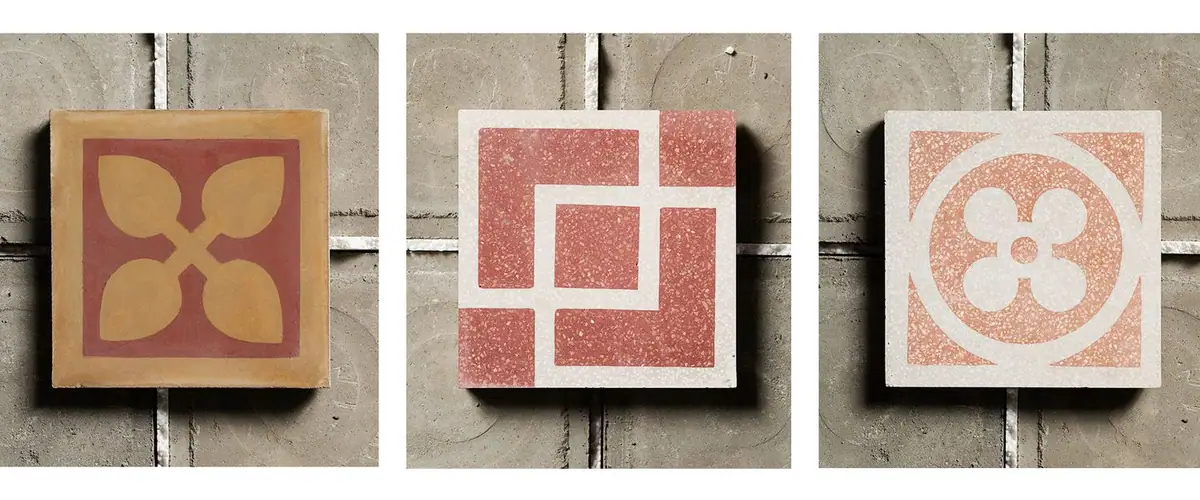
A craft factory in Lucca since 1902
Tessieri was founded in 1902 in Lucca, Tuscany, and from the outset specialised in tiles decorated with floral and geometric motifs inspired by Art Nouveau. To reproduce them it created more than three hundred original moulds, which the factory still keeps and uses. Its early work was recognised with a gold medal at the Esposizione del Lavoro e dell'Industria in Rome (1908), a medal from the La Spezia Chamber of Commerce at the international exhibition in Genoa (1912) and another gold medal at the provincial exhibition in Lucca (1924).
Thanks to these historic moulds, the factory often works with public bodies and restorers to bring old floors back to life. According to the specialist press, in 2018 the company began a relaunch with new partners and the art direction of the StorageMilano studio, which reinterprets its decorative repertoire in a contemporary key. In 2025 it presented the Concreta installation at the Milan FuoriSalone and took part in Marmomac in Verona.
A handcrafted process that brings uniqueness
Each piece is made individually through a manual process involving mineral pigments, cement, marble powder and moulds specific to each design. The preparation of the mixes, the pouring of the colours and the curing follow traditional techniques, producing pieces with the slight variations and nuances characteristic of handcrafted manufacturing.
The manufacturer describes the making of a decorated tile as follows: a metal frame (the 'corona') sets the shape and size of the piece; a metal divider that draws the motif is placed inside it, and the cement paste of each colour is poured by hand into its compartment. The divider is removed, the second layer of cement and sand is added, and the tile is pressed, released from the mould and left to cure. The colours are prepared in the factory by adding oxides to the cement following old formulas, starting from the primary colours, so they can be adjusted to each project.
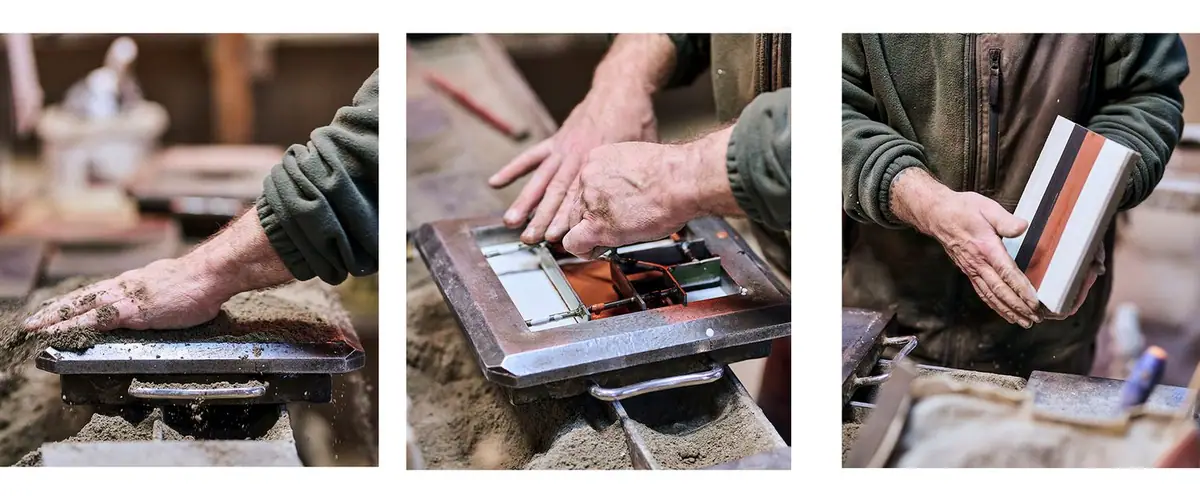
A double-layer tile
Both Tessieri cementine and graniglie are double-layer tiles. According to the manufacturer, these are their characteristics:
- Wearing layer: cement, marble powder and pigments; in graniglia, fragments of marble and other stones are added. It is smooth and carries the colour and the pattern.
- Backing layer: washed river sand and cement, with a rough face that improves adhesive bond.
- Thickness: around 2.2 cm in total; the two layers are of similar thickness, about 1 cm each.
- Through-body colour: the colour runs through the whole wearing layer, so it does not depend on a surface glaze and withstands foot traffic.
- Finish: matt.
Tessieri samples at Matter
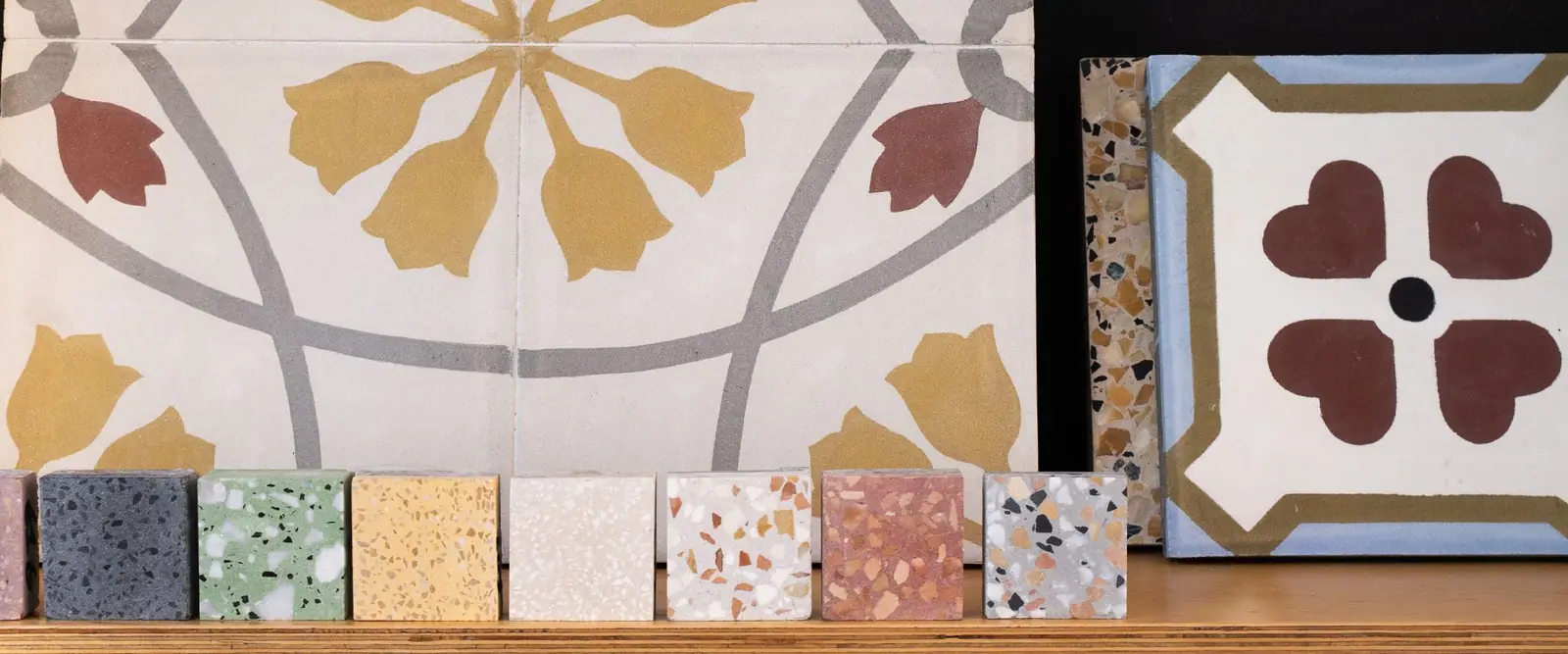
At the Matter material library we have a selection of Tessieri samples that let you appreciate up close the quality of the material, the intensity of the pigments and the precision of the designs. The factory works with three product families: cementine, graniglie and larger graniglia slabs.
The classic format is the 20×20 cm square, plain or decorated, which can be laid straight or diagonally. It is often paired with the 10×20 cm listello, decorated only, which acts as a border around the central field, with 10×10 cm corner pieces so the band runs without interruption. The 20 cm octagon is combined with an 8×8 cm square insert, both in plain cementina.
Cementine
Cement paste and marble powder, with a smooth surface and crisp colour.
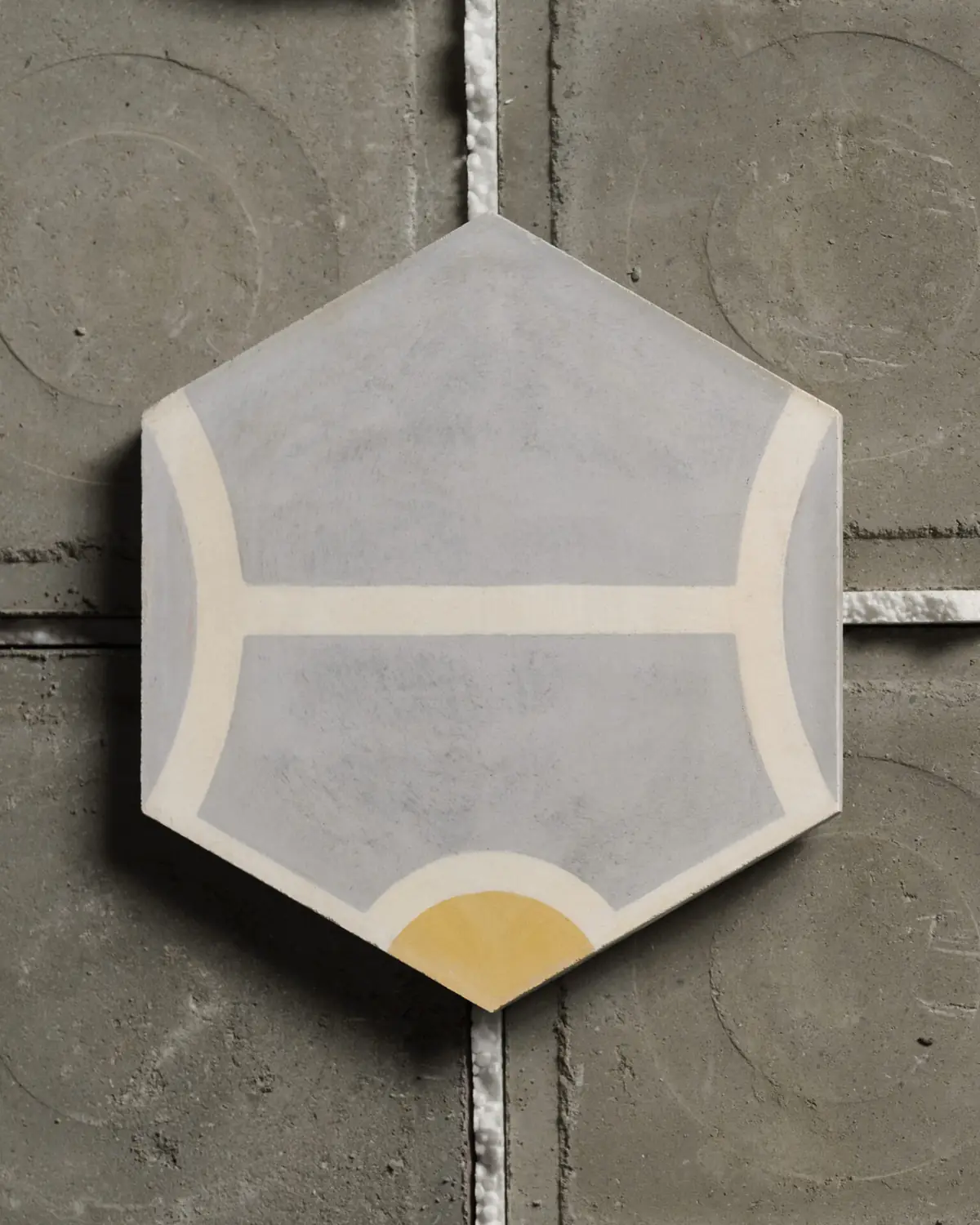
Made using a traditional double-layer system, cementine combine cement, marble powder and pigments to create surfaces with a matt finish and great chromatic depth. They are the Italian counterpart of what is known in Spain as baldosa hidráulica, the encaustic cement tile. Tessieri makes them in square, rectangular, hexagonal and octagonal shapes, plain or decorated, and the palette runs to 41 colours, from whites such as Bianco Neve, Bianco Sporco and Bianco Santo Spirito to greys, greens, blues, ochres and reds.
The hexagon, in 20, 21.5 and 25 cm, is made only as a cementina. It is a very old format, usually laid without a border: combining hexagons in different colours makes it possible to compose a decorated floor with simple means, and the factory also offers hexagons with a three-dimensional pattern that create an optical relief effect.
Graniglie
Marble and stone fragments in a coloured cement base: the Italian 'marmetta'.
Graniglie, also known as marmette, are characterised by grains of marble and other stones of different colours and sizes, bound together by a coloured cement paste. The result is surfaces reminiscent of traditional terrazzo, but with a handcrafted production that gives each piece its own uniqueness. Although they look more stone-like, the manufacturer points out that there is no substantial difference in strength between graniglie and cementine: the difference lies in the decoration.
Tessieri produces them in 20×20 and 10×20 cm, plain or decorated, and organises its range by grain size: 26 fine-grain mixes, 20 medium-grain and 14 coarse-grain. Fine grain gives almost continuous surfaces, such as Bianco Neve or Blu Bardiglio; coarse grain gives mixes with a strong presence, such as Giallo Carrara or Nero Ghiaia.
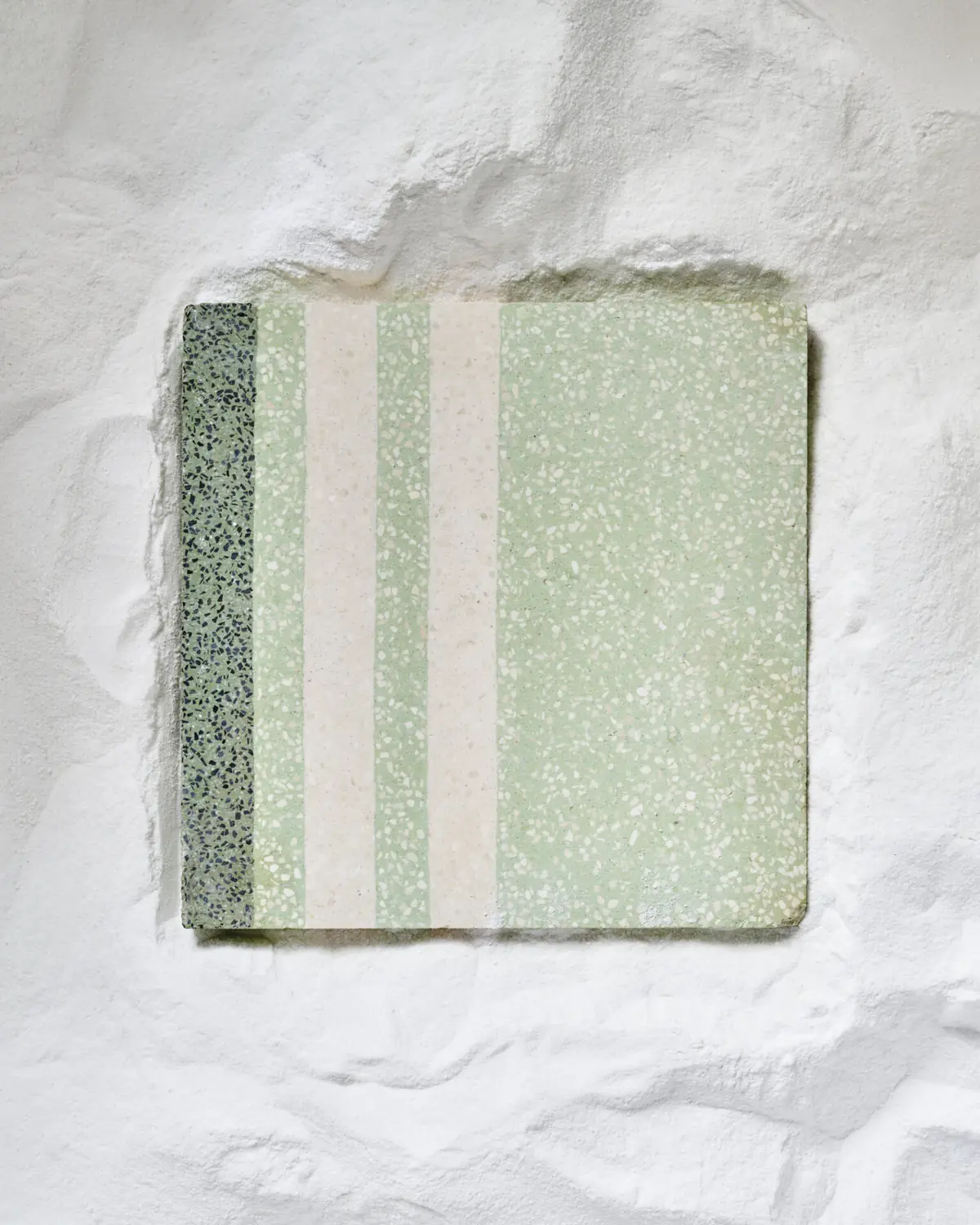
Lastre: graniglia in large format
Alongside its tiles, Tessieri makes solid graniglia slabs (lastre) reinforced with glass fibre. They come in 115×40 cm as well as 80×40, 60×40 and 40×40 cm, in every graniglia colour mix. According to the manufacturer, the reinforcement makes handling and installation easier in complex situations and allows graniglia to be treated as a continuous surface, for both high-end residential and contract projects.
Decorative designs and historical motifs
A significant part of the Tessieri catalogue revives designs inspired by historical motifs and decorative patterns that have been part of Italian architecture for generations. Geometries, floral compositions and ornamental drawings sit alongside more refined, contemporary proposals. The factory organises them into five collections:
- Liberty: floral motifs and curves inspired by Art Nouveau, made with the factory's historic moulds.
- Geometriche: lines, symmetries and modules that repeat to form decorative rugs or continuous rhythms.
- Astratte: free, irregular compositions that create dynamic surfaces.
- Tinta unita: single-colour pieces, the basis for understated and chequerboard floors.
- Cornici: borders, bands and linear pieces to frame the central field of a floor.
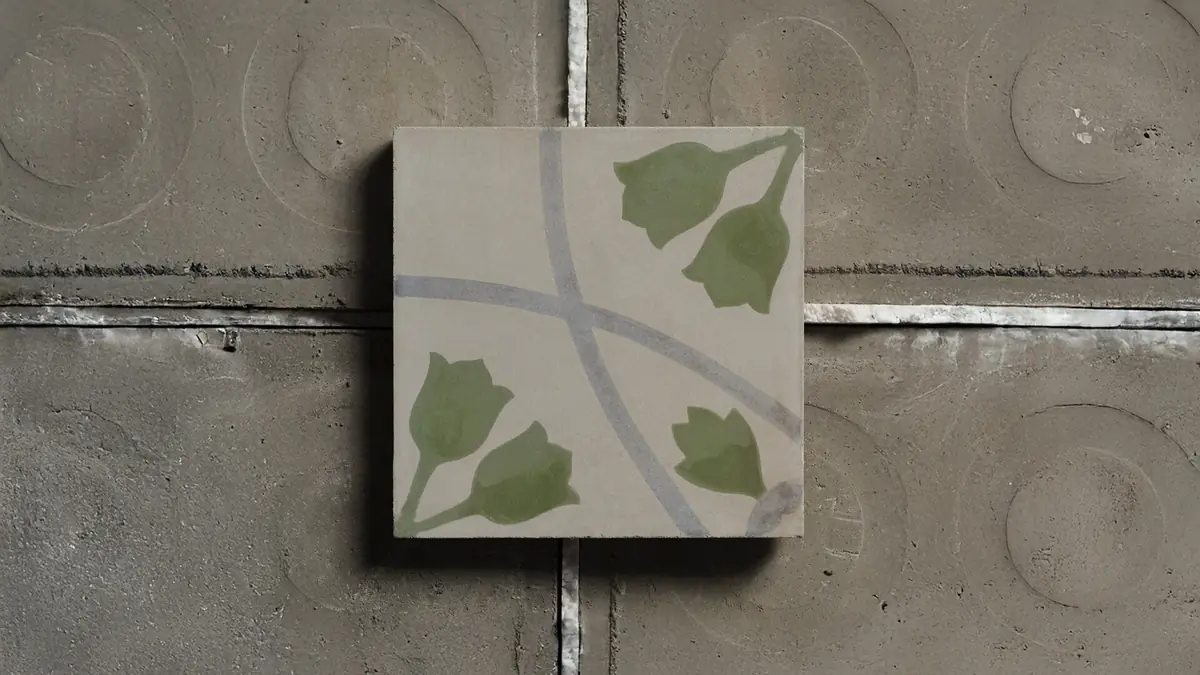
Designing the floor: band, border and field
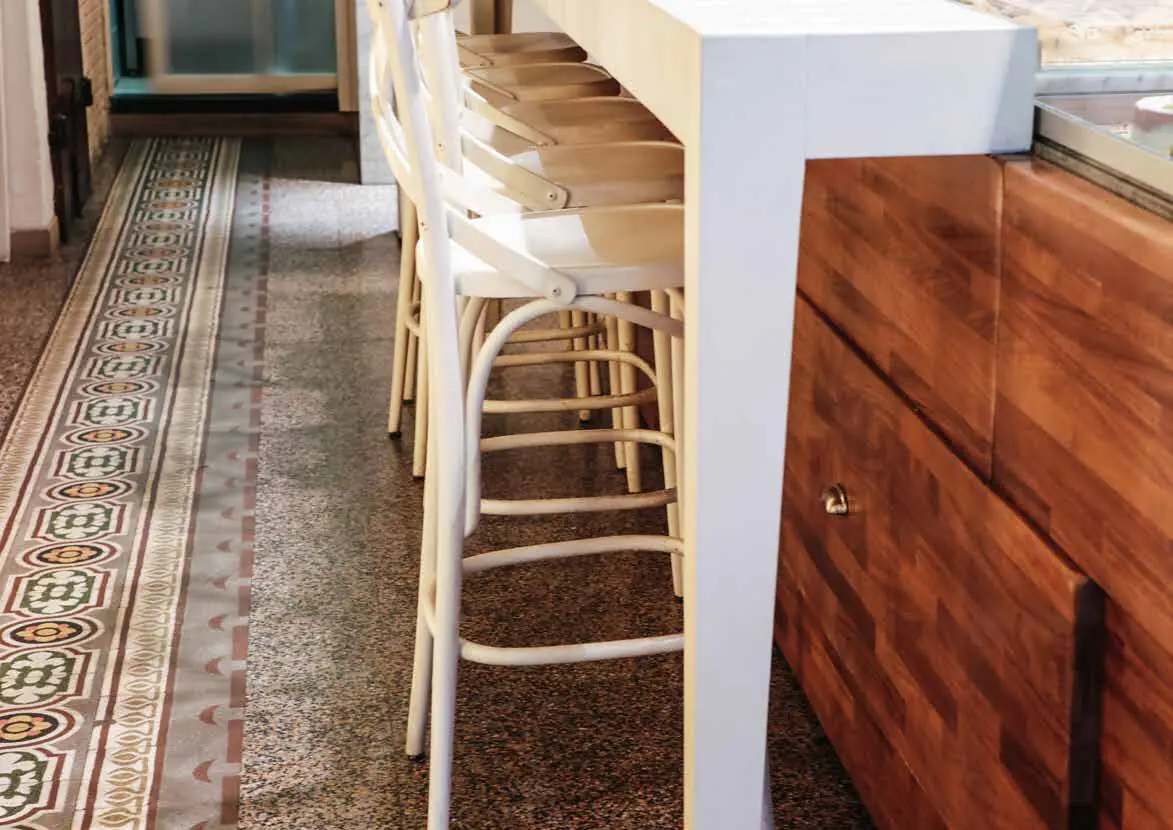
For Tessieri, a well-designed floor depends on the relationship between its three components: the outer band, the border and the inner field. The choice of pattern takes into account the period of the building, the size of the room and its use. With 10×20 cm listelli and 20×20 cm decorated tiles, bands of up to 60 cm can be formed, common in the reception rooms of hotels and villas. The factory offers technical and artistic support to compose the floor and still uses its 1927 'Album dei Pavimenti' as a catalogue.
Where they have been installed
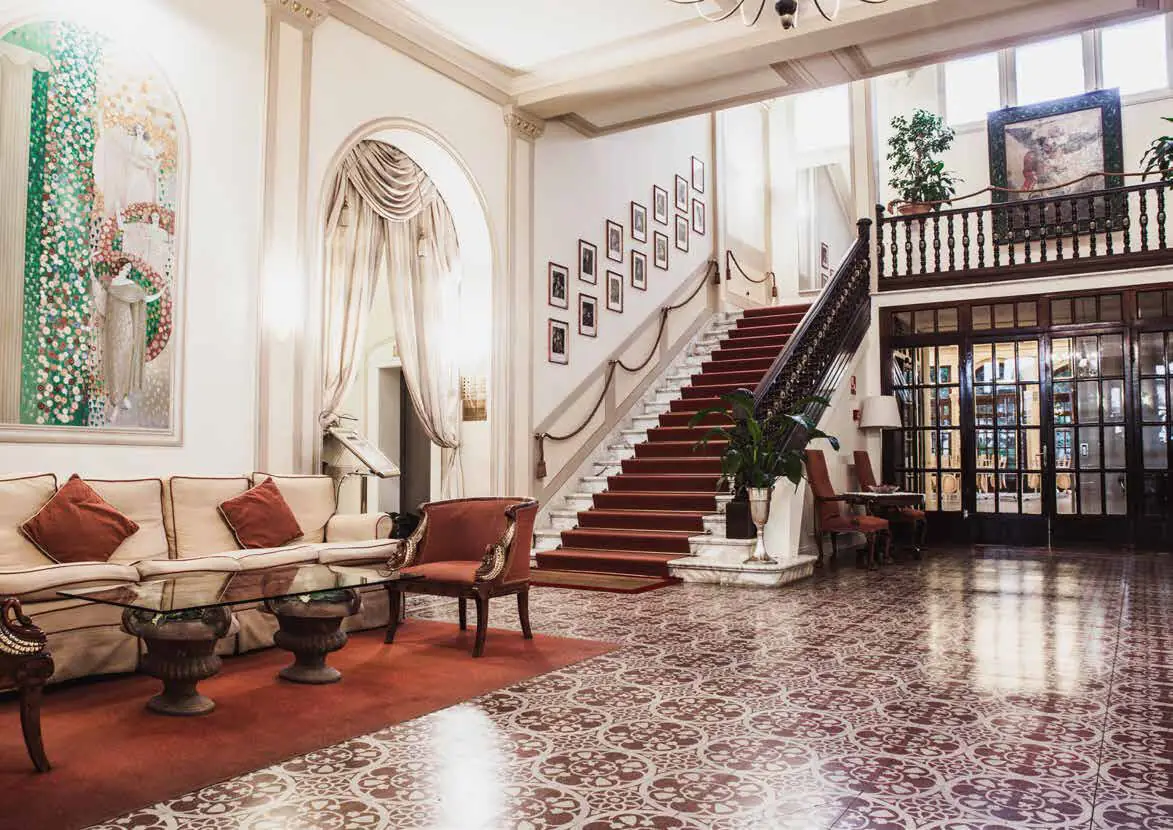
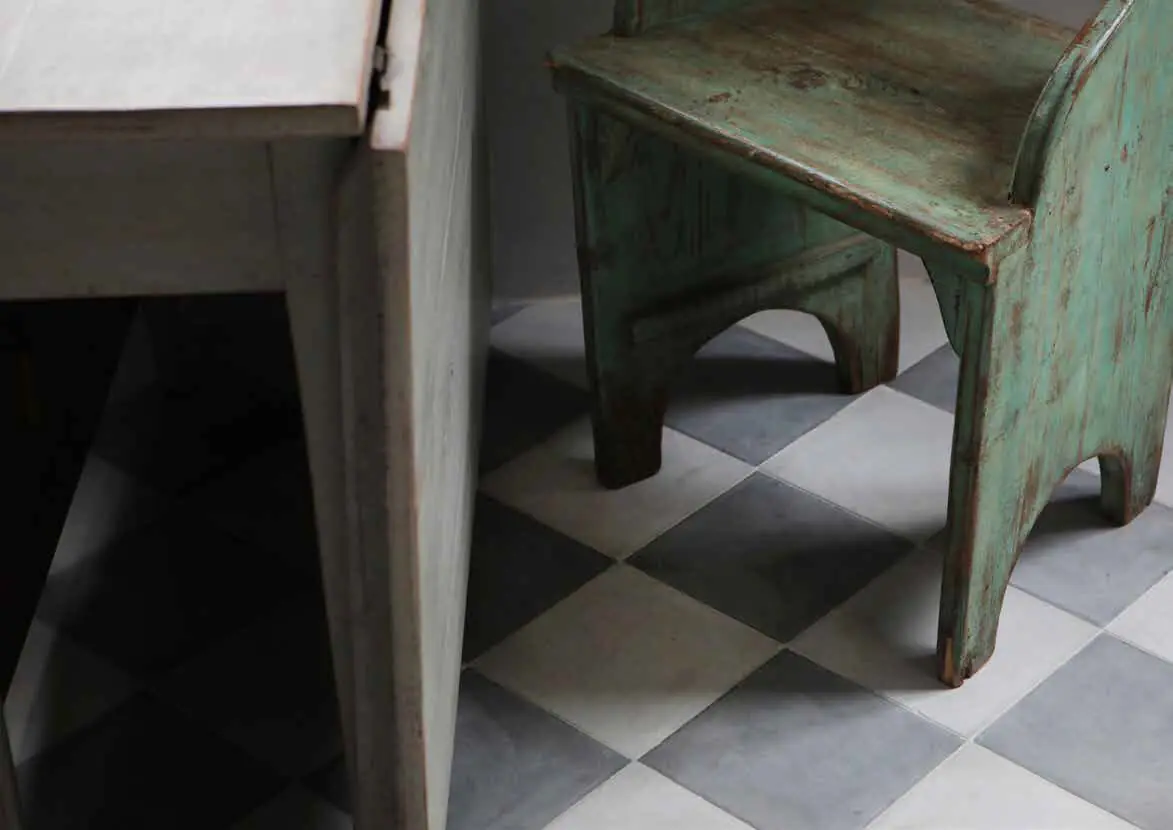
The projects published by the factory show the range of uses, from retail to housing. In the reception of a historic seafront hotel in Viareggio, decorated 20×20 cm graniglie whose pattern is completed across four tiles provide a backdrop for a very large space. In a pastry shop in Lucca, a border of three listelli frames a field of medium-grain graniglia, and in a home and studio in the same city a chequerboard of white and grey cementine organises a large living room.
Specification and installation essentials
Cementine and graniglie are fixed with adhesive, like a ceramic tile, but a few points should be planned from the design stage. These are the manufacturer's recommendations:
- Substrate: any flat, dry base. It is good practice to apply a water-repellent treatment to the screed before laying.
- Dry lay: set the tiles out dry before fixing to group those with a similar appearance, as is natural for a handmade product.
- Adhesive: standard white adhesive, spread on the screed and also on the back of each tile (back-buttering).
- Joints: about 1 mm, filled with cement grout. Tessieri offers its own coloured jointing cement, the same used to make the tiles.
- Walls and wet areas: the unseen edges are not finished, so on walls the top edge is finished with a metal profile. In very humid rooms, the tile is treated with a water repellent after laying.
Once laid, the manufacturer recommends that the floor be treated by a specialist firm: it is grouted with cement grout, washed with a water-based detergent and waxed, preferably with hard waxes microdispersed in water. Day-to-day cleaning is done with neutral pH cleaning products.
Frequently asked questions
- What is the difference between a cementina and a graniglia?
- The wearing layer. A cementina is made of cement, marble powder and pigments, with a smooth, evenly coloured surface; a graniglia adds fragments of marble and stone that remain visible. According to Tessieri, strength is practically the same: what changes is the decoration and the available formats.
- Can they be used on walls?
- Yes. They were conceived as flooring, but many architects use them to clad walls. As the edges are not finished, the manufacturer recommends finishing the top edge with a metal profile.
- Are they suitable for bathrooms and kitchens?
- Yes, with a water-repellent treatment after laying in particularly humid rooms. The manufacturer also advises applying a water repellent to the screed before installation.
- Can they be laid outdoors?
- They are designed mainly for interiors, but the manufacturer states that the through-body colour and the thickness of the wearing layer allow them to be laid outdoors too without the colour changing over time. It is worth confirming the specific use of each project with Tessieri.
- What maintenance do they need?
- After installation, an initial clean and waxing by a specialist firm. After that, regular cleaning with neutral pH products is enough.
The depth of colour of a cementina, the grain of a graniglia or the precision of a pattern made with a divider are best appreciated with the tiles in your hands. At Matter you can see a selection of Tessieri samples and discuss formats, colours and compositions for your project with our technical team.
To use them in your project, book your visit to Matter.
Book a visit