Acoustic tiles and panels by BAUX
Wood wool and cement panels, tiles and 3D Pixel designed by Form Us With Love: formats, sound absorption and key points for installation.
Products7 min read
This month we would like to introduce BAUX, the Swedish brand that designs, produces and sells functional building materials without compromising the environmental standards of the future. BAUX holds that building materials can be sustainable, functional and beautiful at the same time.
In this article we look at what its material, cement-bonded wood wool, is made of, how much sound it absorbs depending on how it is mounted, which formats its acoustic panels and tiles come in —including the three-dimensional 3D Pixel pieces— and what to bear in mind when specifying them in a project.
Wood wool, cement and water
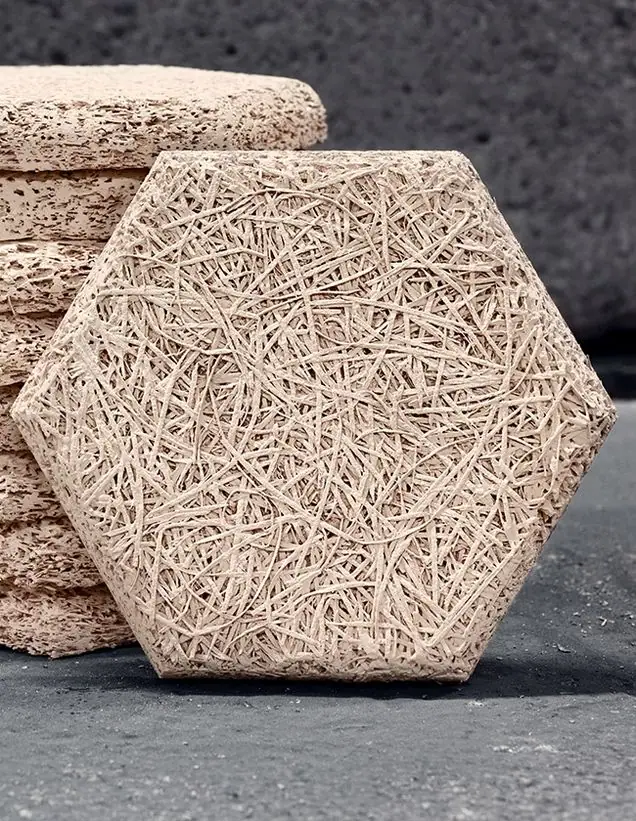
Among its materials we would like to highlight the BAUX acoustic panels and tiles, designed by the Swedish industrial design studio Form Us With Love. They are made from BAUX Acoustic Wood Wool, a wood wool that combines two of the oldest building materials in the world, wood and cement, with a third ingredient, water. The combination is simple and ingenious: the wood fibre provides insulation, thermal mass and sound absorption, while the cement acts as a binder and gives it strength, stability in the face of moisture and protection against fire.
The wood wool comes from Norway spruce from FSC- and PEFC-certified forests, and the material is produced by Träullit, a family company founded in 1946 with a factory in Österbymo, in southern Sweden. The union of these natural components gives rise to the functional properties the manufacturer attributes to its products:
- Sound absorption: the open structure of the material reduces sound reflections and is particularly effective at the frequencies of the human voice, between 500 and 4,000 Hz.
- Moisture regulation: it absorbs moisture from the air and releases it when the air dries. Its high pH inhibits mould growth, and the material does not rot.
- Heat storage: according to BAUX, it stores heat from the air and releases it when the temperature drops, which helps reduce energy consumption and maintain a stable indoor climate.
- Fire performance: Euroclass B-s1,d0 under EN 13501-1.
- Low emissions: the manufacturer's measurements show very low emissions, and the surface can be vacuum-cleaned without shedding dust or particles.
How much sound they absorb
The absorption of an acoustic lining depends as much on how it is mounted as on the material itself. BAUX publishes values for its pieces fixed directly to the wall or ceiling and with various backings. The difference is considerable: a 25 mm board glued to the substrate is a class D absorber, whereas the same board backed by a 40 mm rock wool panel reaches class A.
These values are useful for comparing solutions. To work out how many square metres a particular space needs, the manufacturer itself recommends bringing in an acoustic consultant to carry out the calculations for the project.
BAUX Acoustic Panels: seven patterns for large surfaces
1160 × 580 mm pieces designed to line entire walls and ceilings.
BAUX presented its panels at the Stockholm fair in February 2015 with five patterns, and in 2018 added Arch and Curve, two curved designs inspired by vaults and monumental architecture. The series now has seven patterns: Quilted, Check, Stripes, Lines, Diagonal, Arch and Curve. All share the same format, 1160 × 580 mm and 25 mm thick, so they can be combined with one another; Diagonal and Curve can be ordered in left- and right-hand versions.
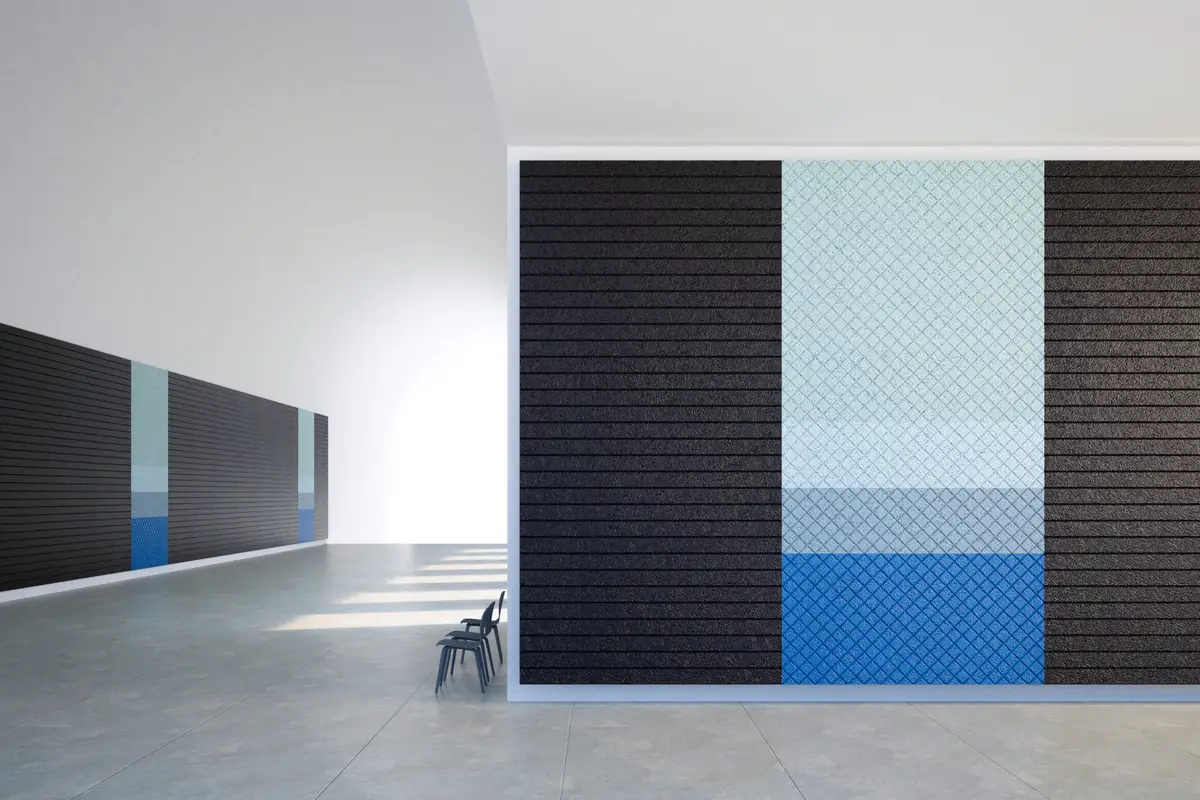
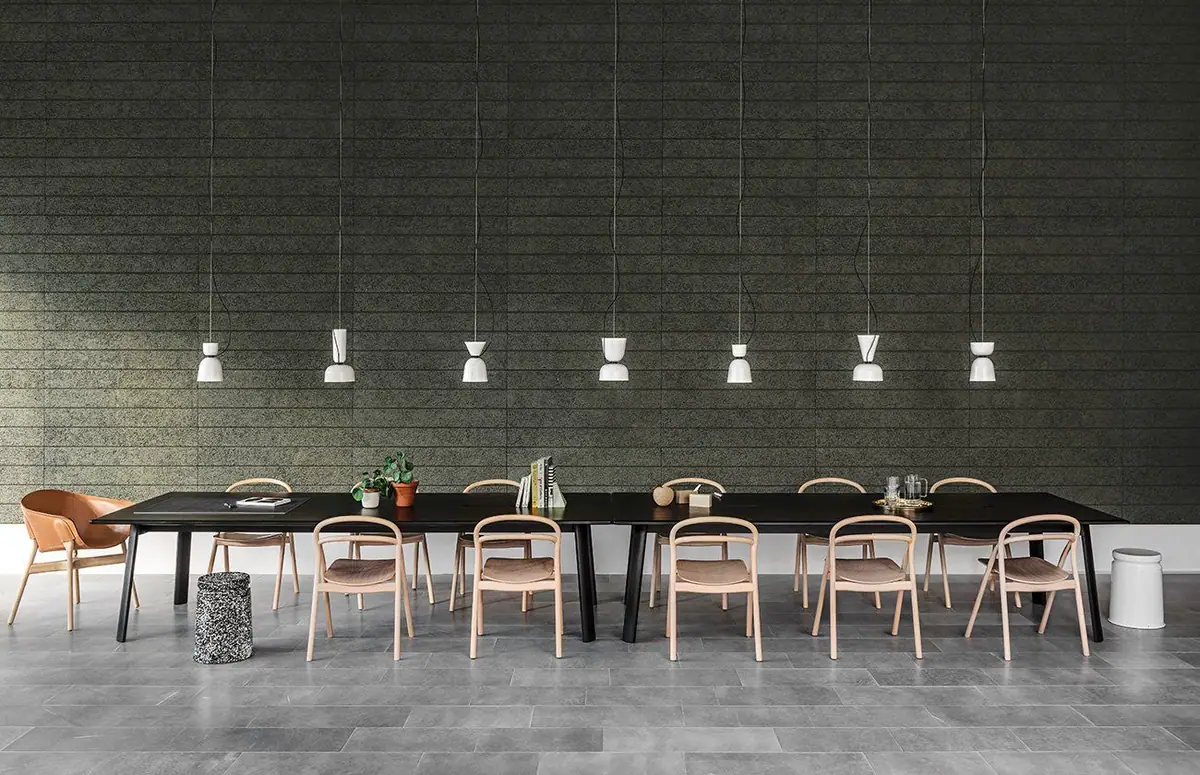
The panels come in the same five colour families as the rest of the collection —Clouds, Woods, Sky in the sea, Heat of the sun and Earth and mountain—, each with four shades, as well as the natural unpainted version. The image at the top of the article shows an example: at Hem's headquarters and showroom in Stockholm, a five-metre dark green acoustic wall divides the spaces of an open-plan floor with glass walls and polished concrete.
BAUX Acoustic Tiles: shapes for composing
Seven shapes in two sizes, plus the three-dimensional 3D Pixel pieces.
Wood wool tiles were BAUX's first product and are available in seven shapes: hexagon, rectangle, square, circle, parallelogram, triangle and Plank. Each is made in two sizes and 25 mm thick. This wide range of shapes makes it possible to customise any installation with countless patterns and, like the panels, the tiles are available in all five colour ranges.
Hexagons at the Wunggurrwil Dhurrung centre
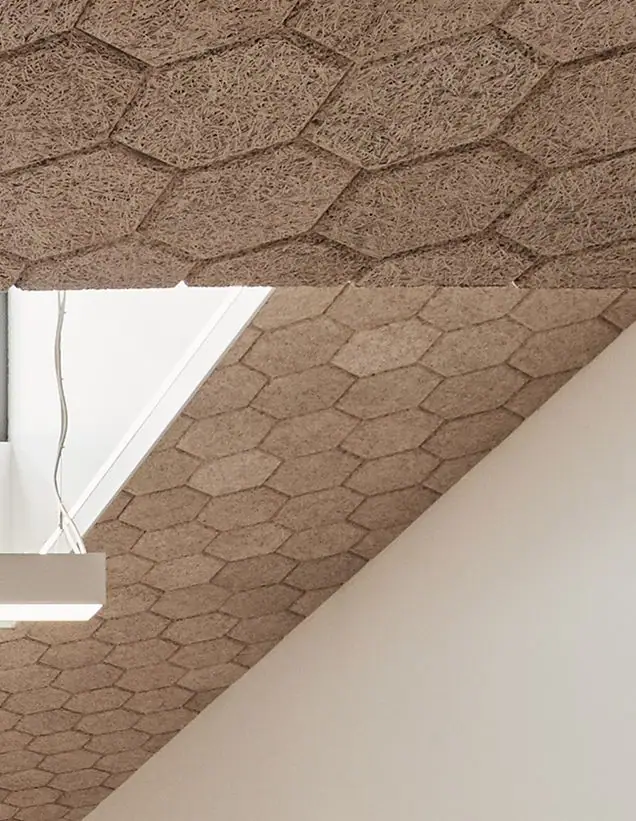
The Wunggurrwil Dhurrung community centre in Wyndham Vale (Victoria, Australia) is a good example of hexagonal tiles used on a large scale. Designed by Gregory Burgess Architects and Gresley Abas Architects, it brings together a centre run by the Koling Wada-Ngal Aboriginal committee, an integrated family centre and community spaces. Its name means ‘strong heart’ in the Wathaurung language.
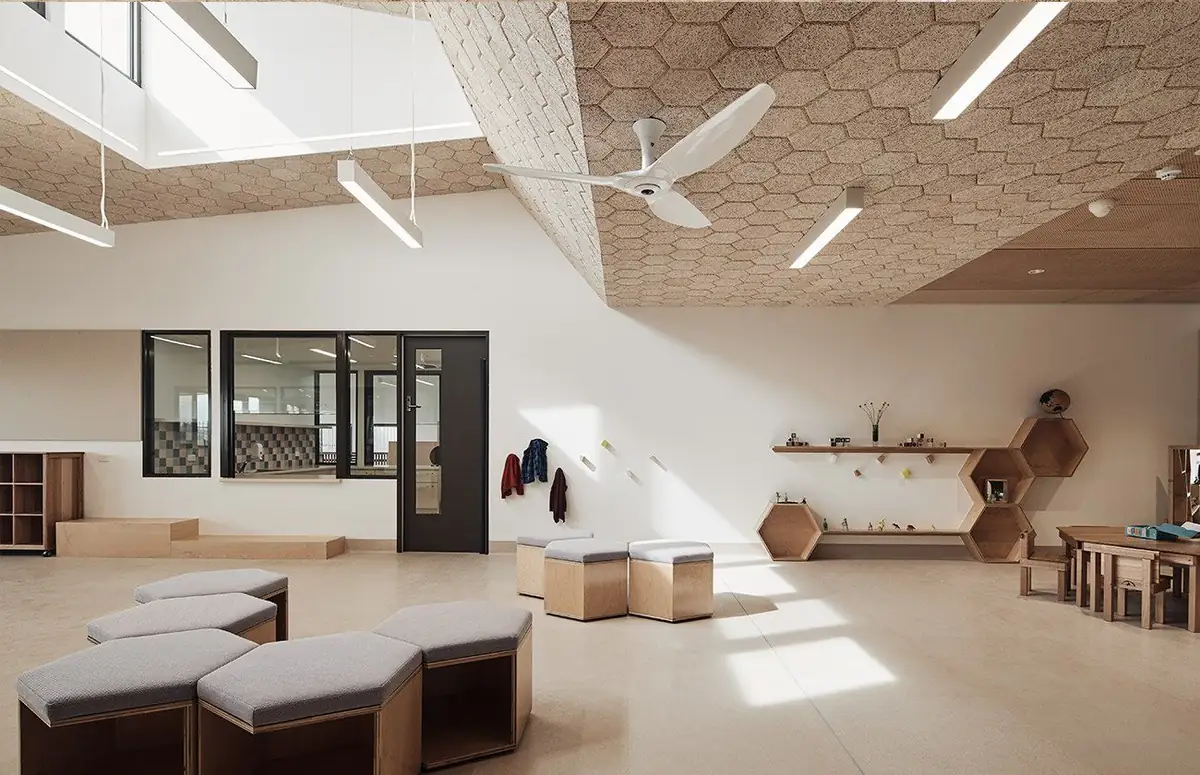
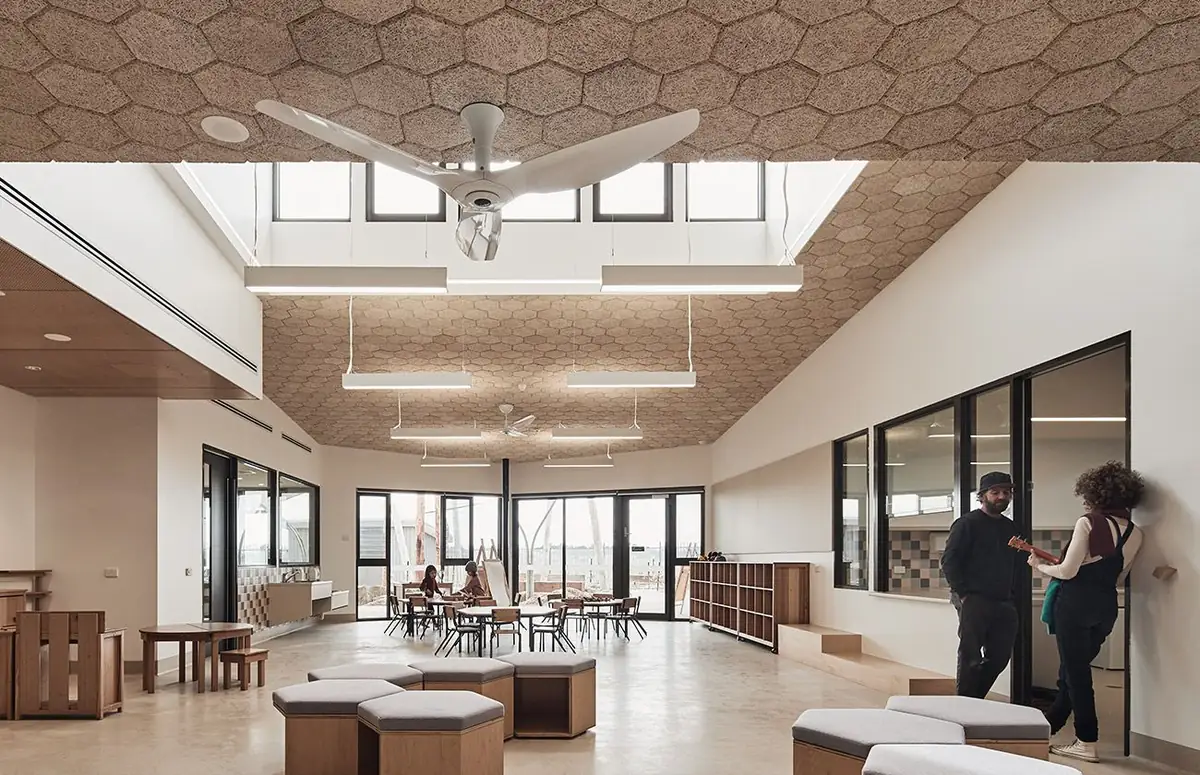
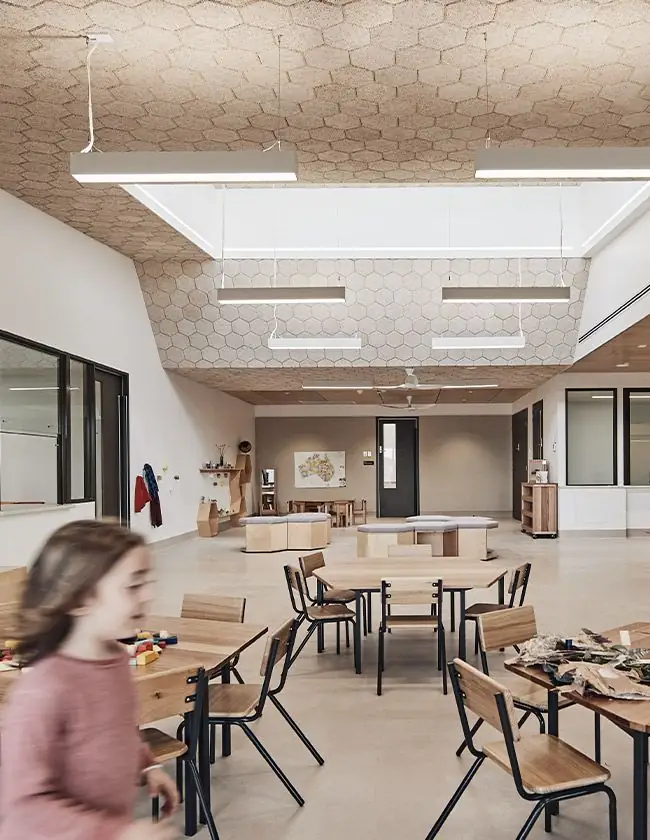
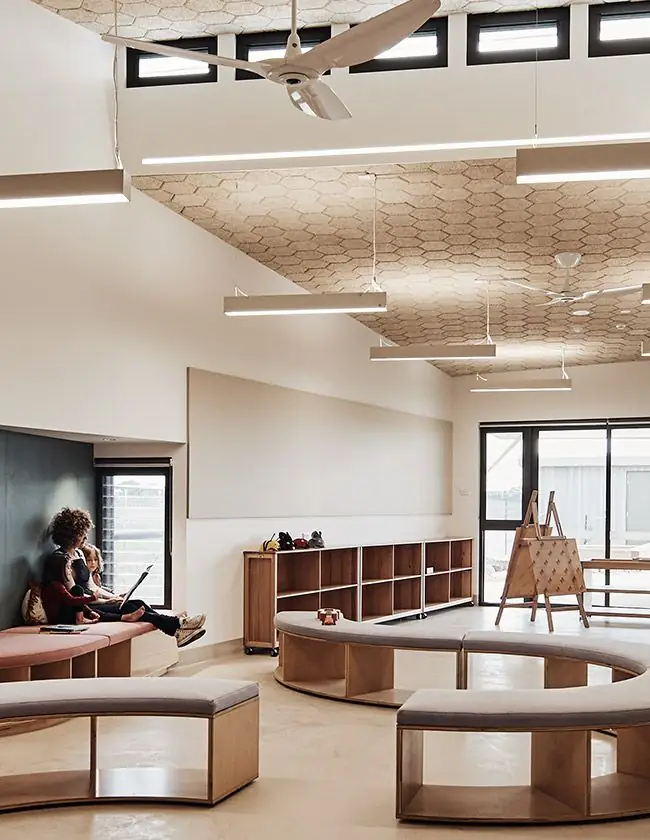
The architects chose the hexagon for the ceilings of the early-years rooms for its neutral tones, its texture and its acoustic performance, and repeated the geometry in some of the furniture. The building was designed with people on the autism spectrum in mind, so avoiding sensory overload —acoustic overload included— was a requirement of the project. According to the architects, the tiles were set out in the 3D model because of the unusual geometry of the ceilings, and were cut on site.
3D Pixel: three thicknesses to add depth
Square tiles that absorb sound and diffuse it at the same time.
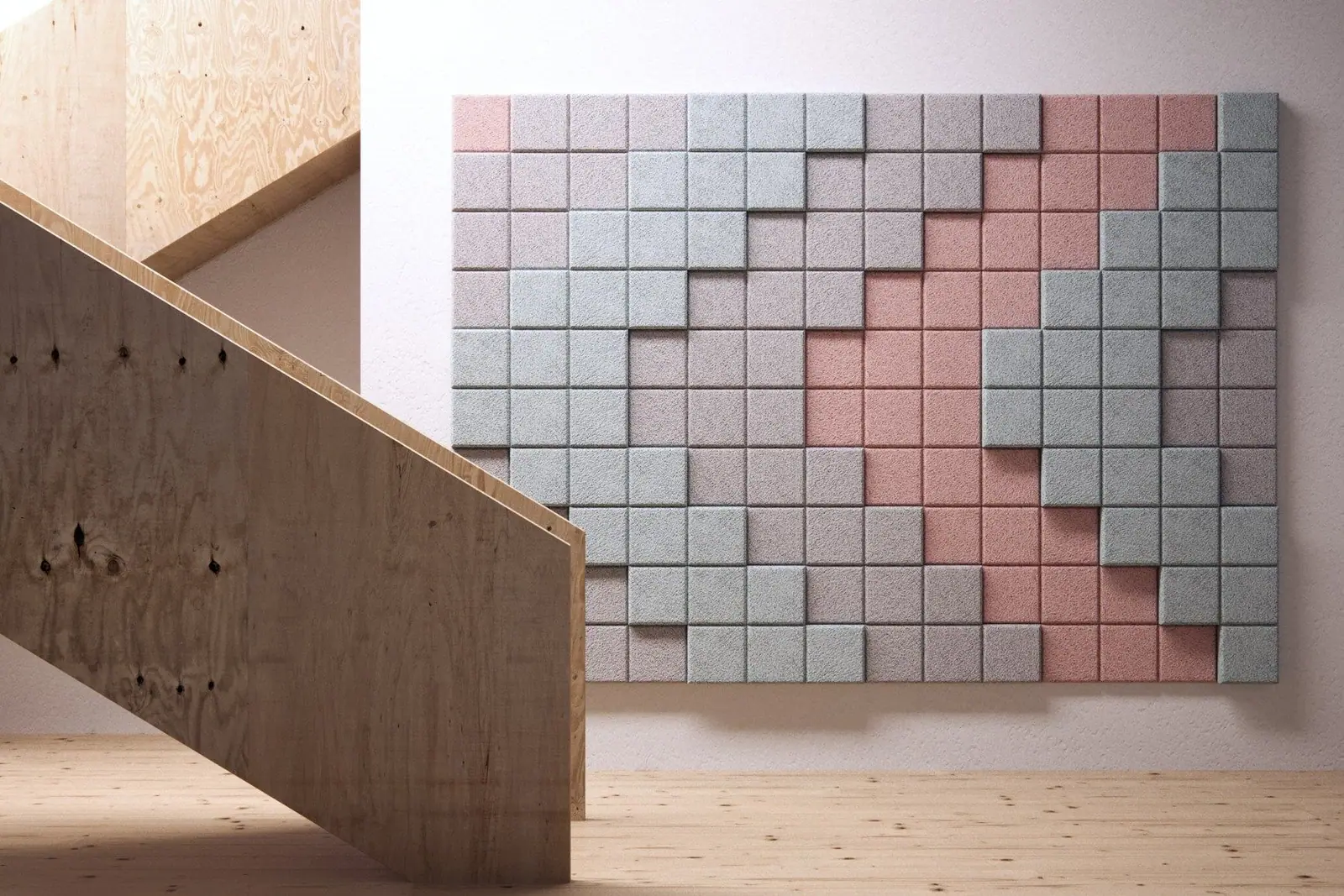
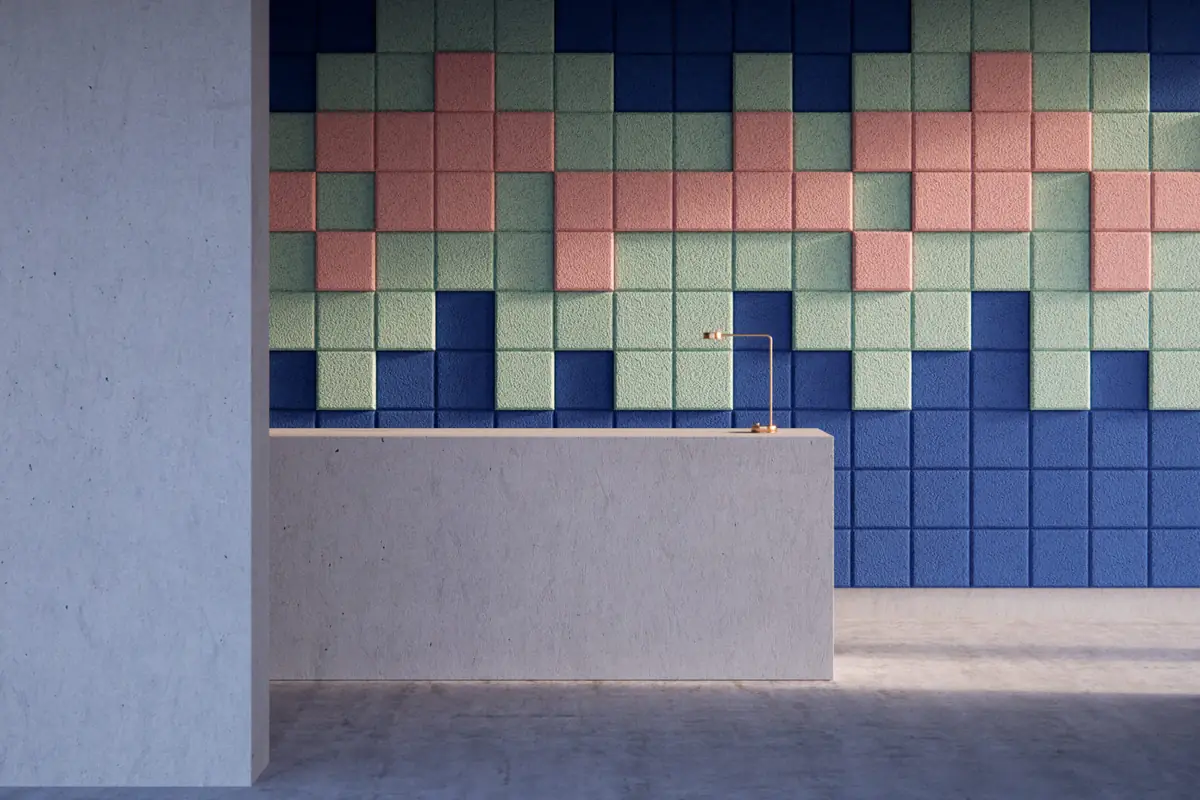
Wood Wool 3D Pixel is the addition BAUX presented to its wood wool product line at the end of 2015. These are 290 × 290 mm square tiles distinguished by their different thicknesses: 25, 50 and 70 mm. Combined, they give a sense of depth to the surfaces on which they are installed, with an aesthetic the brand associates with 8-bit graphics.
The third dimension also has an acoustic function. According to BAUX, the different depths break up sound waves as well as absorbing them, which helps in small rooms with flutter echoes and early reflections. With the three thicknesses evenly mixed, the manufacturer gives an αw of 0.50 when fixed directly to the wall, compared with 0.30 for the flat 25 mm tile.
Key points for specifying BAUX
Beyond aesthetics, these are the points to resolve at the design stage, according to the manufacturer's technical documentation:
- Absorption, not insulation: BAUX products reduce reverberation within a space, but do not stop noise passing from one room to another.
- Mounting: pieces can be glued with construction adhesive, screwed, or fixed with magnets to metal sheets or trays. On ceilings, BAUX recommends screws or suspended ceiling systems, and the 3D Pixel pieces are intended for walls.
- Cutting and touching up: pieces are cut with a hand saw or circular saw, but the colour does not run through the material, so exposed edges and screw heads are touched up with paint.
- Wet areas: the material can be used in kitchens, bathrooms and swimming pools; in showers, only on the ceiling.
- Weight and colour: a 25 mm board weighs about 11 kg/m². In addition to the catalogue colours, custom colours can be ordered with an NCS reference; below 25 m² a surcharge applies.
A Swedish brand founded in 2013
BAUX was founded in 2013 as a joint venture between the entrepreneurs Johan Ronnestam and Fredrik Franzon and the founders of Form Us With Love: Jonas Pettersson, John Löfgren and Petrus Palmér. Its first product, the wood wool tiles, was developed with Träullit, which manufactures the brand's wood wool products in Sweden. According to BAUX, its tiles and panels have been installed in more than 1,500 projects in over 30 countries.
BAUX Acoustic products are designed to meet the expectations and needs of architects and designers, with an intelligent combination of form and function. They can be used to create patterns that renew residential, industrial and public spaces and give them character.
Frequently asked questions
- Do BAUX panels insulate against noise between rooms?
- No. They are absorbers: they reduce reflections and reverberation within the space where they are installed, but are not designed to block sound passing from one room to another.
- How is class A absorption achieved?
- By placing a 40 mm rock wool panel behind the 25 mm board. According to the manufacturer, this achieves an αw of 1.00 (class A), compared with 0.30 (class D) for the board fixed directly to the substrate.
- Can they be used in bathrooms, kitchens or swimming pools?
- Yes. BAUX wood wool withstands moisture and its high pH inhibits mould growth. In showers, the manufacturer specifies that it should be installed only on the ceiling, not on the walls.
- Can other colours or shapes be ordered?
- Yes. BAUX produces custom colours from NCS references, with a surcharge below 25 m², and special shapes within maximum dimensions of 600 × 2400 mm.
- How are they cleaned?
- With a vacuum cleaner and brush, using light pressure. Ingrained dirt can be removed with a brush or a damp cloth, and minor damage can be touched up with paint.
At Matter we help you choose the acoustic linings that best suit your project and compare them with the other materials and finishes in the space.
Book a visit to Matter to explore our Materioteca and talk about the materials for your next project.
Book a visit