CIRCULARITY: exploring innovative solutions
Rice-husk boards, ceramics and solid surfaces with recycled content, and recycled-PET acoustics: four circular materials and how to specify them.
Products10 min read
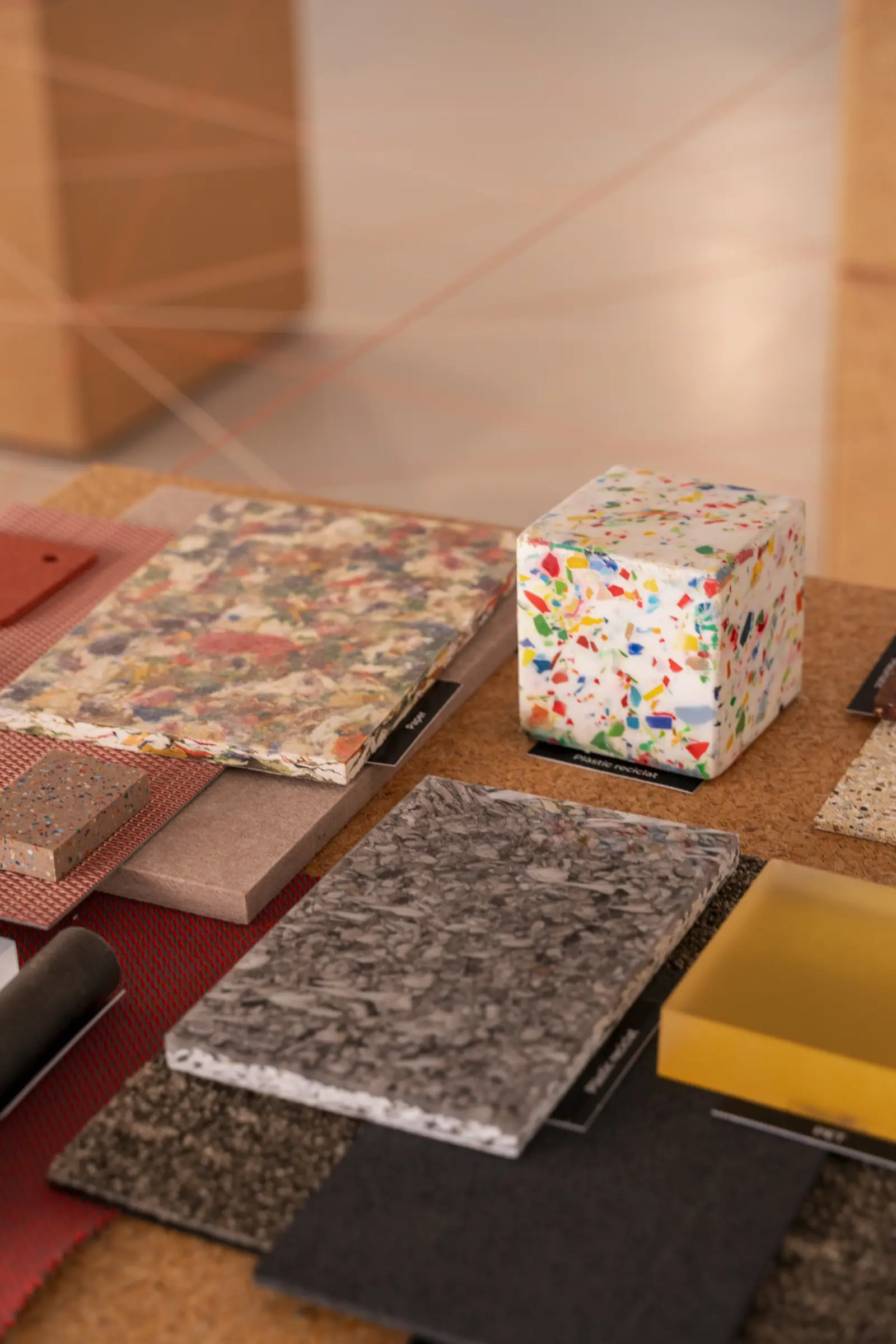
The construction industry is among the main contributors to global environmental impact. According to the 2024/2025 Global Status Report of the United Nations Environment Programme (UNEP), buildings and construction consume 32 % of the world's energy and account for 34 % of CO₂ emissions; in the European Union, construction and demolition waste makes up more than a third of all waste. Yet its size and influence also make it a strategic player in leading the transition towards more sustainable models of development.
Moving in this direction means going beyond the traditional linear approach of extracting, producing, consuming and discarding, and adopting a systemic view that changes how materials are designed, used and managed. The circular economy offers a concrete way to do this: optimising resources from the earliest stages of design, extending the service life of products and systems, reusing components and making it easier to recover or recycle them at the end of their life cycle.
Bringing these principles into construction practice means choosing low-impact materials and reversible, adaptable solutions, together with tools to assess the life cycle of products and guarantee the traceability of their inputs. This approach not only reduces pressure on ecosystems, but also drives innovation, improves efficiency and responds to new market demands for environmental responsibility.
In this article we explore four families of materials that apply these criteria —agricultural-waste boards, ceramics with recycled content, solid surfaces and recycled-PET acoustic panels— with a concrete example of each: Rice Tab by Birdmind, Florim, Durat and Archisonic Felt by Impact Acoustic. At the end you will find a comparison table, the keys to specifying them and answers to the most common questions.
Rice husk as a circular resource
The circular economy calls for a profound rethink of the environmental impact of conventional materials, promoting regenerative solutions based on secondary, renewable and low-impact resources. In this context, rice husk, an agricultural by-product generated on a large scale by the rice industry, has emerged as a raw material with high technical and environmental potential that has so far been under-used.
It is the outer casing of the rice grain, removed during milling. Its composition, rich in silica, lignin and cellulose, gives it structural, thermal and chemical properties of great interest to the building materials industry: low thermal conductivity, good dimensional stability and good behaviour in the presence of moisture and fire, thanks to its high silica content.
In recent years this waste has begun to be turned into technical boards, an alternative to materials such as MDF, OSB or conventional particleboard. One example is Rice Tab, the rice-husk board made by Birdmind in Pontevedra (Spain). According to the manufacturer, it is produced without using water, with 100 % renewable energy and with formaldehyde-free binders.
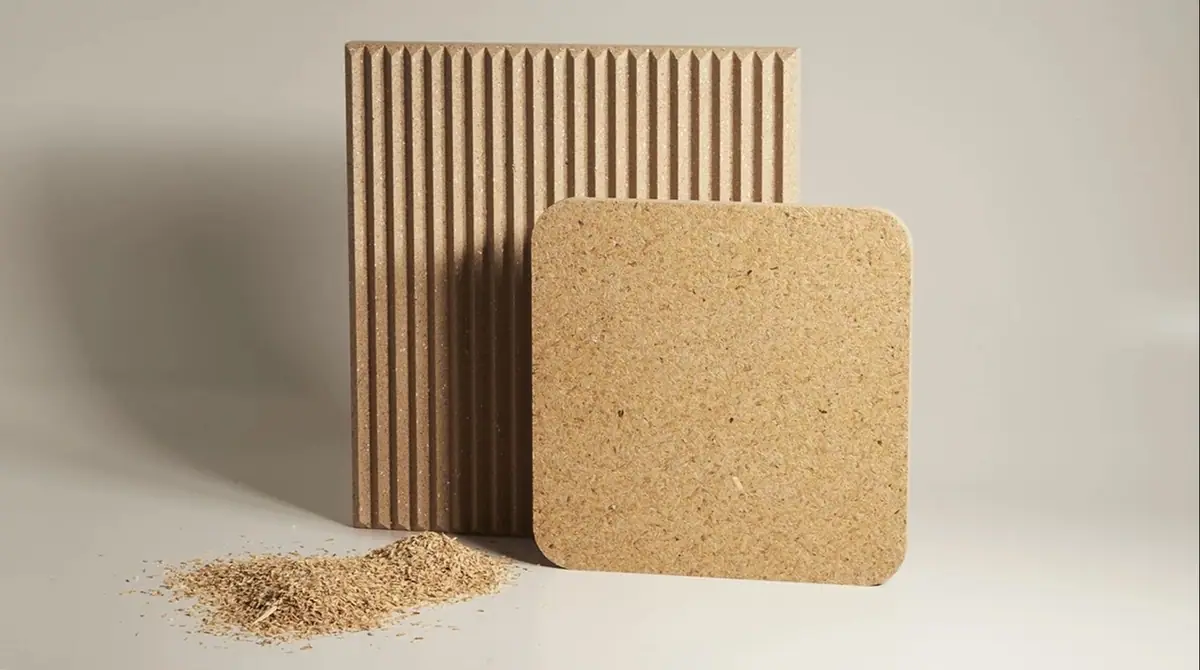
The result is a recyclable, large-format board (2710 × 1360 mm), available in thicknesses of 16 and 19 mm, which offers significant technical and environmental advantages:
- A renewable, nearby resource: Birdmind states that its husk comes from Catalonia, the Levante region and Portugal.
- Lower carbon footprint: using the waste avoids the emissions from burning it and replaces wood-based material, with no trees felled.
- Reaction to fire: Rice Tab is classified C-s1,d0 and the Rice Tab Plus version B-s1,d0, thanks to the addition of mussel shell powder.
- Clean machining: the same density in every layer means it can be worked with conventional woodworking machinery and tools.
- Closed loop: production offcuts go back into the line, and the company offers to collect the board at the end of its life to shred it and make a new one.
Rice Tab in the project
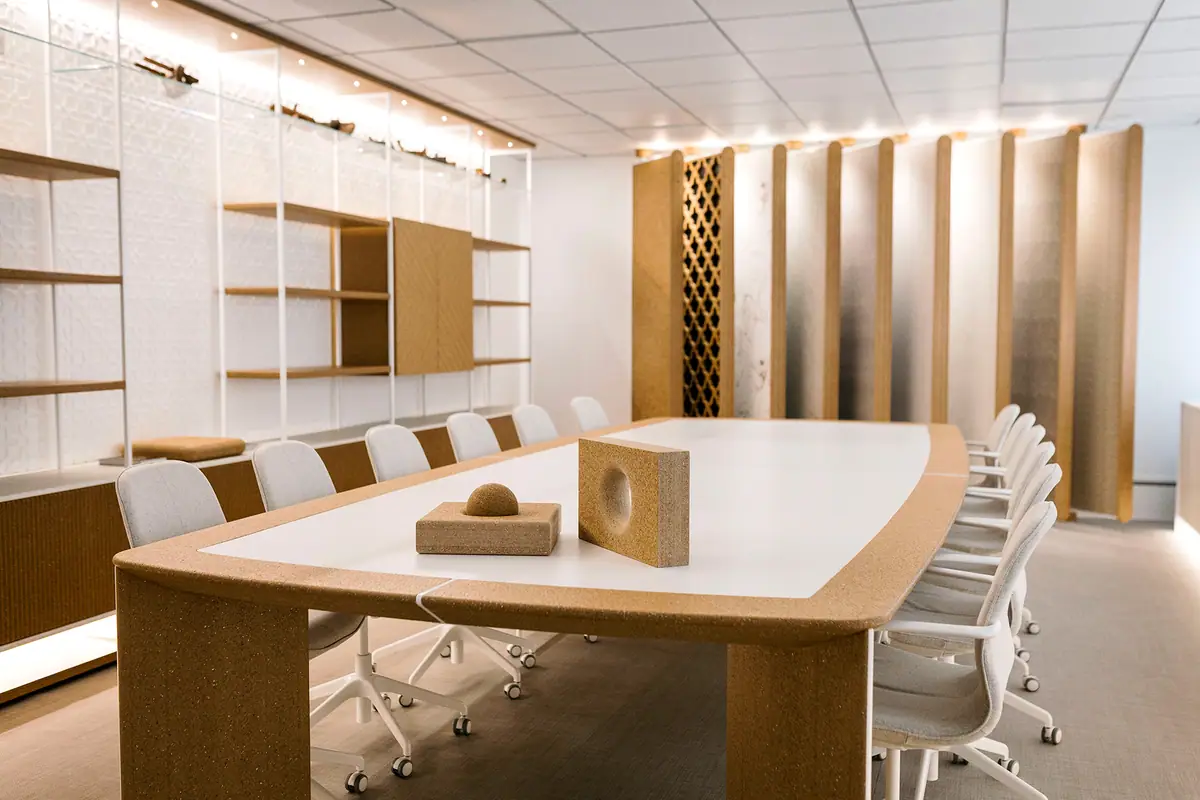
The Rice Tab data sheet puts its formaldehyde content below the quantification limit of the test (EN 12460-5) and states that the moisture-resistant version meets the requirements for non-structural boards for use in humid conditions. It can be varnished, stained, lacquered or digitally printed —without adding laminates that would make recycling harder— and leaves, branches or logos can be embedded before pressing. It is used for furniture, wall cladding and decorative elements.
This development is a tangible opportunity for architecture and design committed to sustainability, bringing an agricultural waste product into a circular system that puts material efficiency, safety and environmental responsibility first.
Ceramic innovation with a circular commitment
Using recycled materials to manufacture ceramic products is a strategic step towards more sustainable construction. This type of ceramic is made with a significant share of recovered materials, both industrial and post-consumer. They include recycled glass, fly ash from the energy industry, rubble, sewage sludge and even ceramic fragments discarded during production itself.
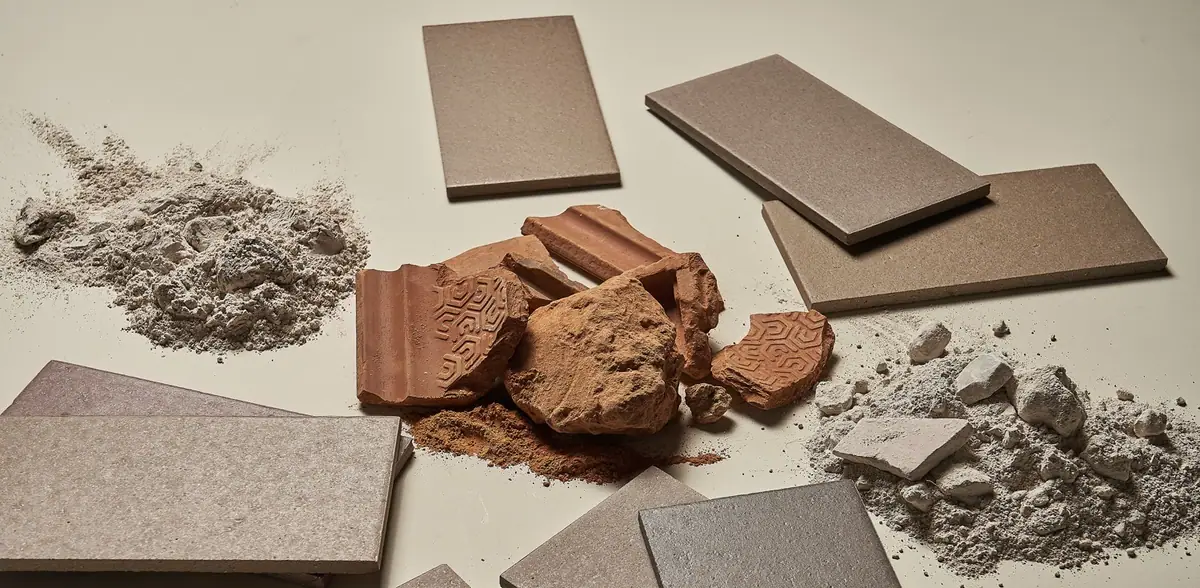
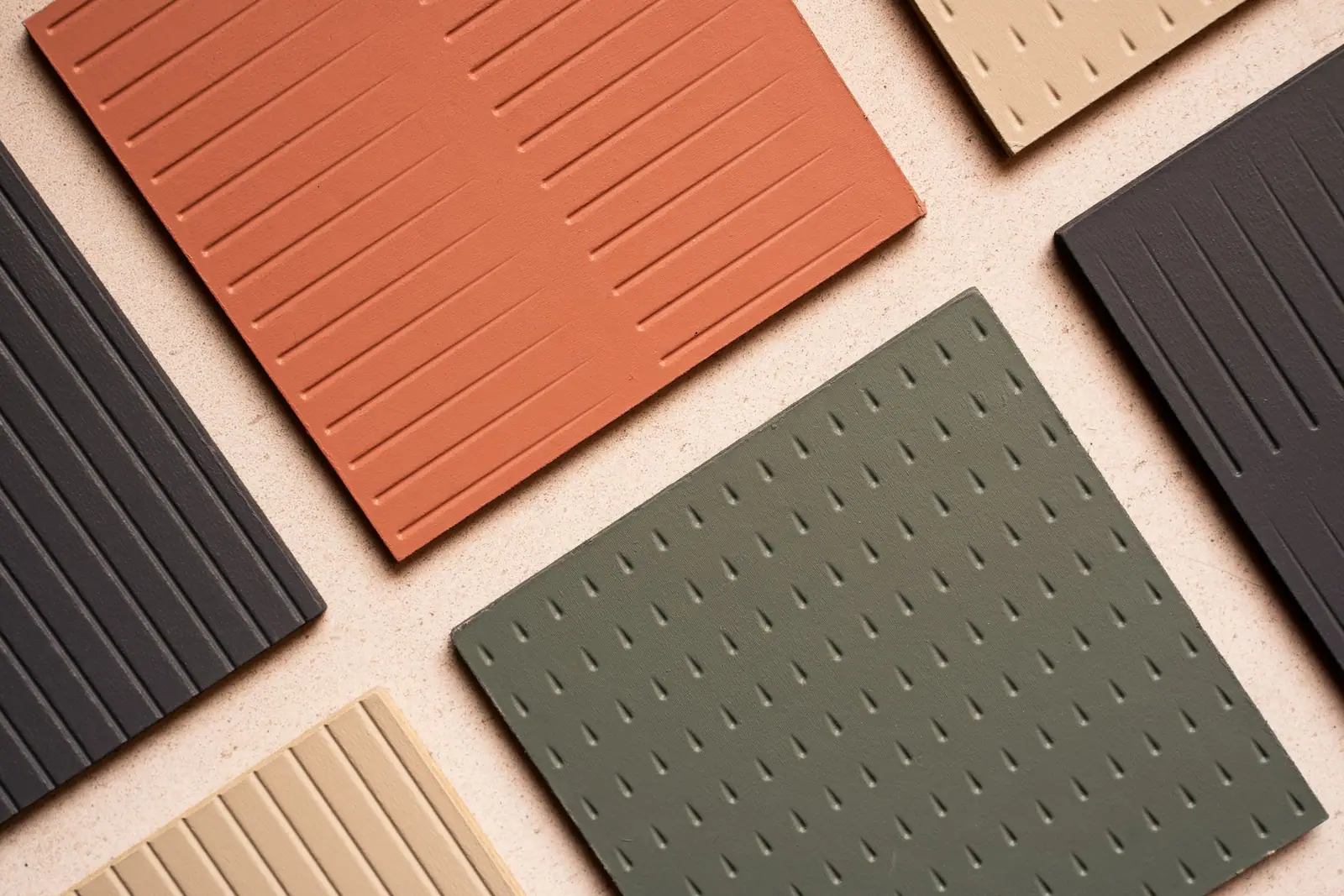
From a technical point of view, ceramics with recycled content retain their mechanical and functional performance. Thanks to controlled formulations and advances in pressing and firing technology, these tiles offer wear resistance, durability and dimensional stability comparable to those of traditional ceramics.
To prove it, many manufacturers turn to certification under ISO 17889-1 —published in 2021, it is the first international standard to define a sustainable ceramic tile, with environmental, economic and social criteria across the whole life cycle— and to environmental product declarations (EPD). This documentation is what earns points in building certification schemes such as LEED or BREEAM, which assess the project rather than the product on its own.
Florim: waste goes back into the process
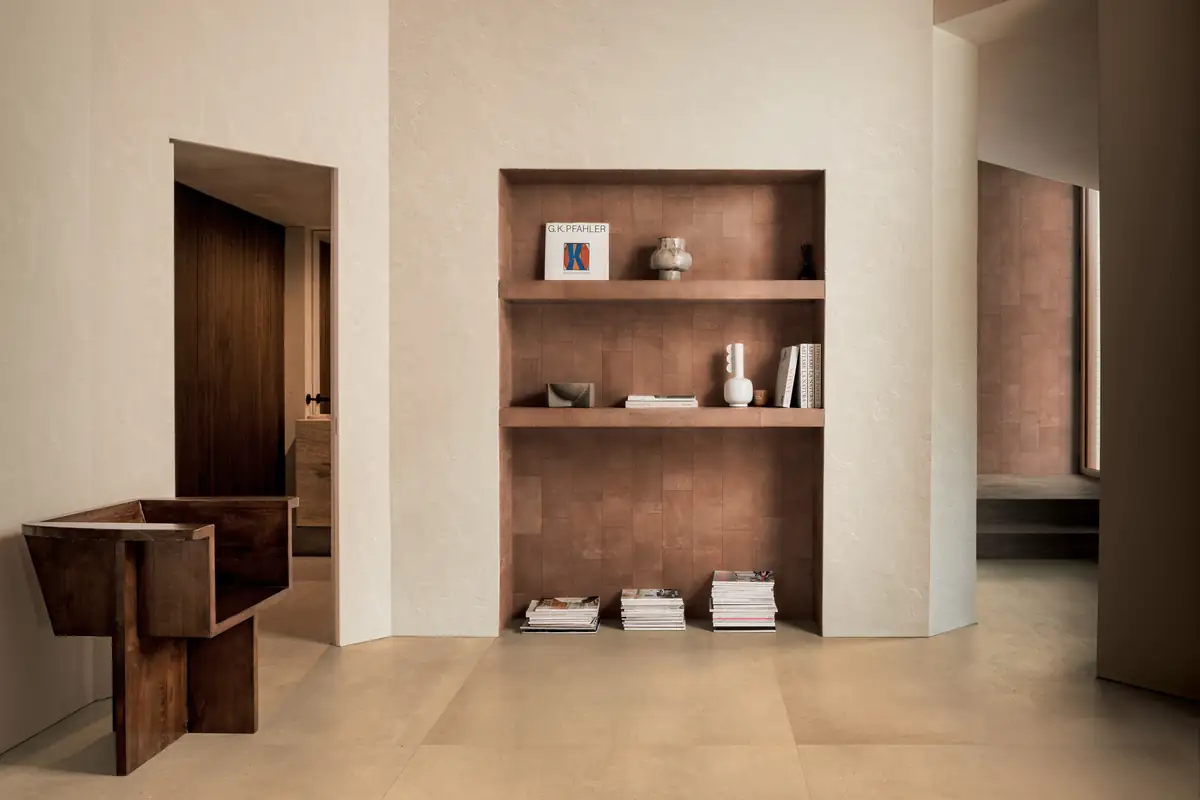
Florim, the Italian porcelain stoneware manufacturer and the first in its sector to achieve B Corp certification, in 2020, recovers 100 % of its production waste for use in new collections, reuses 100 % of its process water and has EPDs based on life cycle assessment. Its Formatech collection, developed with Gensler and presented at Cersaie 2025, contains up to 60 % recycled material according to the brand, in rectified slabs from 60 × 120 to 120 × 280 cm and thicknesses of 6, 9 and 20 mm. They are suitable for floors, walls and continuous surfaces.
Solid surfaces with recycled content
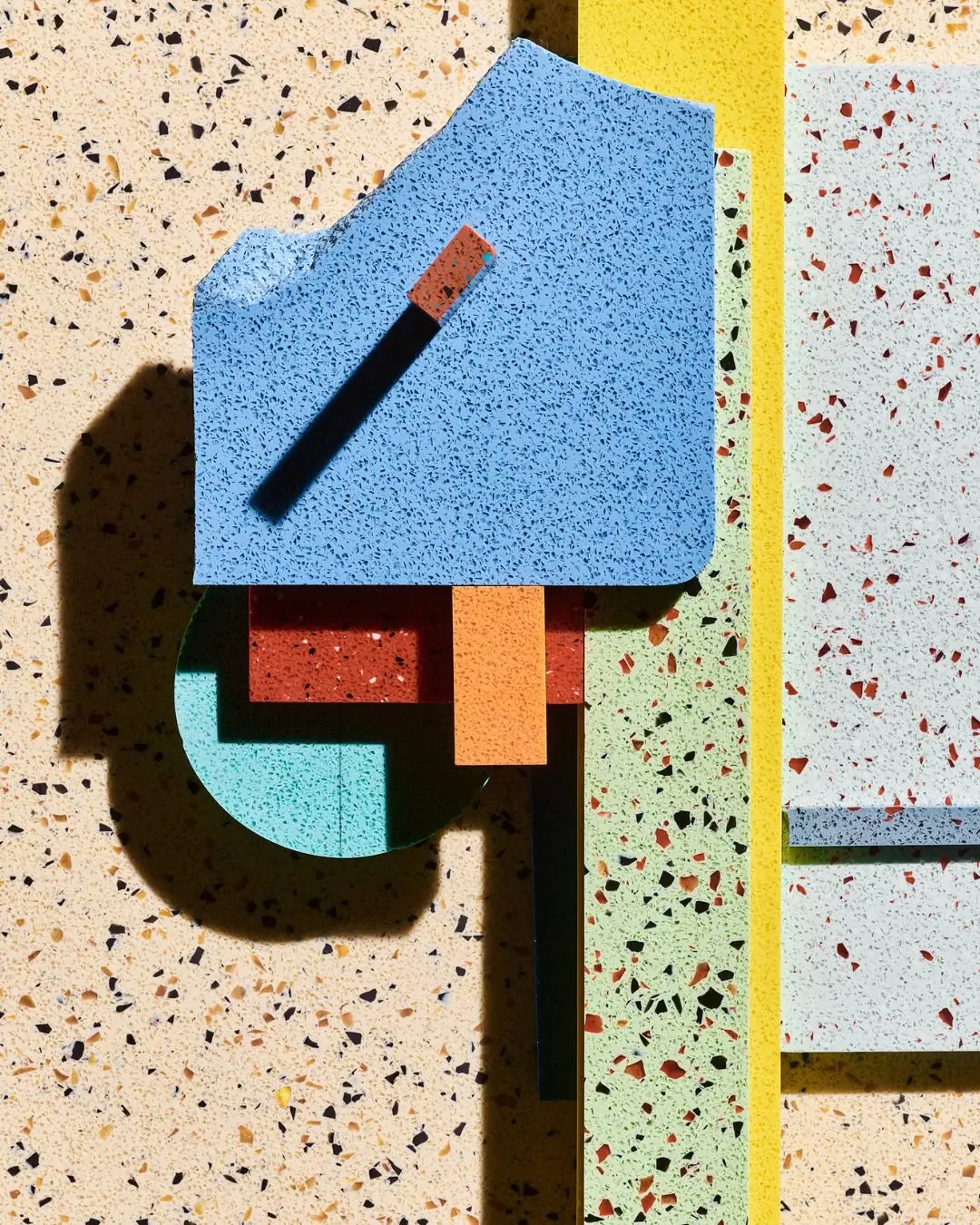
Since their introduction, solid surfaces have been an important step forward in solutions for architecture, interior design and furniture making. They are a homogeneous material, based on acrylic or polyester resins with mineral fillers, distinguished by their compact structure, stability and a continuous finish with no visible joints.
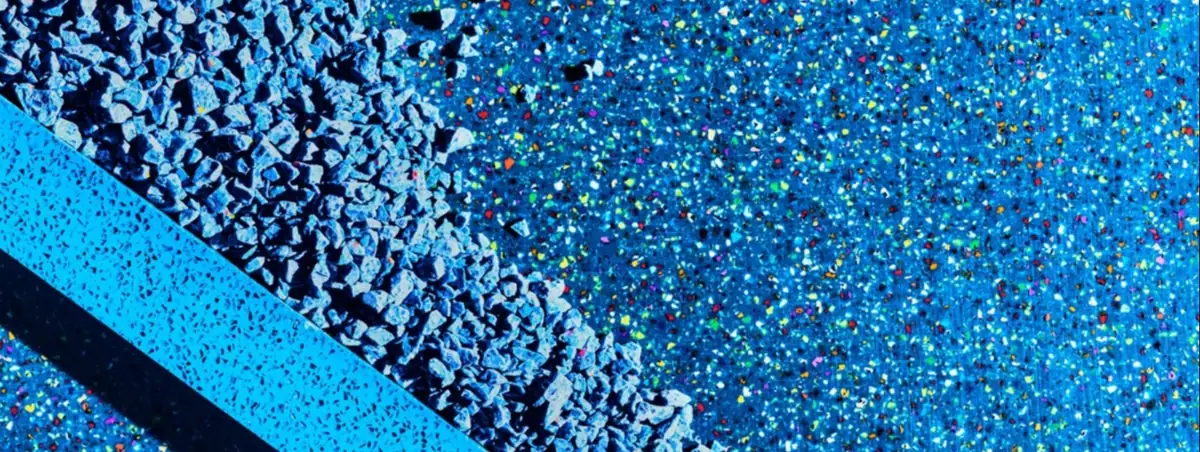
In recent years these solutions have begun a transition towards more circular manufacturing, in which waste recovery and the use of recycled post-industrial and post-consumer polymers take centre stage, without compromising mechanical performance, chemical stability or surface appearance. A good example is Durat, a Finnish manufacturer founded in 1990: its polyester-based solid surface contains around 30 % recycled plastic, and the Durat Plus version, which combines recycled PET resin and recycled solid surface, around 55 %, according to the manufacturer.
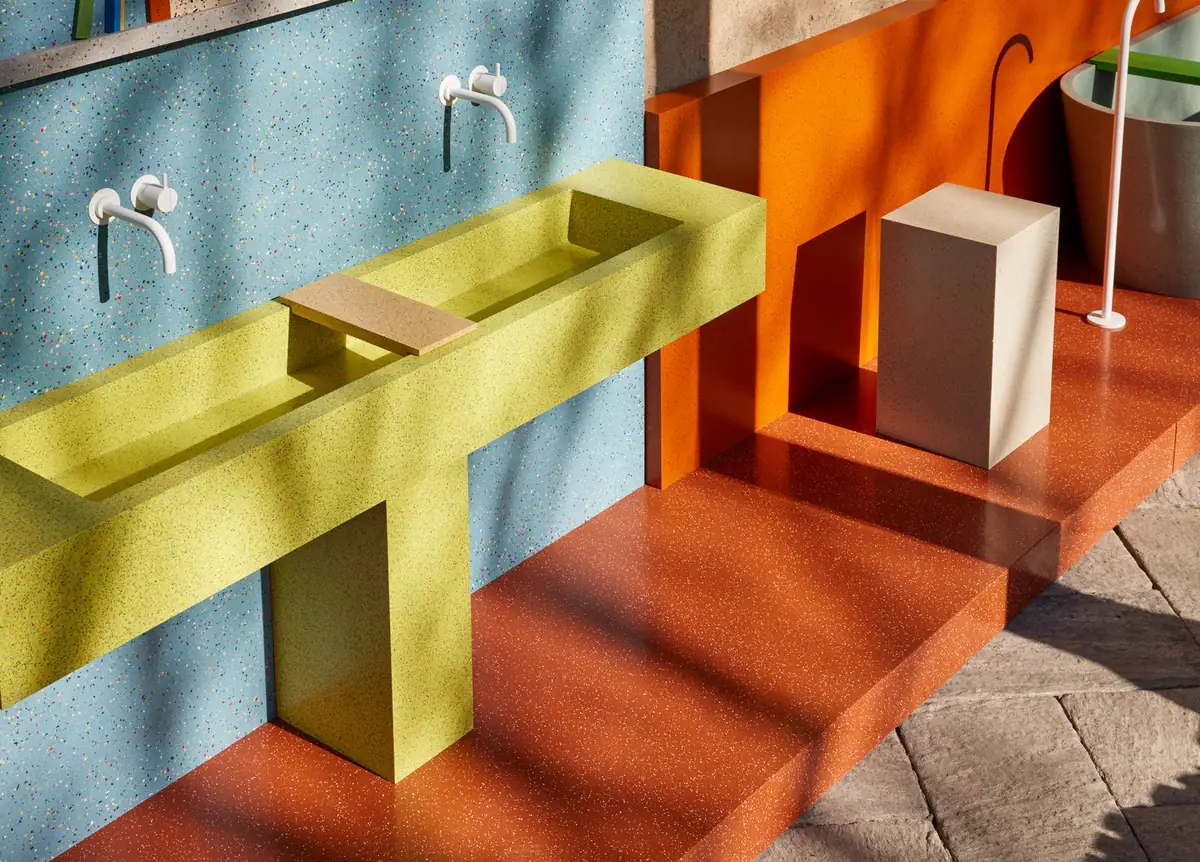
From a technical perspective, its solid, uniform nature allows high-precision work. It can be cut, milled and machined with woodworking tools or CNC machinery, bonded with practically invisible joints and thermoformed to create curved edges and parts. It is well suited to worktops, washbasins, bespoke furniture, wall cladding and one-off architectural elements. Durat is made in standard 2900 × 800 × 12 mm sheets, in thicknesses from 9 to 18 mm, and in moulded items such as washbasins and bathtubs.
Beyond their technical performance, solid surfaces respond well to today's challenges of hygiene and durability. Their dense, non-porous surface, with no joints to trap dirt, makes cleaning easier in heavily used spaces such as hospitals, hotels, restaurants, shops or public buildings. Surface damage can also be repaired by sanding, which extends the material's service life and reduces the need for replacement: Durat offers a 15-year warranty.
The environmental commitment also shows at the end of the cycle. Durat is 100 % recyclable and, through its Durat Circular service, takes back disused furniture to reuse it as raw material; it also has an environmental product declaration (EPD) and the low-emission M1 classification.
Aesthetically, these surfaces offer an extensive colour range, including neutral tones, intense colours and finishes with visible aggregates: recycled fragments that add texture, depth and character of their own. In Durat, the characteristic speckle comes from the granulated recycled plastic in the mix.
Circular acoustics for contemporary design
With sustainability now an essential criterion in construction, acoustic materials have evolved towards more responsible options. Felt panels made from polyester fibres from post-consumer PET bottles stand out. Archisonic Felt by Impact Acoustic, a Swiss company based in Lucerne, is 100 % PET, with a minimum of 60 % post-consumer recycled content certified by SCS Global Services: around 88 bottles per square metre in the 24 mm panel.
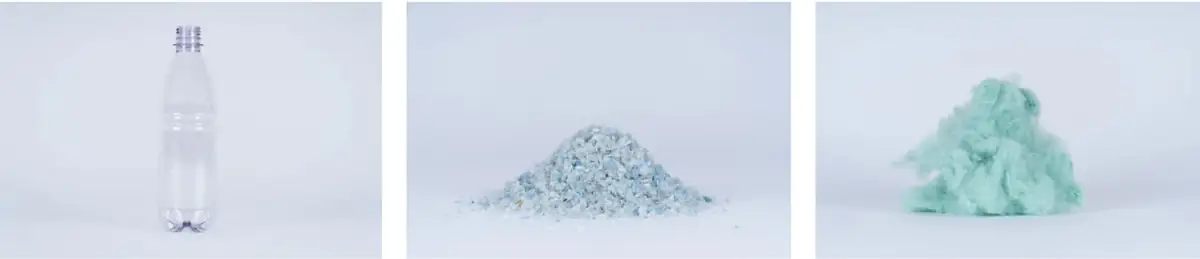
This strategy helps close the production loop by giving plastic waste a new life, and reduces dependence on virgin resources. Acoustic performance depends on thickness and, above all, on mounting: according to the manufacturer's tests (EN ISO 354), 24 mm Archisonic Felt reaches an NRC of 0.70 fixed directly to the wall, 0.85 with 40 mm of insulation behind it and 0.90 with a 200 mm air gap.
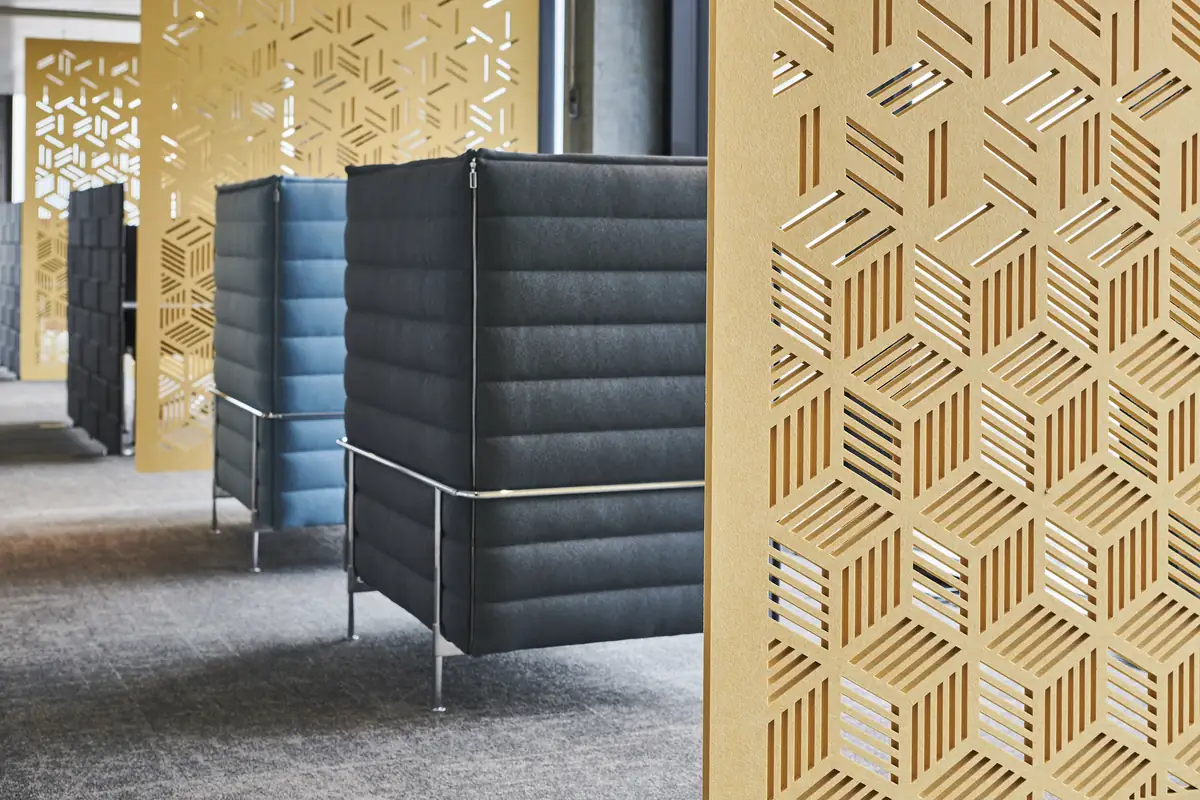
From a technical point of view, these panels stand out for their lightness, strength and ease of installation. The felt can be CNC-cut, making it possible to create pieces with complex geometries and cut-out patterns tailored to each project. This versatility makes them suitable for wall cladding, ceiling panels and baffles, room dividers, acoustic furniture and decorative elements that combine function and design.
The colour range is wide: Archisonic Felt comes in a palette organised by families —neutrals, warm tones, greens, blues, darks and bright colours— with NCS equivalents, in matt finishes with a soft, even texture that broaden the creative possibilities for anyone seeking acoustic comfort and aesthetic value. The mass-dyed fibres do not fade with disinfectants.
In terms of safety and sustainability, the felt has a B-s1,d0 reaction-to-fire classification under EN 13501-1, making it suitable for public and commercial spaces, and A+ emissions of volatile organic compounds (VOC) under French regulations. The manufacturer holds Cradle to Cradle certification, an environmental product declaration (EPD) and runs a take-back programme, Re:Impact, to return the material to the production cycle.
Integrating these circular materials improves the comfort and functionality of interior spaces and makes a concrete contribution to reducing the environmental impact of construction: high acoustic performance, design flexibility and a commitment to sustainability in a single solution.
Four circular materials at a glance
Each family solves a different part of the project, but the questions worth asking are the same: where the material comes from, how much circular content it has, which formats it is made in and what happens to it at the end of its life.
Keys to specifying circular materials
- Recycled content: ask for the percentage, whether it is pre-consumer or post-consumer and whether it is verified by a third party, such as the SCS certificate for Archisonic Felt.
- Reaction to fire: check the class under EN 13501-1 for the intended use; with Rice Tab, for example, the Plus version goes from C-s1,d0 to B-s1,d0.
- Environmental documentation: EPDs, ISO 17889-1 certification for ceramics, Cradle to Cradle or VOC emission tests, which are what count towards LEED and BREEAM.
- Indoor health: for boards, formaldehyde content; for claddings and panels, VOC emissions.
- End of life: ask about take-back programmes —such as those of Birdmind, Durat or Impact Acoustic— and favour fixings that allow the material to be dismantled and recovered.
Frequently asked questions
- What is the difference between pre-consumer and post-consumer recycled content?
- Pre-consumer, or post-industrial, content comes from manufacturing waste that never reached the user, such as offcuts or rejected pieces. Post-consumer content comes from products that have already been used, such as the PET bottles in the acoustic felt. Both reduce the use of virgin material; what matters is that the manufacturer states which one it declares and whether it is verified by a third party.
- Does a recycled material perform as well as a conventional one?
- In the examples in this article, yes, for their intended uses: ceramics with recycled content keep their mechanical performance, and recycled-PET felt reaches B-s1,d0 and an NRC of up to 0.90 depending on mounting. Even so, it is worth checking each product's data sheet for the specific use in the project.
- What documentation should I ask for on a LEED or BREEAM project?
- Mainly the environmental product declaration (EPD), recycled-content certificates and VOC emission tests. For ceramics, also certification under ISO 17889-1. LEED and BREEAM certify buildings, not products: materials contribute to their credits through this documentation.
- What happens to these materials at the end of their life?
- It depends on the manufacturer. Birdmind offers to collect Rice Tab boards to shred them and make new ones, Durat takes back disused furniture through its Durat Circular service and Impact Acoustic runs its Re:Impact take-back programme. Florim, for its part, feeds 100 % of its production waste back into manufacturing.
Using circular materials is a technical and environmental opportunity to reduce the impact of construction and raise the quality of projects. It responds to growing market demands and opens the door to innovations that add technical and economic value.
Choosing the right circular material means comparing data, samples and documentation. At Matter, our technical team supports you at every stage, from assessing alternatives to specification, so that you can bring efficient, responsible and competitive solutions into your project.
Book your visit to Matter to talk about your project.
Book a visit