3D meshes by Wood-Skin
WOOD-SKIN’s Mesh Sheets turn wood, laminate or metal into flexible 3D surfaces: patterns, materials, acoustics, installation and a project in Paris.
Products8 min read
WOOD-SKIN introduces an innovative system with its Mesh Sheets, which offer a new way of designing curved, undulating and free-form surfaces from flat sheets. Surfaces such as wood, laminate or metal are strategically cut and bonded to a membrane that allows these rigid materials to behave almost like a fabric.
In this article we explain how WOOD-SKIN’s patented process works, the families of patterns and materials the Milan-based firm offered when we published it, how the meshes perform acoustically, which services they can integrate, how they are installed and what should be defined when specifying them. We illustrate it with a real project: the Chalgrin entrance hall in Paris.
What Mesh Sheets are
WOOD-SKIN’s manufacturing process turns rigid materials into 3D sheets. It is based on a programmable composite that can be coded to take on a particular shape: the meshes go from flat to three-dimensional in a single step and can adopt a wide variety of forms and functions.
The result, according to the manufacturer, is a semi-rigid membrane in which the polygons that define the surface are held together by durable textile hinges. Because the facets can be of different sizes, the radius of curvature can be very tight without the surface losing its fluidity.
This technology extends the design potential of rigid surfaces. WOOD-SKIN’s meshes have a mobility reminiscent of a fabric, but their geometry ensures a solid, reliable surface. That is why, the firm explains, they do not need a rigid structure behind them: the mesh itself, once tensioned, holds its shape.
A patented process: composite and digital fabrication
WOOD-SKIN describes its technology in two steps: the creation of a composite, and parametric design with digital production. The composite is a sheet of building material with a textile membrane sandwiched within it. A CNC milling machine then cuts lines along and across the material that act as hinges, so that the whole sheet can flex as if it were a textile. The company’s software tessellates the project’s 3D model and gives the machines the exact geometry of each piece.
As there are no moulds or formwork, the manufacturer presents it as a system suitable for projects of any scale. The meshes are made to each project’s specifications and shipped flat to site, ready to install. Among the qualities the manufacturer highlighted at the time:
- No rear structure: the geometry of the mesh makes heavy, costly structures unnecessary.
- Light and very thin: the composite is a thin sheet that is transported flat or rolled.
- No moulds: each shape comes from the digital model, not from a mould that has to be made.
- Dry assembly: the meshes are installed dry and can be easily dismantled.
- Customisable: pattern, size, material and finish are defined for each project.
Four families of patterns
The firm organises the meshes into four pattern families: Classic, Basic, Digital and Decor. Each has variants with different geometries and behaviours, and almost all were offered in three pattern sizes, S, M and L, corresponding to the scale of the facet pattern. The table summarises the range as WOOD-SKIN presented it in 2020 and 2021.
The choice of pattern is not just aesthetic. According to the manufacturer, Basic A and Classic B are self-supporting; Classic A, fabric-like and rollable, is designed for free forms; Classic C offers maximum freedom of form and Classic D free waves. Decor curves gently and, when folded, its triangles form squares, rhombuses, hexagons or trapezoids. Digital A has a digital, random look with moderate curvature, and Digital B aims for an unexpected 3D effect. The 2D and 3D files for each pattern, the catalogue and the technical installation manual could be downloaded from the WOOD-SKIN website.
Materials and finishes
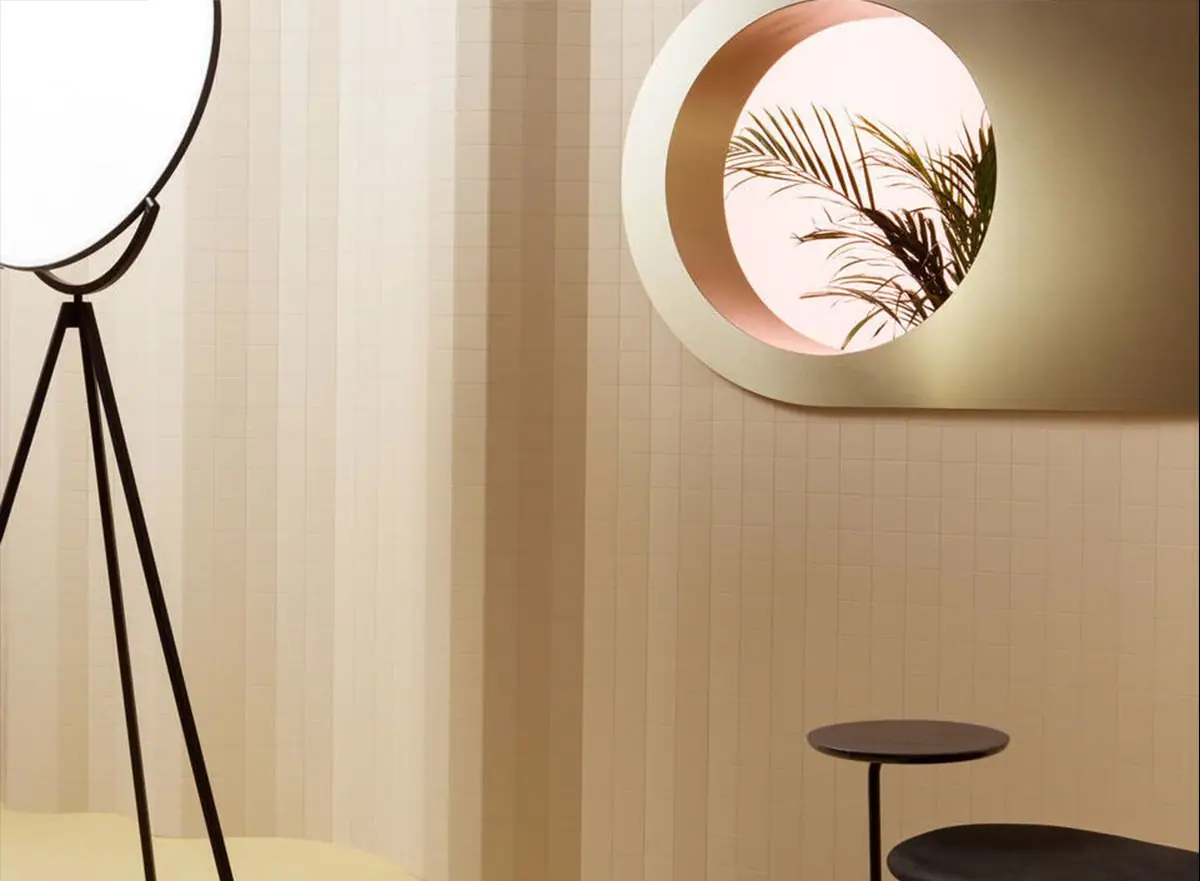
The meshes offer a wide selection of materials, finishes and patterns. Finishing materials include reconstituted wood veneer, laminates, bamboo, cork, synthetic felt and aluminium. The WOOD-SKIN website presented them as follows:
- Classic selection (2020): okoumé, birch and MDF.
- Advanced selection (2020): laminate, ultra-thin reconstituted wood, synthetic felt and aluminium, the latter for exterior applications.
- 2021 range: ten families of materials, with birch and okoumé plywood (varnished, veneered or laminated), bamboo, MDF, synthetic felt, metals, laminates, ultra-thin woods and ultra-matt laminates.
The material is chosen according to the setting: WOOD-SKIN states that, with the right combination, the meshes can be installed in kitchens, wet areas or outdoors. Reaction to fire also depends on the material and the country of installation; the manufacturer explains that it has carried out tests for different markets and that, if a project requires a specific certification, it assesses its technical feasibility case by case.
Acoustics: a geometry that diffuses and absorbs
The meshes also stand out for their acoustic performance, linked to the geometry of the surface. They improve sound quality and the well-being of the people using the spaces. As a result, WOOD-SKIN offers a product that combines acoustic properties with other functions in a single solution that is both versatile and specialised. The Acoustic line offers the same flexibility as the original Mesh Sheets.
According to the manufacturer, the three-dimensional geometry breaks up sound waves and diffuses them, while the textile membrane allows part of the sound to be absorbed. Thanks to the digital process, the surface can have perforations of variable density to create zones with different performance, and the absorbent material placed behind follows the shape of the mesh. In 2021 the firm stated that all its products were available in an acoustic version.
Integrating services
WOOD-SKIN allows standard and specialist components to be integrated into the mesh. According to the manufacturer, light fittings, sprinklers, sockets and other services are accommodated with cut-outs or openings that can be made at the factory, with the CNC milling machine, or on site with a hole saw. The firm also offered doors and access panels integrated into the surface, and lists the integration of loudspeakers among its custom options.
These integrations should be defined with the WOOD-SKIN design team from the outset, because they form part of the digital model from which the pieces are made.
How the meshes are installed
The firm compares it to hanging a curtain. To achieve the characteristic 3D effect, certified steel cables with quick-release stops are used; main anchors carry the weight and give the mesh a slight tension that gives it the desired shape. The pieces arrive flat, packed in wooden crates, together with the necessary hardware and a step-by-step installation manual.
According to WOOD-SKIN, a general contractor can install the system, as carpenters usually have the necessary skills. On large or complex projects, the company can send one or two members of its team to supervise the installation. Because of their scale and complexity, Mesh Sheets require somewhat more installation work than Fold Panels, the brand’s most standardised product.
Key points for specifying
Before requesting a quote, these points should be resolved:
- Pattern and size: the family and the S, M or L size determine the texture and the ability to curve or to be self-supporting.
- Material and finish: depending on the use (interior, wet area or exterior), the desired look and the project’s reaction-to-fire requirements.
- Acoustics: whether the surface should absorb, diffuse or both, in order to define the perforation and backing material.
- Integrations: light fittings, sprinklers, access panels, doors or loudspeakers, which are incorporated into the model before manufacture.
- Lead times: in 2020 the manufacturer quoted 6 to 14 weeks of production for Mesh Sheets, depending on the size and complexity of the project, plus transport.
On site: the Chalgrin entrance hall in Paris
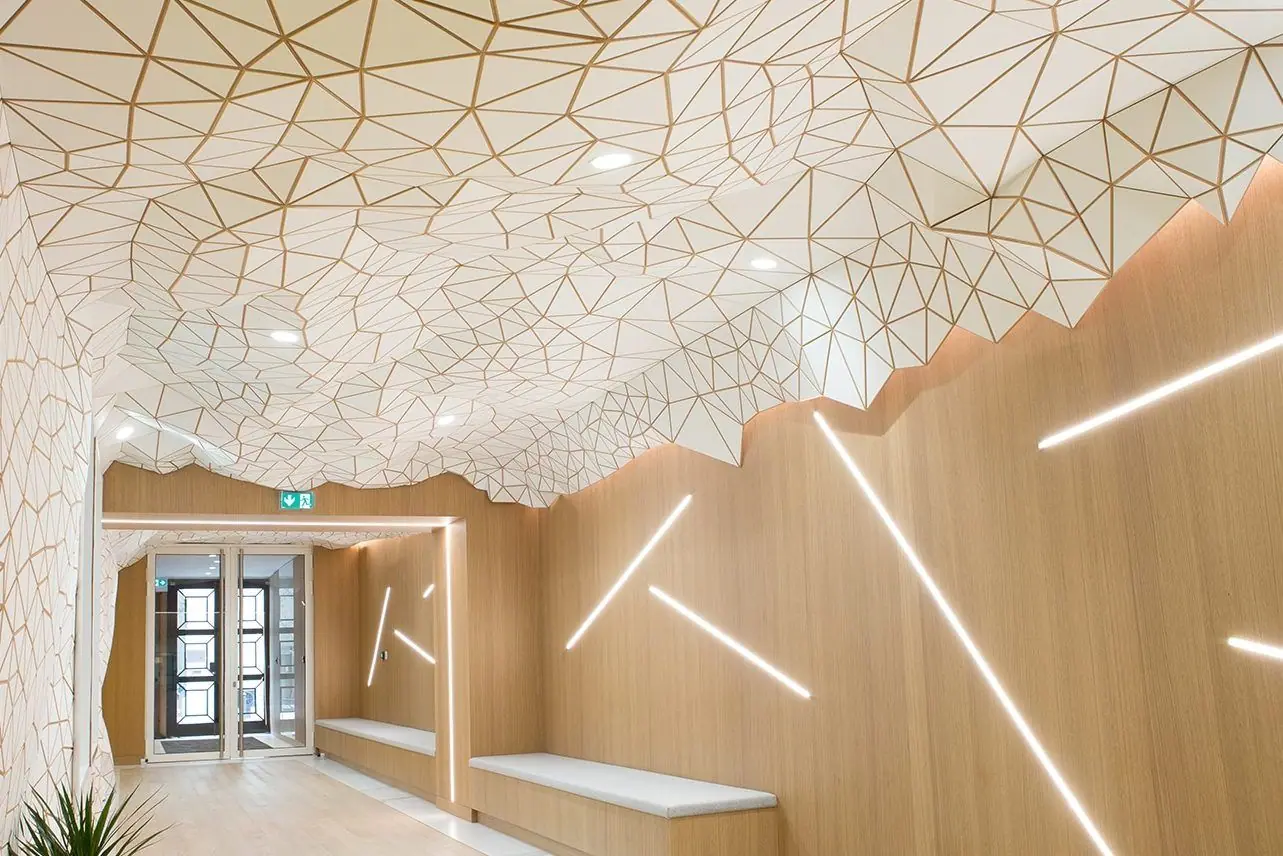
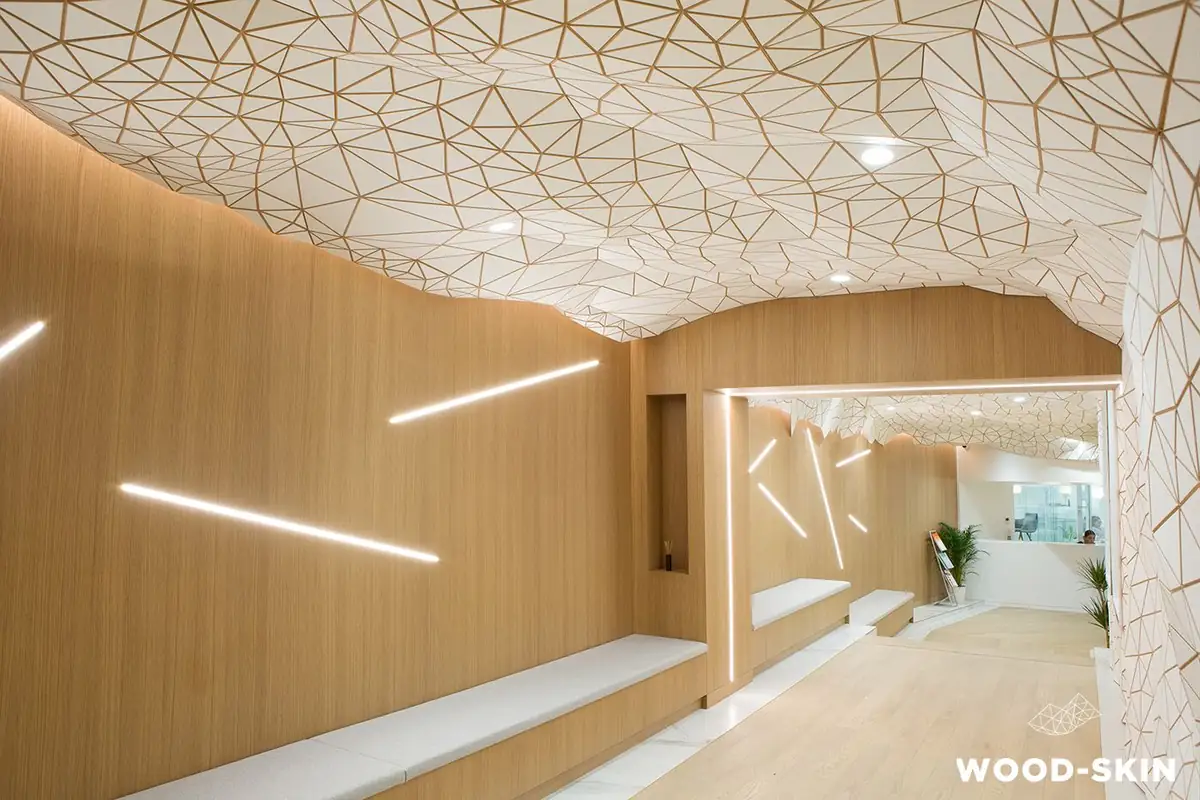
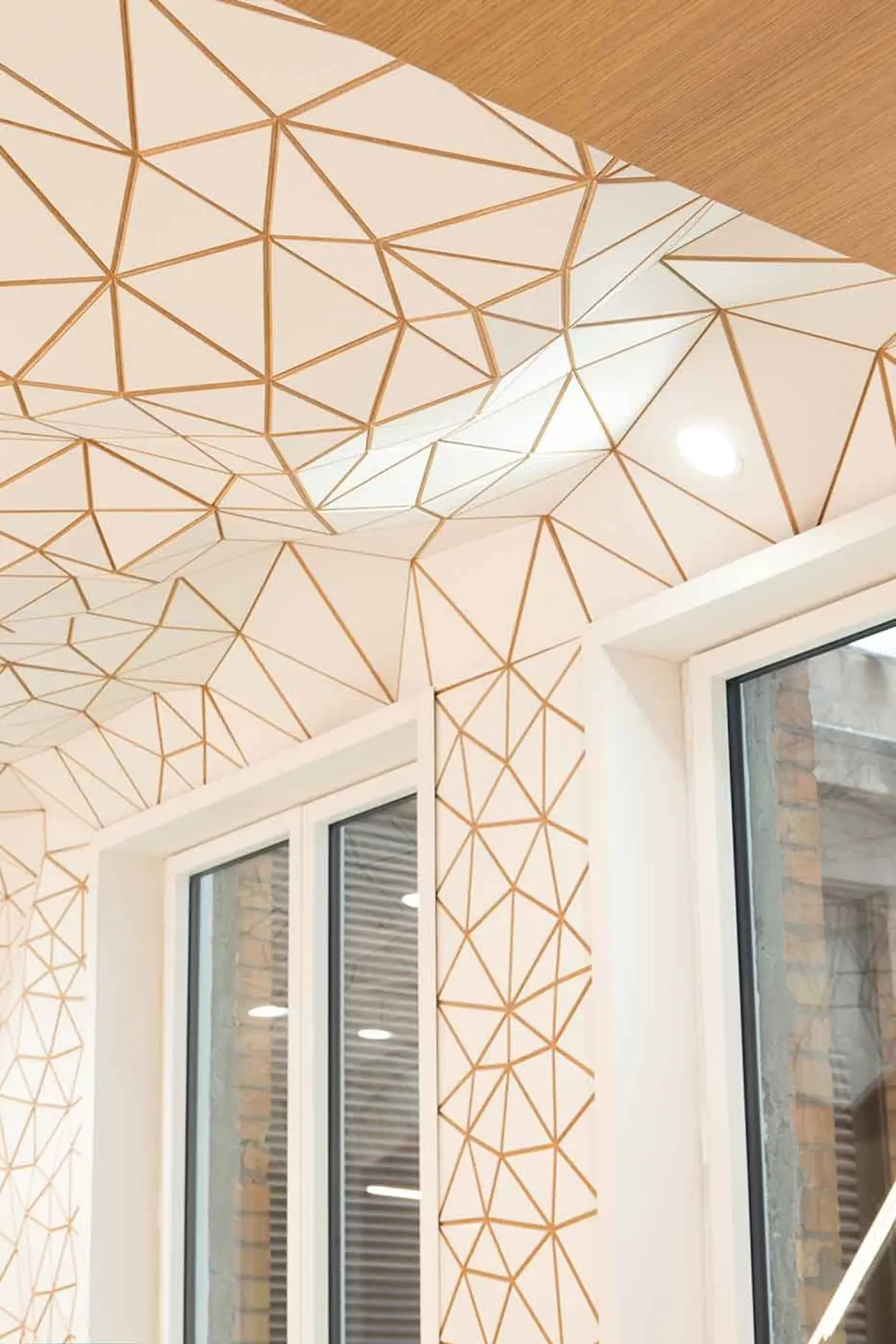
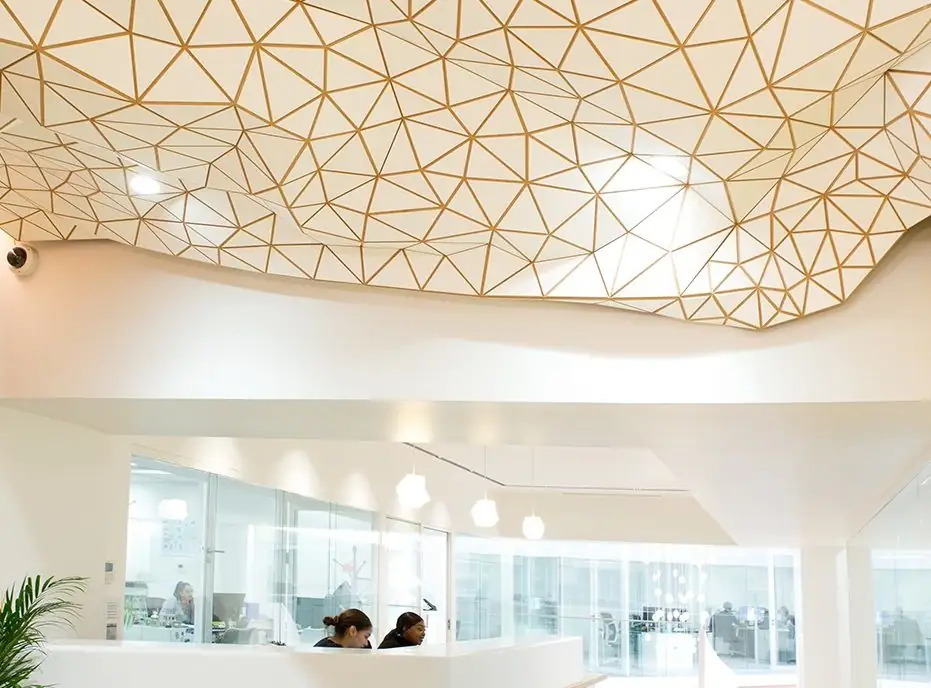
The photographs in this article show Chalgrin, an entrance hall in Paris designed by Quadri Fiore Architecture and completed in 2019, according to WOOD-SKIN’s project page. A tessellation of white laminated okoumé covers the ceiling and walls, creating a space that, in the manufacturer’s words, seems to defy the laws of physics.
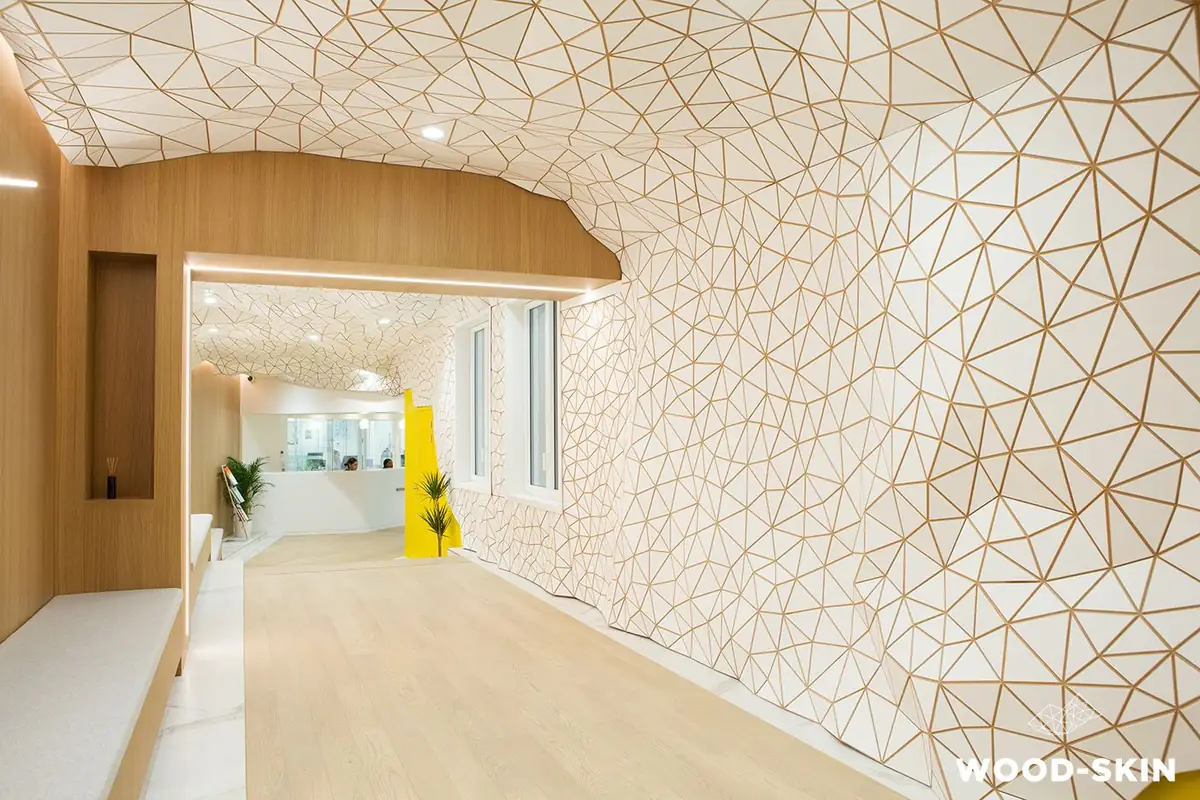
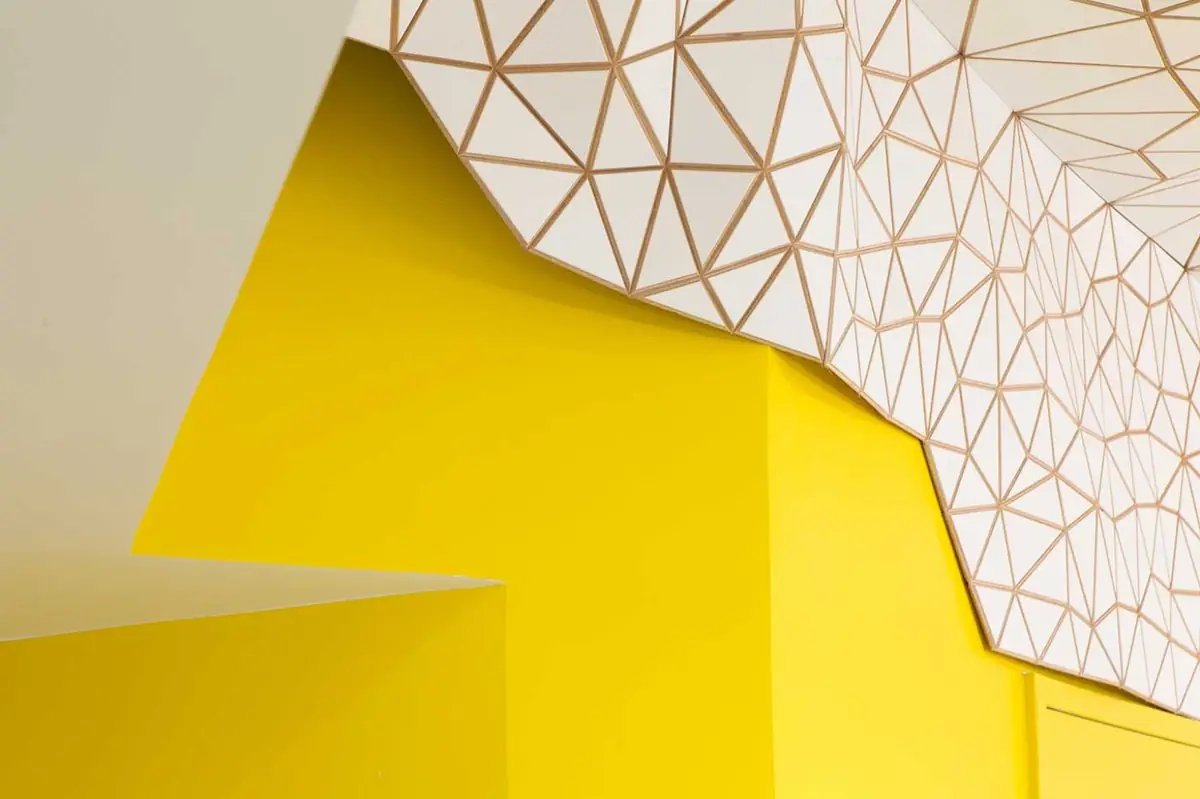
The tessellation was studied to integrate windows, arches, spotlights and doors, in a process developed with WOOD-SKIN’s design team and software. The white of the okoumé balances a very intense yellow wall and gives continuity to the existing walls and timber floor. To wrap the openings, beams and stairs, custom meshes were used in part; the digital model of the material made it possible to anticipate its behaviour before installation.
Where they are used
WOOD-SKIN presented Mesh Sheets for airports, auditoriums, entrance halls and shops, and as a reliable, certified system. The references shown on its Mesh Sheets page included the Longchamp boutique in Paris, Maison Margiela in Milan, the Reign restaurant in Dubai, Room XIX at the Palais des Nations in Geneva and the Volkswagen Financial Services headquarters in Milan.
WOOD-SKIN, the manufacturer
WOOD-SKIN was founded in Milan in 2013 and combines digital fabrication with traditional components through patented processes. Its computational design department, made up of architects, designers and engineers, develops complex bespoke projects based on two main products, Mesh Sheets and Fold Panels. The company designs and manufactures in Italy.
On the environmental side, the company states that it is an FSC-certified supplier, uses local materials wherever it can and takes advantage of the precision of digital fabrication to tessellate the pieces and reduce offcuts. Among its sustainability goals it also cites shipping the pieces flat.
Epilogue: from Mesh Sheets to Prism Panels
Since this article was published, the range has evolved. WOOD-SKIN renamed its meshes Mesh Panels, and its current data sheet gives them a reaction to fire of B-s2-d0 according to UNI EN 13501-1. As of October 2026, the company’s website announces that WOOD-SKIN is now Presentform and that the Mesh Panels tessellated surfaces continue in the Presentform catalogue as Prism Panels.
Frequently asked questions
- Do the meshes need a substructure?
- Not a rigid structure. According to WOOD-SKIN, they are hung with certified steel cables and main anchors that carry the weight and tension the mesh; its own geometry holds the shape.
- Do they improve the acoustics of a space?
- Yes, according to the manufacturer: the geometry diffuses sound and the textile membrane helps absorb it. With perforations of variable density and absorbent material behind, performance can be adjusted zone by zone.
- Can they be used outdoors or in wet areas?
- WOOD-SKIN says they can, provided a suitable material is chosen for each setting. In its 2020 range, aluminium was the option indicated for exterior applications.
- What is the difference between Mesh Sheets and Fold Panels?
- According to WOOD-SKIN, Fold Panels are its most standardised product and clients can install them themselves. Mesh Sheets tend to be used in larger, more complex projects, so their installation requires somewhat more work; the manufacturer assesses in each case whether its support is needed.
- How long does manufacture take?
- In 2020 the manufacturer quoted 6 to 14 weeks for Mesh Sheets, depending on the size and complexity of the project, plus transport.
Three-dimensional surfaces are best understood by seeing and touching the material: the thickness of the facets, the finish and the effect of the joints cannot be appreciated in the same way in an image. At Matter we help you plan 3D and acoustic finishes and compare materials and finishes with your technical team.
Book your visit to Matter.
Book a visit